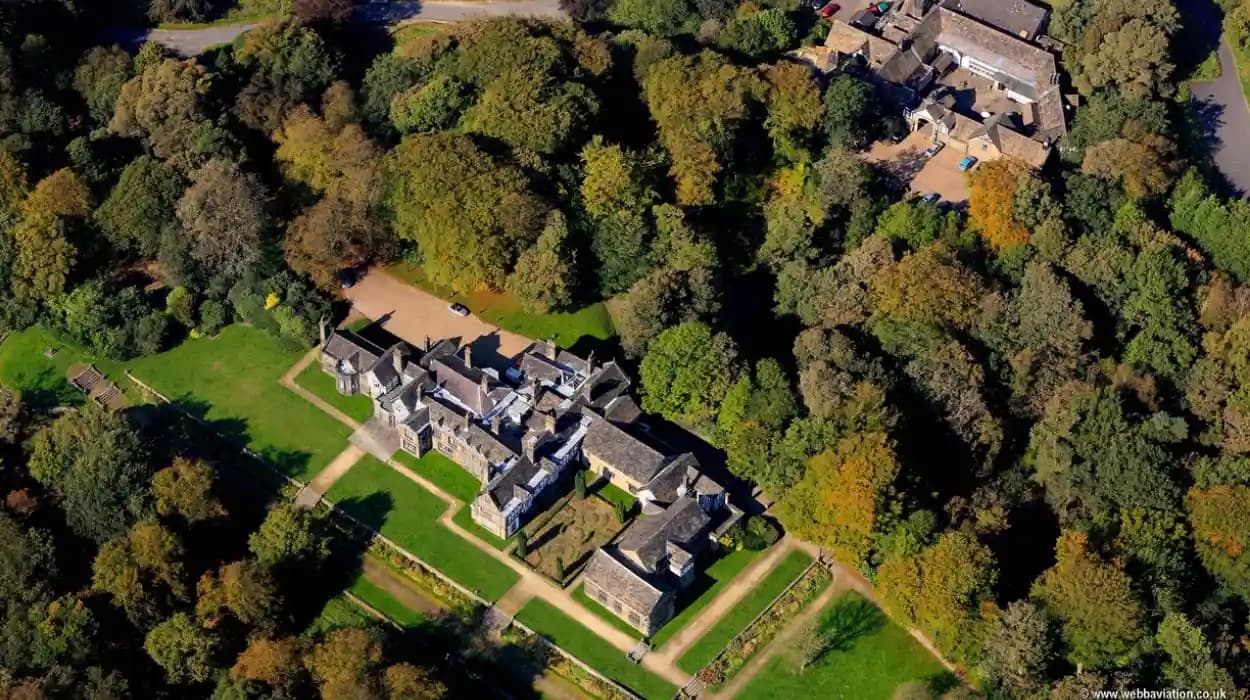
Smithills is one of Bolton’s most historically layered landscapes. Its woodland, moorland, farmland, streams, cloughs, archaeological remains and historic buildings record centuries of environmental and human change. The landscape connects prehistoric activity, medieval landholding, agricultural development, industrialisation, public-access campaigns and modern conservation.
The modern Smithills Estate covers approximately 685–686 hectares, or about 1,700 acres, and includes ancient woodland, broadleaved woodland, grassland, farmland, moorland, bog and wooded cloughs. The Woodland Trust describes it as the largest site it has acquired in England. The organisation acquired two-thirds of the current estate in 2015 and the remainder in 2017.
Smithills therefore cannot be understood as woodland alone. Its history is the history of a changing landscape. Trees survived alongside farming, quarrying, coal mining, reservoirs, transport routes and settlements. Some woodland areas retain evidence of long-term ecological continuity, while other tree cover represents later planting and restoration.
What is the ancient woodland history of Smithills?
Smithills contains ancient woodland alongside farmland, moorland, bog and newer woodland, forming a historic landscape shaped by prehistoric activity, medieval estates, agriculture, mining, quarrying, recreation, conservation and modern woodland restoration across northern Bolton.
Ancient woodland is woodland that has existed continuously as woodland since at least 1600 in England, although its present trees are not necessarily centuries old. Ancient woodland is identified through historical records, ecological indicators and landscape evidence rather than simply by the age of individual trees.
This distinction is important at Smithills. A mature-looking woodland does not automatically represent ancient woodland. Conversely, an ancient woodland site can contain relatively young trees because woodland has been coppiced, felled and regenerated over centuries.
The Woodland Trust identifies areas of important ancient woodland within Smithills Estate. It also records established woodland, broadleaved woodland, moorland and grassland as separate but connected habitats. Current restoration work aims to connect existing woodland pockets and strengthen wildlife corridors.
The landscape also contains wooded cloughs. A clough is a steep-sided valley or ravine, often associated with a stream. Smithills has numerous such valleys, creating sheltered environments where woodland developed beside watercourses and rocky slopes.
The historical significance of these areas extends beyond individual trees. Woodland provided fuel, timber, shelter, grazing resources and physical boundaries. Its survival patterns reflect land ownership, agricultural pressure, industrial demand and later conservation policies.
When did human activity begin at Smithills?
Human activity at Smithills extends back to prehistoric periods, with Mesolithic flint scatters providing the earliest recorded evidence, followed by Bronze Age artefacts and later Romano-British finds that demonstrate repeated human use of the wider estate.
The Woodland Trust records scatters of worked flints from the Mesolithic period, broadly covering the eighth to mid-fourth millennia BC. Mesolithic communities were hunter-gatherers who used stone tools and moved through changing landscapes rather than establishing the permanent agricultural settlements associated with later periods.
A Bronze Age stone hammer and palstave were reportedly found in the Smithills area in 1812. A palstave is a prehistoric bronze axe with a characteristic flanged form. The estate record also notes a whetstone, a blue ribbed bead, a bottle neck described as Romano-British and a bronze coin of uncertain date. These finds indicate activity extending beyond the Mesolithic period.
The evidence does not establish an uninterrupted settlement at one location for thousands of years. Archaeological artefacts instead demonstrate that people repeatedly used the wider landscape.
The upland environment was significant because prehistoric communities exploited different ecological zones. Woodland, open moorland, watercourses and elevated ground provided different resources and routes. Later land-use changes altered the physical visibility of this early archaeology.
Smithills therefore forms part of a wider archaeological landscape around Bolton and the West Pennine uplands. Prehistoric remains are particularly important because later farming, quarrying, mining and construction removed or obscured many traces of earlier activity.
How did medieval land ownership shape Smithills woodland?
Medieval land ownership transformed Smithills from a predominantly natural resource landscape into a managed estate, with the Hospitallers controlling the property before later families occupied and developed the land surrounding Smithills Hall and its agricultural holdings.
Historic England records that the Smithills estate was owned by the Hospitallers from the late 12th century or earlier. The Hospitallers were the religious military Order of St John of Jerusalem, commonly known as the Knights Hospitaller. They administered extensive landed properties across medieval England.
The Hospitallers leased Smithills to successive families. The Radcliffe family was resident from 1335. In the 15th century, the estate passed by marriage to the Barton family.
This ownership history is important because medieval estates were economic systems rather than isolated houses. Woodland, pasture, arable land, watercourses and buildings were managed as connected resources.
Smithills Hall became the architectural centre of the estate. Historic England identifies its origins as a medieval hall house dating to the early 14th century, with substantial later extensions. The building is now Grade I listed.
The surrounding landscape also retains evidence of successive phases of estate management. Historic England records gardens and orchards on William Senior’s 1620 map of Smithills. That map was prepared for Sir Thomas Barton and provides valuable evidence for the organisation of the estate during the early 17th century.
The woodland was therefore part of a wider managed environment. Its history cannot be separated from the manor, farms, gardens, orchards, pasture and routes that surrounded it.
How old is Smithills Hall and why is it important to woodland history?
Smithills Hall originated as a medieval hall house, with early structures dating from the 14th century and later additions from the 15th, 16th, 19th and early 20th centuries, providing architectural evidence for the estate’s changing relationship with its surrounding landscape.
Historic England lists Smithills Hall at Grade I, the highest standard of listed-building designation in England. The official record describes the original building as an early 14th-century medieval hall house, extended during the 15th or early 16th century and expanded again during the late 16th century.
The great hall contains timber structural elements including collar trusses, arch-bracing and king-post construction. The building also incorporates stonework, timber framing, later panelling and additions from different historical periods.
A chapel was reconstructed following a fire in the 19th century. Architect George Devey carried out major extensions and alterations during the 1870s and 1880s. The result is a building whose architecture records successive phases of estate occupation.
The relationship between the Hall and its grounds is equally significant. Historic England separately registers Smithills Hall as a Grade II historic park and garden. The registered landscape includes mid-to-late 19th-century pleasure grounds, late 19th-century gardens and associated parkland surrounding the medieval building.
Historic England records that the gardens and pleasure grounds integrate the medieval hall with a later landscape. This explains why woodland history at Smithills includes both long-established wooded areas and designed landscape features.
The Hall and its surroundings therefore provide a physical record of changing attitudes towards land. Medieval estate management emphasised production and status. Later owners developed gardens, parkland and pleasure grounds. Modern conservation treats the wider landscape as a heritage and ecological resource.
Smithills Hall was acquired with the estate by Bolton Corporation in 1938. The medieval section later became a museum, with the Great Hall opening to the public in 1963 and Victorian rooms opening during the early 1990s.
How did agriculture change the Smithills landscape?
Agriculture became one of the main forces shaping Smithills, expanding from medieval estate farming into a documented network of farms, fields and holdings; by 1620 the estate contained six farms, while by 1769 the number had increased to fourteen.
The Woodland Trust records six farms on the Smithills Estate in 1620. By 1769, the number had increased to fourteen. Their sizes ranged from approximately 2.6 hectares to 48.9 hectares, demonstrating a landscape divided into holdings of significantly different scales.
This agricultural expansion altered woodland boundaries. Farmers needed fields for crops and pasture, while woodland supplied timber, fuel and other resources. Dry-stone walls became important physical boundaries across the upland landscape.
Agricultural change also explains the fragmented character of some surviving woodland. Instead of forming one continuous forest, woodland appears in pockets, cloughs and sheltered areas between open fields and moorland.
Historic maps provide evidence for this process. William Senior’s 1620 map records farms and other estate features. Hugh Oldham produced another plan of the Smithills demesne and neighbouring lands in 1769. These maps are important primary sources for reconstructing historical land use.
The agricultural landscape remained important into the modern era. However, farming gradually declined as estate maintenance costs increased and agricultural activity became less economically sustainable. Neglect during the Second World War contributed to the deterioration of parts of the estate infrastructure.
The modern landscape consequently contains several generations of agricultural evidence. Fields, walls, farm buildings, tracks and woodland boundaries collectively record the transformation of Smithills from a medieval estate into a complex upland agricultural landscape.
How did the Industrial Revolution affect Smithills woodland?
Industrialisation introduced coal mining, stone quarrying, reservoirs, brick and tile production and transport infrastructure to Smithills, placing pressure on woodland while creating archaeological remains that still demonstrate the industrial use of the upland landscape.
Bolton became one of Britain’s major textile manufacturing centres during the Industrial Revolution. Smithills remained comparatively rural but was not isolated from industrial development.
Coal mining took place within the estate. The Woodland Trust records archaeological evidence associated with the industry, including remains connected with workers’ accommodation. Coal mining cottages were built because the working sites were remote from established settlements.
Stone quarrying also changed the landscape substantially. Quarrying removed rock from slopes and created visible scars and altered landforms. The extracted stone supported local construction and infrastructure.
The estate also contained reservoirs and a brick and tile works. These industries demonstrate that the landscape supplied materials and infrastructure for a wider regional economy.
Woodland was affected by these activities in several ways. Industrial sites required cleared ground, access routes and construction materials. Workers required housing and fuel. Quarrying and mining altered drainage and vegetation. At the same time, steep wooded cloughs remained difficult to exploit intensively and therefore retained woodland characteristics.
Industrial archaeology now provides an important method for understanding this transformation. Former quarries, mine-related remains, cottages, tracks and other structures form part of Smithills’ historic landscape.
The industrial history also links Smithills with Bolton’s wider development. The town’s textile economy depended on extensive networks of energy, transport, labour and raw materials. Smithills supplied some of these resources while retaining substantial areas of upland countryside.
What evidence survives from the industrial history of Smithills?
Industrial evidence survives through former mining areas, quarry landscapes, workers’ infrastructure, reservoirs, transport features and historic buildings, allowing researchers to reconstruct how coal, stone, water and manufactured materials influenced Smithills during industrialisation.
The Woodland Trust identifies coal mining, stone quarrying, reservoirs and brick and tile production as important parts of the estate’s industrial history. Archaeological finds associated with coal mining remain within the wider estate.
One particularly visible historic feature is the 63 Miners’ Steps in the Barrow Bridge woodland area. The steps were used by miners travelling to work on the moorlands during the 19th century. Their survival provides direct physical evidence of the relationship between industrial labour and upland access.
The Barrow Bridge area also demonstrates how industrial settlement and woodland interacted. Woodland occupied steep cloughs and stream valleys, while workers travelled through these landscapes to reach industrial workplaces.
Historic buildings reinforce the same story. Sheephouse Farmhouse and its attached cottages are listed by Historic England. The property formed part of the Ainsworth Smithills Hall estate and preserves architectural evidence of estate farming.
The surviving features are valuable because they demonstrate processes rather than isolated events. Mining required workers. Workers required transport and housing. Quarrying required access. Industrial activity altered vegetation and landforms. Each change left physical evidence.
Why was access to Smithills important in the 19th century?
Public access became a major historical issue at Smithills in the Victorian period, culminating in an 1896 mass trespass involving more than 10,000 people who demanded access to the moors decades before the Kinder Scout mass trespass.
The 1896 Smithills mass trespass forms an important chapter in the history of public access to the countryside. The Woodland Trust records that more than 10,000 people went onto the Smithills moors in 1896 to demand their right of access.
The event occurred more than three decades before the Kinder Scout mass trespass of 1932. Kinder Scout became a defining episode in the campaign for public access to upland landscapes, but Smithills demonstrates that organised demands for access had earlier roots.
The issue was directly connected with the industrial population of Bolton. Rapid industrialisation produced a large urban workforce living close to extensive upland landscapes. Access to open countryside became a social and political issue.
The Smithills campaign also changed the historical meaning of woodland and moorland. These spaces were not simply economic resources controlled by landowners. They became places associated with recreation, collective action and public rights.
The legacy remains visible today. The Woodland Trust states that it continues to improve access across Smithills, including the installation of 1.6 kilometres of flagged moorland paths.
This continuity connects Victorian access campaigns with modern public rights and conservation management.
How did ownership change in the 20th century?
Smithills passed through major ownership changes during the 20th century, moving from private estate management to public ownership in 1938 and later into large-scale conservation management under the Woodland Trust during the 21st century.
The Ainsworth family purchased the Smithills estate in 1801. Their ownership continued until 1938, when Bolton Corporation acquired the estate. Historic England records the acquisition as the beginning of its public ownership and identifies the site as a country park under Bolton Metropolitan Borough Council.
The transfer reflected changing attitudes towards historic estates and public landscapes. Smithills was no longer managed solely as a private agricultural estate. Its historic buildings and landscape increasingly became public heritage assets.
Smithills Hall subsequently developed into a museum. The Great Hall opened to the public in 1963, creating a permanent public interpretation of the medieval building.
The wider estate then entered another major phase in the 21st century. The Woodland Trust acquired two-thirds of the current Smithills Estate in 2015 and the remainder in 2017. The organisation now manages approximately 685–686 hectares.
This sequence created a distinctive ownership history: medieval religious ownership, aristocratic and landed families, private estate management, municipal ownership and modern charitable conservation.
How has modern conservation changed Smithills woodland?
Modern conservation combines ancient woodland protection, new tree planting, habitat restoration, public access improvements, archaeological conservation and moorland management, creating an integrated approach to protecting Smithills as both a natural and historic landscape.
The Woodland Trust describes Smithills as a mosaic of woodland, grassland, farmland, moorland, wooded cloughs and bog. It identifies ancient woodland as one of the important habitat types within the estate.
Modern woodland creation is not intended to replace ancient woodland. Instead, new planting connects fragmented existing woodland and establishes ecological corridors. The Woodland Trust reports plans involving large-scale tree planting to increase tree cover and improve connectivity.
This distinction is important for heritage management. Ancient woodland represents historical ecological continuity, while new woodland represents contemporary landscape restoration. Both have value, but they serve different conservation purposes.
Management also includes invasive-species control. Modern restoration programmes have involved removing invasive vegetation such as rhododendron, helping native woodland communities recover.
The estate’s moorland forms part of the West Pennine Moors Site of Special Scientific Interest. A Site of Special Scientific Interest, or SSSI, is a statutory designation protecting areas of particular importance for wildlife or geological features.
Conservation therefore operates across several connected environments rather than treating woodland as an isolated habitat.
How did wildfire affect the modern history of Smithills?
The 2018 Winter Hill wildfire caused serious damage to moorland and vegetation at Smithills, demonstrating the vulnerability of upland habitats and creating a major restoration challenge involving peatland recovery, tree replacement, fire prevention and long-term ecological management.
A major fire began near the Winter Hill television mast on 28 June 2018. A second fire was reported at the eastern end of the estate the following day. The Woodland Trust records serious damage to moorland and the destruction of newly planted trees.
The consequences extended beyond visible vegetation loss. Upland peatlands store carbon and regulate water. Damage to peat can therefore affect biodiversity, carbon storage and water management.
Restoration has focused on recovering damaged bog habitats and reducing the risk of future fires. The Woodland Trust identifies wildfire as a significant threat and links increasing risk to climate change.
The fire also demonstrates why Smithills requires landscape-scale conservation. Woodland, peatland, heathland and grassland are ecologically connected. Damage to one habitat can influence neighbouring habitats through changes in drainage, erosion, vegetation and wildlife movement.
The 2018 fire has therefore become part of Smithills’ modern environmental history. Future conservation work must address both historic damage and emerging environmental pressures.
What historic features can visitors still identify at Smithills?
Visitors can encounter medieval architecture, historic parkland, wooded cloughs, dry-stone walls, former industrial landscapes, miners’ steps, farm buildings, ancient woodland and prehistoric archaeological features, creating a landscape where environmental and cultural history remain physically connected.
Smithills Hall is the most prominent architectural monument. Its medieval Great Hall, timber framing, later extensions and historic interiors demonstrate centuries of occupation and adaptation. Historic England lists the building at Grade I.
The surrounding registered park and garden covers approximately 48 hectares and includes terraces, lawns, pleasure grounds, woodland and parkland associated with the Hall. Historic England designated the landscape Grade II in 1999.
Further into the wider estate, visitors encounter woodland, streams, cloughs, dry-stone walls and upland habitats. The 63 Miners’ Steps provide a particularly direct connection with 19th-century industrial labour.
The estate also contains the Two Lads cairns, historic stone structures associated with local tradition and archaeological interest. The Woodland Trust records restoration work for Two Lads supported by the National Lottery Heritage Fund in 2026.
For readers researching the landscape as a destination, the historical evidence works best when combined with responsible exploration. To experience this historic landscape in person today, consult our comprehensive [Best Woodland Walks in Smithills Every Outdoor Enthusiast Should Experience at Least Once] for itineraries and visiting parameters.
Why does Smithills matter to the history of Bolton?
Smithills matters to Bolton because its landscape preserves evidence of prehistoric activity, medieval landholding, agricultural expansion, industrial labour, public-access campaigns, municipal heritage management and modern conservation within one interconnected upland environment.
Smithills provides an unusually broad historical record. Prehistoric flints demonstrate early human activity. Medieval ownership records establish the importance of the estate under the Hospitallers and later families. Historic maps document farms, gardens and orchards. Industrial archaeology records mining and quarrying.
The landscape also records the growth of Bolton as an industrial town. Workers travelled into the uplands, industries extracted resources and surrounding settlements expanded. The 1896 access campaign demonstrates how the same industrial population later challenged restrictions on countryside access.
The survival of Smithills Hall provides another layer. The building is one of the region’s most important surviving medieval houses, while its registered park demonstrates how later generations modified the landscape around the historic structure.
Modern conservation adds another historical phase. The Woodland Trust is restoring habitats, improving access, connecting woodland and addressing the effects of wildfire and historic land-use pressure.
Smithills is therefore valuable as a connected historical landscape rather than as a collection of separate attractions.
What is the future historical significance of Smithills woodland?
The future significance of Smithills rests on conserving ancient woodland, restoring damaged habitats, protecting archaeological evidence, maintaining historic buildings, improving public access and documenting landscape change so future generations can study centuries of Bolton’s environmental history.
Smithills is now undergoing long-term restoration rather than a single conservation project. The Woodland Trust describes plans involving woodland management, moorland restoration, bog recovery, habitat connectivity and continued public access improvements.
The scale of the estate makes this significant. Approximately 685–686 hectares are under Woodland Trust care, making Smithills the organisation’s largest acquisition in England.
Future conservation must preserve differences between ancient and newly created woodland. Ancient woodland carries evidence of long-term ecological continuity. New woodland provides opportunities to reconnect fragmented habitats and increase tree cover.
Archaeological preservation is equally important. Prehistoric artefacts, industrial remains, historic boundaries, former quarries, mining features and estate structures provide evidence that cannot be recreated once destroyed.
Historic buildings require the same approach. Smithills Hall remains protected through Grade I listing, while its historic park and garden receive Grade II registration. Bolton Council recognises Smithills Hall among the borough’s five registered parks and gardens.
The long-term historical value of Smithills therefore depends on treating woodland, archaeology, architecture and public access as interconnected subjects.
The landscape has changed repeatedly since prehistoric times. Mesolithic communities used its resources. Medieval landowners managed its fields and woodland. Agricultural families expanded farms. Industrialisation introduced mining and quarrying. Victorian residents fought for access. Bolton Corporation established public ownership. Modern conservation is now rebuilding ecological connections while protecting the surviving historic record.
Smithills consequently represents a continuous record of landscape transformation rather than a static remnant of the past. Its ancient woodland is one part of a much larger historical system that includes Smithills Hall, farms, moors, cloughs, industrial remains, archaeological sites and public rights of access.
For Bolton, that combination gives Smithills enduring heritage importance. The landscape demonstrates how environmental resources, economic activity, architecture, social movements and conservation policies have shaped the area across centuries. Its surviving woodland is therefore both a natural habitat and a historical archive, while its wider estate remains an important reference point for understanding the long development of Bolton and the West Pennine landscape.
FAQS
How old is Smithills woodland?
Smithills contains areas of ancient woodland, meaning woodland that has been continuously wooded since at least 1600. The wider Smithills landscape has evidence of human activity dating back to the Mesolithic period.