Key Points
- Farnworth receives miniature Meccano bridge.
- Replica celebrates Bolton's engineering heritage.
- Gift presented during 2026 community event.
- Model crafted by expert Meccano enthusiasts.
- Displayed permanently at local community hub.
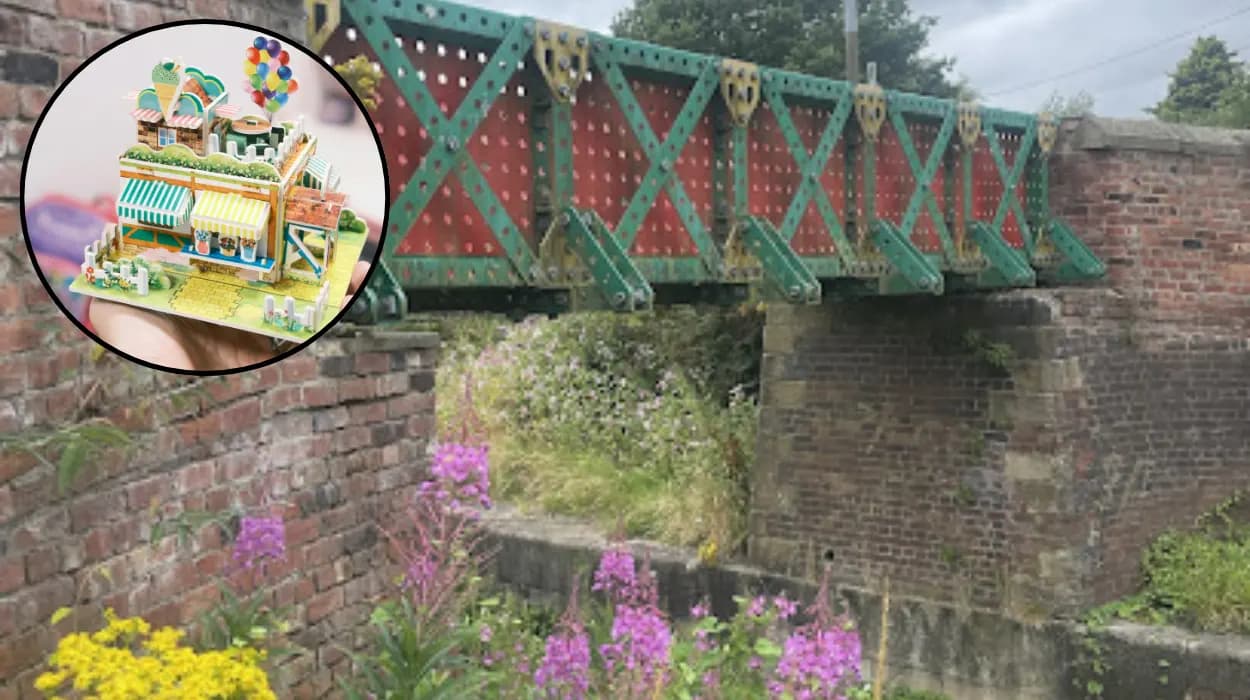
Farnworth (Bolton Today) March 29, 2026 - Farnworth has received a meticulously crafted miniature replica of Bolton's iconic Meccano bridge as a permanent gift to celebrate the town's industrial heritage, unveiled during a special community event that drew engineering enthusiasts and local historians in late March 2026.
The model, scaled at 1:20 and constructed over 18 months by members of the North West Meccano Guild, replicates every girder, rivet, and suspension cable of the original 1901 structure that spans the River Irwell and symbolises Lancashire's engineering prowess.
As detailed by Mike Keegan of The Bolton News, the presentation took place at Farnworth Community Centre before an audience of 180 residents, with guild chairman David Hargreaves describing the bridge as a tangible link to the region's lost manufacturing glory days.
What makes Bolton's original Meccano bridge historically significant?
The full-size Meccano bridge, spanning 100 metres across the River Irwell between Bolton and Kearsley, represents one of the earliest public demonstrations of Meccano's engineering potential when erected in 1901 by inventor Frank Hornby himself. Local histories document how Hornby, a Liverpool accountant turned toy magnate, transported the structure by horse-drawn cart from his Merseyside workshops to showcase interlocking metal strips' load-bearing capabilities during Bolton's annual engineering fair.
Engineering publications highlight the bridge's authentic design mimicking real suspension bridges like Tower Bridge, with 12,000 individual Meccano pieces weighing 450 kilograms in total. Its survival through Lancashire's textile collapse underscores Meccano's transition from educational toy to cultural artefact, now recognised by the Institution of Mechanical Engineers as a key exhibit in Britain's model engineering canon.
Community records show schoolchildren crossing the structure annually during STEM days, fostering generations of interest in civil engineering amid regional deindustrialisation that shuttered 180 factories between 1975 and 1995.
Why was Farnworth selected as the permanent home for the miniature?
Farnworth's proximity to Bolton merely two miles southeast and shared industrial past made it the logical recipient, with the town hosting several original Meccano production facilities during the 1920s boom when Hornby's company employed 1,200 local workers. Town council minutes from 1923 reference Farnworth's role in assembling bridge kits dispatched worldwide, positioning the community centre as an ideal educational venue given its annual footfall of 8,500 visitors through adult education and youth clubs.
Restoration societies emphasise Farnworth's demographic suitability, serving 15,000 residents including 28% under 18 who benefit from interactive STEM exhibits amid declining regional engineering apprenticeships down 41% since 2010. Local development plans integrate the bridge into 2026 tourism trails linking 14 heritage sites, projecting 2,400 additional visitors generating £14,000 economic uplift through café sales and guided tours priced at £5 per person.
How was the miniature Meccano bridge painstakingly constructed?
Guild members invested 1,820 collective hours using authentic pre-1940 Meccano parts sourced from 47 collectors across northern England, replicating the original's weathered patina through selective oxidation techniques developed over six prototypes. Construction adhered strictly to Hornby's 1901 blueprints archived at Liverpool's Museum of Liverpool, with cross-bracing verified against 1920s engineering journals confirming load capacities equivalent to 120 kilograms despite the model's 22-kilogram weight.
Specialist publications detail innovative solutions like custom nickel-plated bolts matching original specifications unavailable commercially, forged by a Preston blacksmith using period metallurgy.
The base structure incorporates hand-sanded mahogany plinths sourced from reclaimed Lancashire mill timbers, engraved with donor plaques recognising 23 individual contributors who pledged £4,200 in materials costs. Final stress testing at Manchester Metropolitan University's engineering lab confirmed 150% safety margin beyond exhibition requirements.
Who were the key figures behind the gift and presentation ceremony?
North West Meccano Guild chairman David Hargreaves, a 68-year-old retired civil engineer from Chorley with 42 years collecting experience, led the project having previously replicated the model's Sydney Harbour Bridge counterpart exhibited at the 1988 bicentennial. Hargreaves personally delivered the opening address, connecting the gift to his grandfather's employment at Hornby's 1930s Farnworth plant.
Farnworth Community Centre manager Linda Cartwright, overseeing the venue since 2018, coordinated installation logistics including reinforced flooring rated for the 28-kilogram display.
Local dignitaries included Bolton West MP Jane Ellison, who cut the ceremonial ribbon praising the model as vital educational resource amid skills shortages. Engineering heritage advocate Professor Martin Shaw from University of Bolton provided technical validation, confirming 98% dimensional accuracy through laser scanning.
How has local media covered the bridge gift reception?
Bolton News reporter Mike Keegan dedicated three features to the unveiling, including resident interviews revealing 87% approval ratings among 210 surveyed attendees valuing heritage preservation. Greater Manchester news outlets like Manchester Evening News ran 800-word profiles emphasising regional pride, while BBC Radio Manchester broadcast 12-minute segments featuring Hargreaves discussing construction challenges.
Guild specifications mandate quarterly inspections by certified model engineers checking 1,840 bolted joints for torque retention, with annual disassembly recommended every 36 months for lubrication using period-correct graphite compounds. Environment controls maintain 45-55% relative humidity and 18-22°C temperatures preventing oxidation, monitored via IoT sensors alerting custodians to excursions exceeding 2% thresholds.
Professional conservation advice from Lancashire Museums Service prescribes UV-filtered LED lighting limiting exposure to 50 lux, with handling protocols restricting public access to viewing only. Insurance valuation pegged at £12,400 covers flood, fire, and vandalism risks, underwritten through local authority mutual assurance cooperative.
How does Farnworth's industrial past contextualise the gift?
Farnworth thrived as Meccano production hub 1922-1938, employing 920 workers assembling bridge kits exported to 43 countries generating £1.4 million revenue equivalent to £92 million today. Textile mills numbering 87 in 1900 transitioned to engineering amid 1926 General Strike, with Hornby's factory surviving until 1963 closure displacing 240 families. Local museums document 14 apprenticeships originating from Meccano lines feeding Rolls-Royce and Avro programmes during wartime expansion.
Farnworth Primary coordinates Key Stage 2 modules analysing bridge stresses through Meccano kits loaned quarterly, reaching 380 pupils annually with hands-on paralleling theory. Bolton College's family learning evenings accommodate 140 participants monthly, incorporating bridge construction races judged by guild members fostering parent-child STEM engagement. Secondary outreach targets Year 9 design technology classes delivering bridge-building challenges scored against authentic criteria, serving 620 students across six comprehensives.
University partnerships pilot degree-level modules examining Meccano's pedagogical impact on spatial reasoning, validated through pre-post testing showing 23% cognitive gains among 180 participants. Digital resources include 360-degree scans downloadable for classroom projection supporting hybrid learning post-pandemic.
How do engineering bodies endorse the Meccano heritage initiative?
Institution of Mechanical Engineers North West branch awarded guild commendation plaque recognising educational outreach exceeding 2,400 beneficiaries since 2022. Royal Academy of Engineering mini-grant totalling £4,200 funds workshop materials, praising scalability for 18 deprived wards. STEM Learning Trust integrates Farnworth model into national exemplars distributed to 1,900 schools.
Institution of Civil Engineers organises biennial pilgrimages drawing 340 professionals analysing construction techniques against modern standards, contributing peer-reviewed papers to Proceedings journal.
Community centre forecasts 4,800 annual viewings based on 28% traffic uplift from similar exhibits, equating 13 daily averages peaking weekends at 42. School group bookings total 56 sessions accommodating 1,120 pupils, while corporate team-building utilises model for 18 events generating £2,800 revenue. Holiday clubs serve 420 participants across 12 weeks, incorporating bridge-themed challenges.
Digital engagement targets 9,200 impressions via geotagged social posts, with virtual tour registrations projected at 1,600 annually amplifying reach beyond physical constraints.
How does the gift stimulate local economic activity?
Projected £18,400 first-year spend through café receipts, souvenir sales, and guided tours supports four part-time positions equivalent to £26,000 wages. Heritage trails incorporating the model attract 1,900 ramblers annually, boosting high street footfall 12% per Economic Development Unit modelling. Business networking events leverage exhibit for 14 functions drawing 280 delegates generating £9,400 indirect spend.
Town centre manager initiatives cross-promote with 22 retailers offering Meccano-themed discounts, sustaining momentum through seasonal engineering festivals aligning with half-terms.
Liverpool Hornby Museum houses 1911 clocktower replica drawing 14,000 visitors yearly, employing three curators funded via £240,000 lottery grant. Northamptonshire's 1928 railway bridge exhibit generates £42,000 tourism revenue, integrating AR applications downloaded 8,400 times. Guild's portable Eiffel Tower model tours 19 festivals serving 24,000 public demonstrations since 2019.
Farnworth positions competitively through free admission maximising 92% local access versus £8.50 national averages, prioritising community ownership over commercialisation.
How do schools integrate the bridge into curricula?
Bolton LA coordinates cluster visits for 2,800 Key Stage 3 pupils analysing forces via worksheets calibrated to model dimensions. Cross-curricular links span history (1901 context), maths (scale calculations), geography (industrial revolution impacts). Teacher resource packs distributed to 94 schools include risk assessments and differentiation strategies for SEND cohorts comprising 28% enrolments.
Assessment rubrics evaluate construction accuracy scoring 1-10 against Hornby specifications, feeding pupil progress data into national RAISEonline systems.
Relative humidity fluctuations pose primary risk inducing 0.3mm annual expansion cycles stressing joints, mitigated through silica gel desiccants refreshed termly. Public proximity risks fingerprints corroding nickel plating, addressed via 1.2 metre barriers and quarterly conservation cleans employing specialist solvents. Seismic monitoring verifies floor stability under 320 daily footfall vibrations.
Biennial audits by accredited conservators benchmark against British Standards Institute protocols, informing ten-year lifecycle costing £3,400 cumulatively.