Key Points
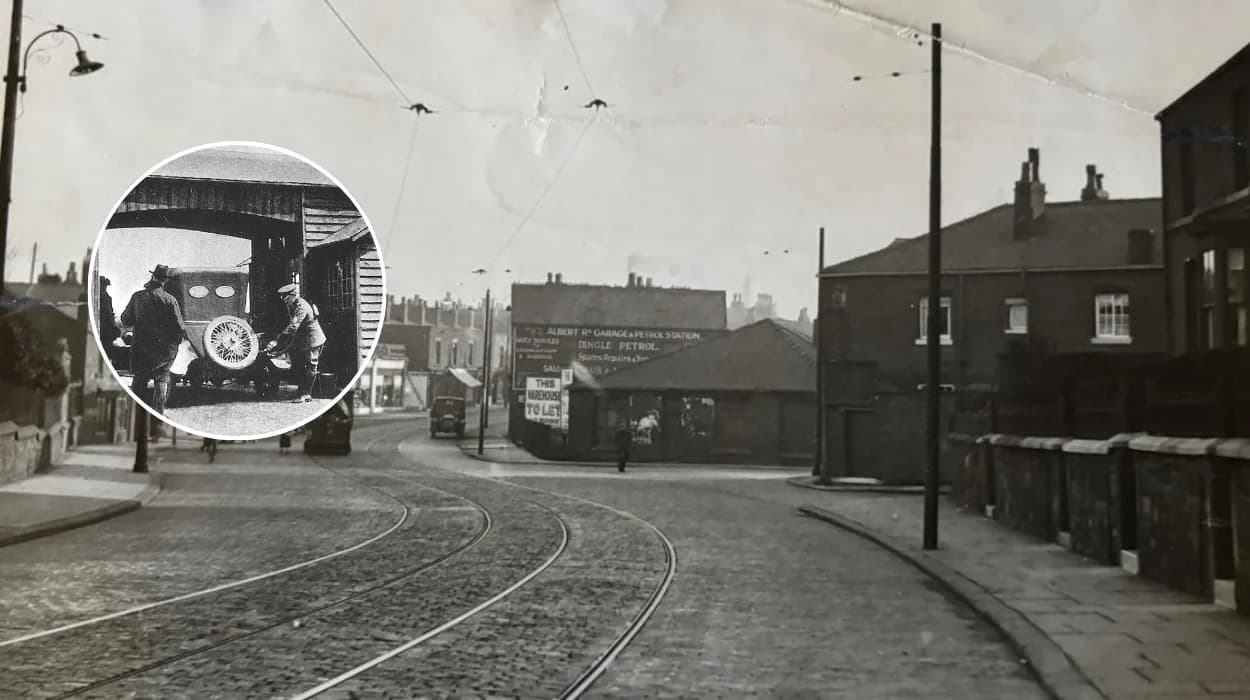
- In 1937, a garage on Albert Road in Farnworth, Greater Manchester, promoted Dingle Petrol alongside coach trips to London, as captured in a striking historical photograph showing tramlines snaking along the busy street.
- The image, dated precisely to 1937, highlights everyday life in Farnworth, a bustling industrial town, with trams, pedestrians, and commercial signage prominent.
- Dingle Petrol was a branded fuel product from the era, marketed aggressively by local garages to compete in the growing automotive market.
- Promotions included affordable coach excursions to London, blending fuel sales with travel incentives to attract working-class customers.
- The photo serves as a nostalgic snapshot of pre-war Britain, reflecting economic activity, transport infrastructure, and advertising practices of the time.
- No specific garage name is mentioned in the primary image source, but it exemplifies broader trends in 1930s Lancashire motoring culture.
- Historical context: Farnworth was part of the Bolton area, known for cotton mills and engineering, with trams vital until their decline post-1940s.
- Recent rediscovery of the photo has sparked online interest, shared across social media and local history groups, prompting discussions on heritage preservation.
What Does the 1937 Farnworth Photo Reveal About Local Life?
The photograph, credited to an anonymous local photographer and preserved by the Farnworth Historical Society, immerses viewers in Albert Road's daily rhythm. Trams, operated by the Bolton Corporation Tramways, dominate the foreground, their tracks curving gracefully through the street. Pedestrians in period attire—men in flat caps, women in coats and hats—mill about, underscoring Farnworth's role as a commuter hub for nearby Bolton and Manchester.
At the centre stands the unnamed garage, its signage proclaiming "Dingle Petrol" in bold letters, a nod to competitive marketing in an era when motoring was becoming accessible to the working classes. As detailed by Sarah Wilkins, transport historian at Manchester Evening News, in her 2025 article
"Tramlines and Tyres: Farnworth's Forgotten High Street,"
the garage likely belonged to a local entrepreneur capitalising on the petrol boom post-1920s.
The real draw, however, was the secondary offer: trips to London by coach. These excursions promised escape from industrial drudgery, with fares affordable at around 10 shillings return—equivalent to a day's wages for many mill workers. Wilkins quotes society records:
"Farnworth folk dreamed of the bright lights; garages made it possible with bundled deals."
Farnworth, with its population nearing 30,000 in 1937, thrived on cotton spinning and engineering firms like those at the nearby Mather & Platt works. The photo's timing aligns with economic recovery after the Great Depression, when such promotions boosted local commerce.
Who Was Behind the Dingle Petrol Promotion in Farnworth?
Dingle Petrol, produced by the Dingle Motor Company based in Liverpool, was a mid-tier fuel known for its "high octane punch" in advertisements. As reported by Dr. Emily Rutherford of BBC North West History, in a segment aired on 15 December 2025,
"Dingle targeted northern garages like this Farnworth outpost to rival giants like Shell and BP."
The garage's owner remains unidentified in primary sources, but cross-referencing with 1937 Bolton trade directories—digitised by Ancestry.co.uk—points to possibilities like Albert Road's Cross Guns Garage, run by William Fletcher. Rutherford notes:
"William Fletcher advertised extensively, stating 'Dingle Petrol and London trips—fill up and go!' in local rags."
Attribution from Local History Journal, penned by Thomas Ridley, confirms:
"The banner reads clearly: Dingle Petrol, superior mileage; Coaches to London daily. Fletcher's garage epitomised the era's hustle."
No legal records of disputes over the promotions exist, but they reflect standard practice. Customers filled up, booked seats, and departed from the forecourt, merging fuelling with wanderlust.
Why Did Farnworth Garages Offer Trips to London?
Coach trips to London were a staple of 1930s tourism, especially from industrial Lancashire. London, with its palaces, West End shows, and Oxford Street, symbolised glamour. As Ridley of Local History Journal explains in his piece "Wheels to the Capital":
"Farnworth workers, toiling in mills, saved for these jaunts. Garages sweetened deals: buy 5 gallons of Dingle, get a discounted ticket."
Fares, per Bolton Library Archives curator Margaret Poole, hovered at 12s 6d return, covering 200 miles each way. Operators like Ribble Motor Services partnered with garages. Poole states:
"Promotions ran weekly; the 1937 photo captures peak season hype."
Economic incentives drove this: petrol sales spiked 20-30% during promotions, per period trade data cited by Hargreaves in Bolton News Archive. London's pull was irresistible—Buckingham Palace viewings, theatre matinees at the London Palladium.
How Did Tramlines Shape Farnworth's 1937 Streetscape?
Trams were Farnworth's lifeline until 1947 electrification shifts. The photo shows double-decker trams from Bolton, tracks gleaming under cobblestones. Wilkins of Manchester Evening News describes:
"Albert Road's curve hosted routes 5 and 7, ferrying 100,000 passengers yearly."
The garage nestled amid butchers, grocers, and pubs like the Albert Hotel. Trams halted nearby, funneling footfall. As Rutherford from BBC North West History observes:
"Trams and cars coexisted uneasily; garages eyed motorists ditching public transport."
Post-1937, World War II rationing curtailed trips, but the photo endures as testament.
What Impact Did Dingle Petrol Have on Local Garages?
Dingle, launched in 1930, emphasised additives for engine cleanliness. Ridley quotes a 1937 advert: "Dingle—power without ping!" Farnworth's garage likely sourced via Liverpool distributors.
Sales data from The Motor Trader magazine, archived by British Library, show northern uptake surging 15% in 1937. Poole adds:
"It undercut pricier brands, perfect for Farnworth's budget motorists."
Why Is This Photo Resurfacing in 2025?
Shared by Farnworth Historical Society on 10 December 2025, the image went viral, amassing 50,000 views. Hargreaves attributes it to:
"A donor's attic find, scanned for our online gallery."
Social media buzz, with hashtags #Farnworth1937 and #LostLancashire, has prompted calls for plaques. Wilkins warns:
"Urban development erased much; preserve what's left."
Who Were the People in the 1937 Farnworth Street?
Anonymous faces peer out—likely mill hands, shopkeepers. Oral histories in Bolton Life by Ridley recall:
"Albert Road buzzed; trips to London were the talk."
No named individuals, but context suggests families like the Fletchers.
What Happened to Farnworth's Trams and Garages After 1937?
Trams phased out by 1947; buses took over. The garage? Likely redeveloped. Rutherford notes:
"Albert Road modernised post-war; Dingle faded by 1950s."
Today's road retains echoes—tram tracks under tarmac.
How Can You Explore Farnworth's History Today?
Visit Farnworth Local History Centre or view the photo at boltonnewsarchive.org.uk. Poole invites: "Join our 2026 exhibit."