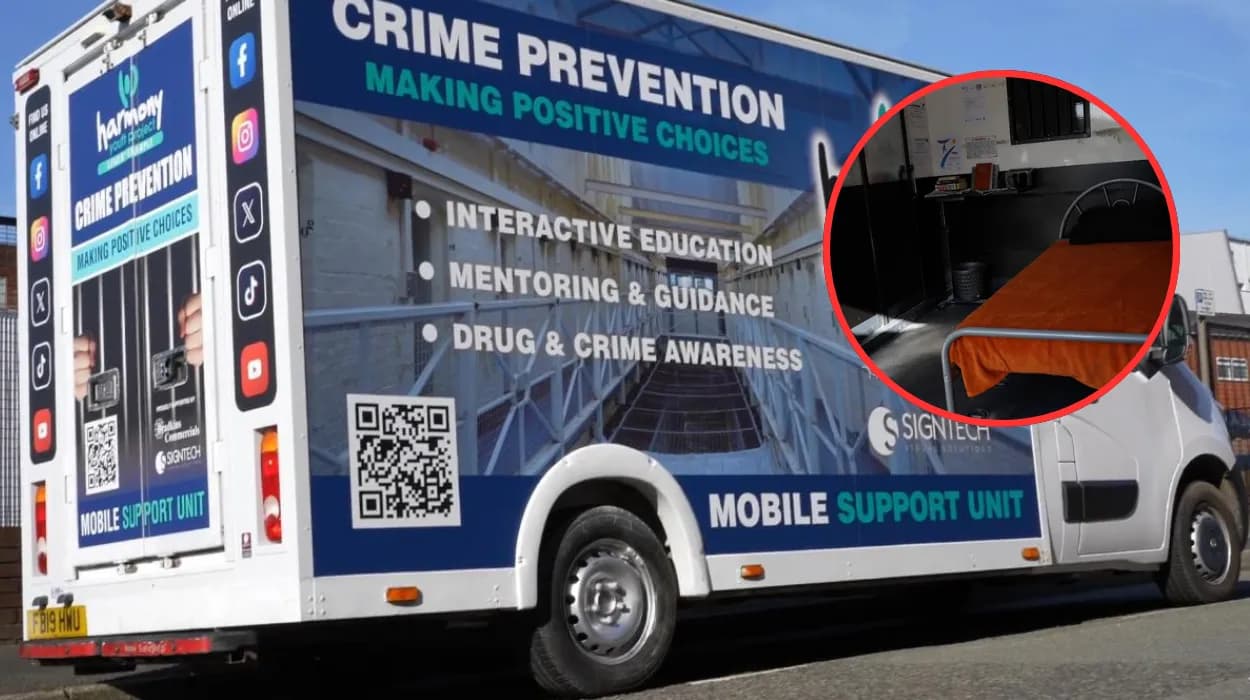
Key Points
- Innovative Initiative: A mobile prison cell replica housed within a van has been launched to show young individuals the stark reality of incarceration.
- Target Audience: The initiative specifically targets young people across Bolton, Greater Manchester, and the wider North West region to deter them from knife crime and antisocial behaviour.
- Organisational Driving Force: The project is developed and spearheaded by the Harmony Youth Project under their dedicated 'Stop Knife Crime' initiative.
- Sensory Learning Tool: Rather than acting as a tool for intimidation, the vehicle acts as an educational, sensory resource designed to trigger claustrophobia and fear, replicating life inside a 23-hour isolation lockdown without access to phones, games, or social media.
- Collaborative Support: Funded by local council backing, the van tour collaborates with secondary schools, community hubs, and grass-roots charities, including the 'Mero's World Foundation'.
- National Recognition: The initiative has attracted high-level political interest, with discussions occurring within the House of Lords and local local authorities regarding using the scheme as a regional hub backed by the Government.
Bolton (Bolton Today) May 18, 2026 - An innovative mobile prison cell designed to expose young people to the unforgiving environment of life behind bars has been deployed across Bolton and the North West region as part of a targeted campaign to combat the escalating local crisis of knife violence. Spearheaded by the Bolton-based charity, the Harmony Youth Project, the replica cell is contained within a specialised transport van that travels directly into secondary schools, colleges, and local youth hubs. The initiative aims to provide an immediate, tactile deterrent to adolescents caught on the periphery of anti-social behaviour, forcing them to physically experience the sensory deprivation and claustrophobia of modern incarceration before they make life-altering decisions involving weapons.
Supported by local authority funding and designed by community leaders alongside youth specialists, the vehicle serves as the vanguard for the charity’s 'Stop Knife Crime' initiative. By removing the romanticised glamour often attached to street violence by television dramas and social media, the project confronts participants with the reality of being locked up for 23 hours a day in isolation, entirely cut off from friends, mobile phones, and technology. The initiative comes amid shifting national statistical patterns regarding youth violence and has quickly gained significant political traction, with representatives evaluating the project's model as a potential blueprint for a federally backed regional anti-crime hub.
Why has a mobile prison cell been introduced in Bolton?
The implementation of the mobile prison cell serves as an urgent, community-led response to the ongoing concerns surrounding adolescent weapon possession and anti-social behaviour across Greater Manchester and the North West. As documented in a regional investigative report by an uncredited correspondent for GB News, national metrics present a complex picture of the contemporary crime landscape. In the analytical data compiled for the year ending September 2025, the Office for National Statistics (ONS) indicated that overall knife crime had experienced a minor decline of nine per cent. However, the broader temporal trajectory tells a far more concerning story for local communities: despite annual fluctuations, the UK still recorded more than 50,000 separate knife-related incidents during that period, maintaining a total figure that remains a staggering 54 per cent higher than the volume recorded a decade ago.
Faced with these statistics, grass-roots organisations in the North West have argued that traditional, classroom-based lectures and purely punitive legal measures are failing to resonate with the modern internet-centric generation. According to official organizational policy documentation published directly on the Harmony Youth Project portal, the charity observed that a dramatic increase in local anti-social behaviour and knife violence had necessitated a complete shift in community engagement strategies. The group determined that conventional outreach programmes were no longer sufficient, leading them to design a secondary, highly interactive educational platform that bridges the gap between abstract warnings and physical consequence.
The project was officially birthed following a highly successful pilot scheme conducted across Yorkshire, where the vehicle received overwhelming praise and foundational support from neighbourhood policing teams and local families. Recognizing the impact of the Yorkshire pilot, administrators at the Harmony Youth Project opted to permanently transition the vehicle to Bolton, establishing a rolling deployment schedule to service towns and municipal areas throughout the North West.
How does the mobile cell simulate the reality of prison life?
The core methodology of the mobile prison cell relies entirely on sensory immersion rather than theoretical instruction. It is configured to precisely mirror the exact dimensions, institutional furniture, and stark atmosphere of a standard British holding cell. As outlined in the public brief issued by the Harmony Youth Project, long-term field experience in youth mentorship revealed that adolescent demographics rarely change their behavioural patterns based on verbal warnings alone. The organisation noted that young people frequently need to physically see, touch, or sense an environment before it becomes an undeniable reality for them, meaning they must tangibly experience the eventual consequences of criminal actions to truly comprehend the magnitude of their daily choices.
When a youth steps inside the van, they are subjected to an environment completely devoid of contemporary comforts. The simulation strips away access to smartphones, gaming consoles, internet connectivity, and peer socialization. Instead, participants are left to experience the psychological weight of isolation, modeling the conditions of real-world convicts who face being confined to a small room for up to 23 hours a day.
The charity explicitly emphasises that the primary objective of the asset is not to inflict psychological trauma or act as a mechanism of authoritarian fright. Rather, it functions as an objective, reality-awareness tool that forces individuals to confront the immediate loss of personal autonomy that accompanies a criminal conviction. The claustrophobic physical constraints inside the vehicle are intended to disrupt the perceived glamour of gang culture, demonstrating that carrying a blade carries a high probability of leading to a sterile, isolated future.
Who is leading the "Stop Knife Crime" initiative?
The strategic deployment of this mobile asset is guided by veteran youth workers and individuals who possess extensive experience in handling young offenders. To maximize the efficacy of the programme, the Harmony Youth Project restructured its internal outreach operations by creating a specialised department dedicated entirely to weapon deterrence.
According to statements released via the Harmony Youth Project’s project management board, the charity initiated the programme by recruiting a dedicated youth specialist boasting over 19 years of direct, hands-on experience within the youth justice and community mentoring sectors. This specialist spent several years embedded within the local community to establish robust trust, transparency, and genuine empathy with active young offenders, working diligently to parse out the underlying socio-economic issues driving adolescent weapon carrying.
Last year, these collective efforts were formalised under the official banner of the 'Stop Knife Crime' initiative. This enabled the charity to systematically integrate these specialized engagement skills into mainstream educational curricula, establishing direct pipelines to deliver courses, interactive seminars, and support services into secondary schools, colleges, and community centres across the region.
Explore More Bolton Crime News
Breightmet shop attack sparks terror in Bolton 2026
Teen charged with murder of Leicester student in Bolton
What do the project's founders say about its impact?
The leadership behind the Harmony Youth Project maintains that innovative, unconventional approaches are vital to breaking the cycle of youth reoffending. In an interview broadcast by a regional field journalist for GB News, Charlie Barrett, the founder of the Harmony Youth Project, defended the unique nature of the initiative against potential critics who might dismiss the vehicle as a superficial marketing stunt.
As reported by the on-air broadcasting team of GB News, Charlie Barrett stated that:
“A lot of people will say this is 'a bit of a gimmick, it's only one van, what's it going to do?' – well I want those people to stop saying it doesn't work and start saying 'I'll tell you what will work.' And until they do that, we'll keep trying to come up with initiatives.”
Barrett continuously reinforces the philosophy that the project is fundamentally rooted in constructive education rather than pure intimidation. He maintains that until mainstream critics offer alternative, proven systems to curb the knife epidemic, community groups must remain bold, agile, and willing to introduce radical sensory tools to protect vulnerable adolescents from the judicial system.
The operational strategy relies heavily on delivering unvarnished truths rather than moral lecturing. In a special broadcast produced for the Manchester News Today audio documentary series, distributed via The Daily News Now podcast network, production journalists highlighted the expanding operational reach of the initiative. The report documented the moments the Harmony Youth Project's mobile prison cell van tour officially arrived at Manchester's prominent Mero’s World youth hub.
The audio documentary detailed that the project, which is sustained through critical local council funding allocations, operates with a strict focus on presenting raw, undeniable facts regarding the legal and physical outcomes of violence, deliberately avoiding patronizing sermons in a focused effort to save teenage lives.
How are victims' families reacting to the project?
The mobile prison cell tour does not operate in isolation; it works in close alignment with families who have been permanently broken by the realities of knife violence. The collaboration between the Harmony Youth Project and local anti-knife foundations ensures that the youth experiencing the van are also exposed to the human cost of violence.
During the vehicle’s deployment at the Mero's World youth hub, the emotional gravity of the campaign was underscored by personal testimonies. As reported within the production logs of the Manchester News Today podcast, prominent community advocates Wesley Thomasson and Charlie Barrett stood alongside grieving family members to share deeply personal stories, explicitly emphasizing the devastating, permanent consequences that weapon violence inflicts upon local families.
The initiative has garnered immense solidarity from mothers who have lost children to the epidemic. In an extended broadcast feature anchored by the investigative unit at GB News, reporters conducted a comprehensive interview with Kelly, a local mother whose teenage son, Rhamero, was brutally murdered in a targeted street stabbing. Kelly vividly recounted the trauma of arriving at the hospital, recalling that her son initially looked as though he was merely asleep. However, because his body was immediately designated as a legal "crime scene," hospital authorities and police personnel prohibited her from embracing or holding her deceased child, restricting her to sitting quietly by the bedside and stroking his eyebrow.
Rhamero’s killers were subsequently convicted and are currently serving a collective total of 61 years in prison. When journalists from GB News questioned Kelly on whether she viewed the judicial sentences as sufficient, her response captured the lifelong grief experienced by victims' relatives.
As reported by the investigative broadcasting team of GB News, Kelly stated that:
“No. I say it all the time – it’s us parents serving the life sentence. There’s no time on anyone taking your child’s life in such a brutal way. We’re the ones serving it daily.”
Following the tragedy, Kelly established the Mero’s World Foundation, a grass-roots charity dedicated entirely to weapon deterrence and providing community support. She remains a staunch supporter of interactive interventions like the mobile cell, telling GB News that if her ongoing collaborative advocacy can manage to save just a single life, then the entirety of their exhausting community work is validated.
Will this initiative be rolled out nationally?
What began as a localised trial in Yorkshire and an independent charity launch in Bolton is rapidly ascending into the national political consciousness. The raw efficacy of using a mobile prison cell to shock young people into a realistic understanding of state confinement has drawn the attention of high-level lawmakers and structural policymakers.
According to the strategic development portfolio issued by the Harmony Youth Project, the organisation is actively expanding the scope of these concepts while simultaneously presenting its collected empirical findings to legislative figures who possess the institutional power to effect wide-scale structural change. The charity confirmed that prominent legislative venues, including the House of Lords and various metropolitan councils, are currently hosting formal discussions to evaluate Harmony’s field experience.
With prospective Government backing, discussions are underway to formally designate the Harmony Youth Project as a primary regional hub. This federal integration would provide the necessary capital and logistical infrastructure to scale the mobile prison cell framework across the United Kingdom, maximizing the reach of the asset to help thousands of young people make better life choices and secure a stable, productive future.