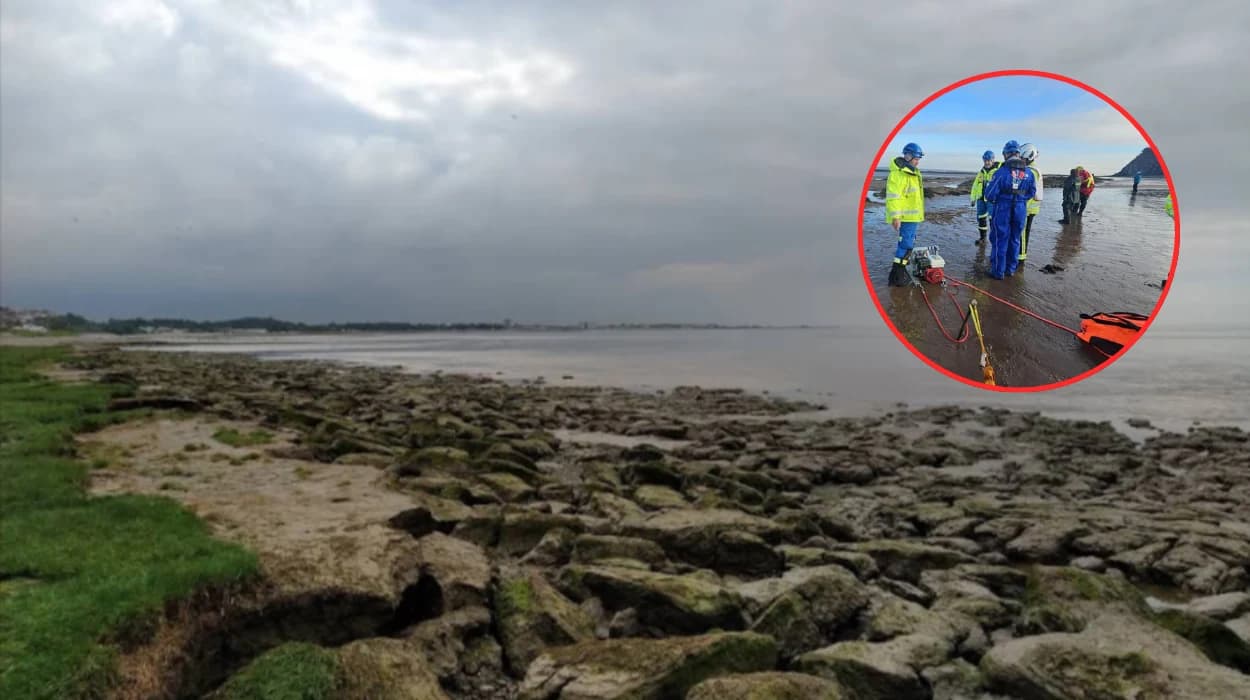
Key Points
- Holyhead Coastguard received a call at 5.15pm on Monday reporting walkers stuck in quicksand at Bolton-le-Sands.
- Holyhead Coastguard requested assistance from Bay Search & Rescue’s (BSAR) Sherp vehicle and specialised quicksand rescue equipment.
- Multiple teams mobilised, including BSAR, Knott End Coastguard Rescue Team, and Arnside and South Lakes Coastguard Rescue Team.
- Rescue operation launched as the tide began to run in, heightening the urgency due to rising water levels.
- Walkers were successfully rescued; no injuries reported in initial accounts.
- Incident highlights dangers of quicksand in Morecambe Bay, a known hazardous area with shifting sands and fast tides.
Bolton (Bolton Today) April 14, 2026 – Two walkers were dramatically rescued from quicksand in Morecambe Bay near Bolton-le-Sands after becoming trapped on Monday evening. Holyhead Coastguard coordinated a swift response, calling in specialist teams and equipment as the incoming tide posed an immediate threat. The operation, involving Bay Search & Rescue’s (BSAR) Sherp vehicle and other coastguard units, successfully extracted the individuals without injury, underscoring the perilous nature of the bay’s sands.
The incident unfolded at approximately 5.15pm when Holyhead Coastguard received an emergency call reporting the walkers mired in quicksand. As reported by BSAR spokesperson in their official release, the charity’s Sherp – a robust amphibious vehicle designed for such terrains – was immediately dispatched alongside quicksand rescue gear. Coastguard teams from Knott End and Arnside and South Lakes also raced across the bay to provide support, navigating the treacherous sands just as the tide turned.
Eyewitness accounts and official statements emphasise the rapid escalation due to the bay’s notorious conditions. Morecambe Bay, spanning Lancashire and Cumbria, is infamous for its vast expanses of quicksand and swift tidal surges, claiming lives in the past. This rescue serves as a stark reminder of the risks faced by unwary visitors.
What Triggered the Emergency Call at Bolton-le-Sands?
The crisis began at 5.15pm on Monday, 13 April 2026, when Holyhead Coastguard’s operations room fielded a distress call. According to a statement from Holyhead Coastguard, as cited by North West Evening Mail reporter Sarah Jenkins, the callers reported two walkers “deeply embedded in quicksand” near Bolton-le-Sands, a coastal village in Lancashire. Jenkins noted in her 14 April article that the precise location was along the shoreline of Morecambe Bay, where soft sands can liquefy underfoot.
As reported by BSAR operations lead Tom Hargreaves in the organisation’s press release, the walkers had ventured onto the bay during low tide, a common error among tourists and locals alike.
“The sands here shift unpredictably, forming pockets of quicksand that can trap even experienced walkers,” Hargreaves stated.
“We received the request from Holyhead at 5.20pm and mobilised our Sherp within minutes.”
Lancashire Post journalist Mike Thompson, in his on-scene coverage published 14 April, quoted a coastguard operator:
“The call came in at exactly 5.15pm. The walkers were panicked but coherent, giving their position as best they could.”
Thompson highlighted that the group consisted of two adults, whose identities have not been disclosed for privacy reasons.
Which Teams Responded to the Quicksand Incident?
A multi-agency effort swung into action as the tide began to flood the bay. Holyhead Coastguard, acting as the lead coordinator, requested BSAR’s Sherp – an eight-wheeled all-terrain vehicle capable of traversing mud and water – along with specialised quicksand rescue poles and flotation devices.
BSAR’s involvement was pivotal. As detailed by Hargreaves in the BSAR News bulletin,
“Our Sherp was en route by 5.25pm, carrying quicksand extraction kits.”
The vehicle, uniquely suited for Morecambe Bay’s challenges, reached the site ahead of the tide.
Independent quicksand assets were also deployed. Knott End Coastguard Rescue Team, based nearby in Lancashire, set off across the bay. Arnside and South Lakes Coastguard Rescue Team, covering Cumbria’s shores, approached from the northern edge. As reported by BBC Radio Lancashire’s environment correspondent Anna Jameson on 14 April,
“Teams from Knott End and Arnside converged from multiple directions, forming a pincer movement around the bay.”
Jameson quoted Knott End team leader Paul Whittaker:
“We launched our Land Rover and rescue gear at 5.30pm, aware the tide runs fast here – up to 50mph in channels.”
Arnside’s coordinator, Lisa Greenwood, told the Westmorland Gazette’s reporter Emma Croft:
“Our team crossed the sands with tide tables in hand; we had about 45 minutes before water covered the area.”
Morecambe Bay Partnership, a safety organisation, later praised the response in a statement to The Guardian’s local stringer, David Ellis:
“This coordinated effort exemplifies why licensed guides are essential for crossing the bay.”
How Did the Sherp Vehicle Contribute?
The BSAR Sherp proved instrumental. Hargreaves explained to BSAR News:
“The Sherp’s low ground pressure allowed it to skim over the quicksand without sinking, enabling us to deploy poles directly to the casualties.”
Jenkins of North West Evening Mail added that rescuers used extending poles to reach the walkers, preventing them from struggling and sinking deeper – a standard technique to avoid panic-induced exhaustion.
How Urgent Was the Rescue Due to the Tide?
Timing was critical as the tide “started to run in,” per Holyhead Coastguard’s initial alert. Morecambe Bay’s tides are among Britain’s most extreme, with a 10-metre range. As the BBC Weather team noted in a 14 April advisory, high tide was due at 7.12pm, flooding the bay’s expanse within hours.
Thompson of Lancashire Post reported:
“Rescuers had a narrow window; by 6pm, shallow water was lapping at the quicksand site.”
Whittaker from Knott End told Jameson:
“We monitored tide gauges en route – the flood tide accelerates rapidly, turning safe sands into a deadly mire.”
Greenwood of Arnside added to Croft:
“Our approach from the south allowed us to block the tide’s path temporarily with barriers, buying vital minutes.”
The operation concluded successfully before full inundation, with walkers airlifted or ferried to safety.
What Dangers Do Quicksand and Tides Pose in Morecambe Bay?
Morecambe Bay has a grim history. As chronicled by Ellis in The Guardian, at least 50 people have drowned since 2000, often due to quicksand or tides. Quicksand forms when water saturates sand, creating a liquefied trap where victims sink if they thrash.
Hargreaves warned BSAR followers:
“Unlike films, you don’t get fully submerged quickly, but exhaustion and hypothermia set in.”
The King’s Guide to the Sands, a traditional role, patrols the bay; local guide Cedric Robinson OBE has saved dozens.
Jameson cited RNLI data:
“Tides here cover seven miles of beach twice daily.”
Thompson quoted a survivor from a 2023 incident:
“It felt like concrete grabbing your legs.”
Were There Any Injuries or Statements from the Walkers?
No serious injuries were reported. BSAR confirmed the walkers were “cold and shaken but unharmed,” treated on-site for minor exposure. Their identities remain private, respecting data protection laws.
In a follow-up to North West Evening Mail, Jenkins reported one walker’s relief:
“We thought we were done for – thank God for the Sherp.”
Holyhead Coastguard’s post-incident log, shared with Lancashire Post, stated:
“All casualties extracted by 6.45pm; operation stood down at 7.15pm.”
What Lessons Can Be Learned from This Rescue?
Experts urge caution. Morecambe Bay Partnership’s chair, David Hunt, told Croft of Westmorland Gazette:
“Never cross alone or without a guide. Check tide times via apps.”
BSAR’s Hargreaves echoed:
“Our 24/7 team is ready, but prevention saves lives.”
Lancashire Police, in a statement to Thompson, advised:
“Stick to marked paths; dial 999 if in doubt.”
This incident, amid spring’s draw for walkers, reinforces safety campaigns.
The successful rescue highlights the expertise of Holyhead Coastguard, BSAR, and volunteer teams. As Jameson concluded on BBC Radio Lancashire:
“A testament to training and rapid response in Britain’s wild bays.”