Key Points
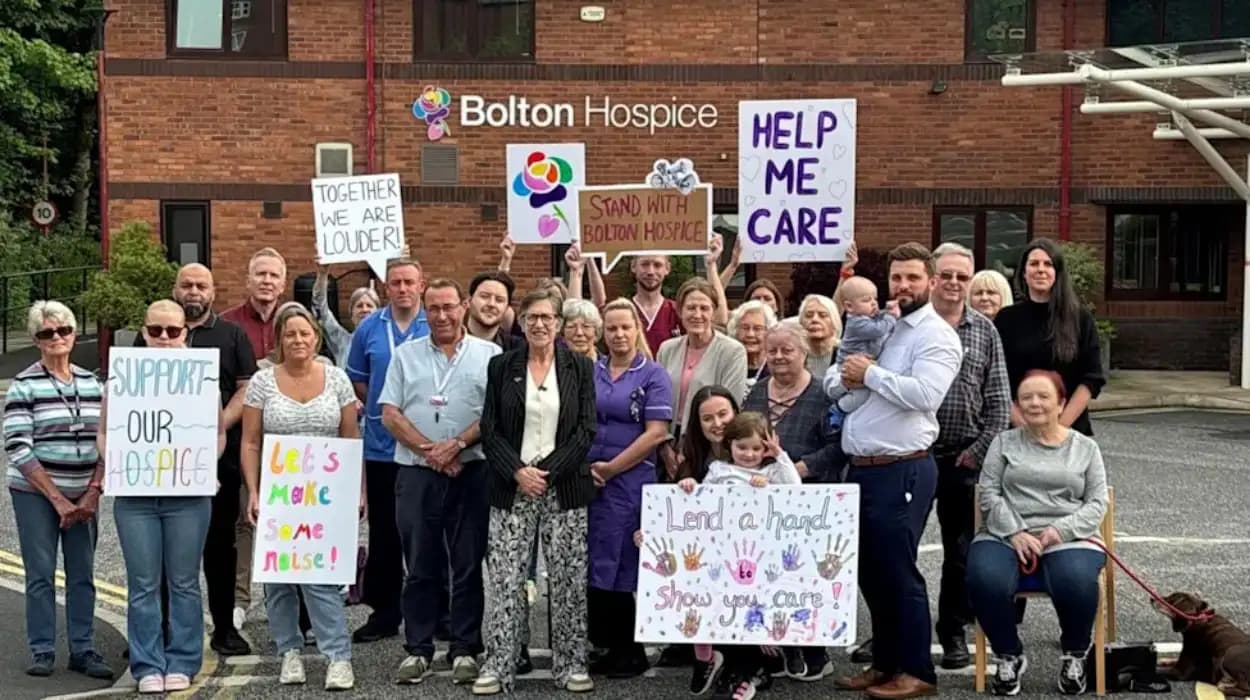
- Urgent Public Appeal: Bolton Hospice has launched an urgent grassroots campaign, urging local residents to "stand with us" by signing a national petition to demand sustainable state funding.
- Severe Funding Gap: Government funding covers only a minor fraction of the hospice's total operational requirements, exposing a stark funding disparity within the local healthcare framework.
- Astronomical Running Costs: Out of its £7 million annual running budget, the hospice is legally and operationally forced to self-generate more than £5.5 million through charity shops, public events, and private donations just to keep its doors open.
- National Systemic Crisis: The financial emergency mirrors a broader UK crisis, where rising operational costs and below-inflation statutory increases have pushed nearly 60 per cent of English hospices to the precipice of cutting vital frontline services.
- Risk to NHS Infrastructure: Industry leaders and local citizens warn that any reduction in hospice beds or specialist home-visit teams will cause a catastrophic domino effect, overwhelming local accident and emergency departments and worsening the national bed-blocking crisis.
Bolton (Bolton Today) June 18, 2026 - Bolton Hospice has launched an urgent public mobilization campaign, pleading with the local community to back an aggressive legislative push for fairer and more sustainable government funding. Facing a crippling financial framework where statutory state funding covers only a fraction of daily operational expenditures, the specialist palliative care facility has issued a stark warning regarding the future viability of its free services. To secure its short-term and long-term future, the charity has initiated a widespread public petition aimed at forcing decision-makers in Whitehall to overhaul the systemic model that dictates how end-of-life care is financed across the United Kingdom.
Why is Bolton Hospice facing an immediate financial crisis?
The operational mechanics of hospice care in the United Kingdom rely on a hybrid model of state grants and intensive local fundraising. However, high inflation alongside stagnant government allocations has widened the gap between statutory funding and real-world costs. Bolton Hospice operates on a strict annual budget of £7 million. Because state support remains capped at a minor percentage, the institution is forced to generate more than £5.5 million every single year through independent public giving, local corporate sponsorships, and retail ventures.
As reported by an investigative reporter for The Bolton News, the institution is under unprecedented structural pressure after years of below-inflation funding increases from the government. Unlike mainstream National Health Service (NHS) provisions, palliative care delivered by independent hospices does not receive comprehensive state financing, despite being universally recognized as an essential public service. Consequently, the hospice cannot reliably plan for its long-term future, leaving its standard of care vulnerable to wider economic fluctuations.
What is the true scale of the UK hospice funding emergency?
The financial strain felt in Greater Manchester is not an isolated local issue, but rather a reflection of a systemic collapse across the sector. Palliative care networks throughout England are facing severe inflationary spikes across energy, medical supplies, and clinical staffing costs. This economic pressure has arrived at a time when statutory funding from integrated care boards has fundamentally dried up or failed to keep pace with basic inflation.
As reported by Toby Porter, the Chief Executive Officer of Hospice UK, independent hospices across the nation are facing a genuine economic cliff edge as funding fails to keep pace with rapidly rising costs and growing demand. He stated that
"The current way in which hospices are funded is not fit for purpose,"
adding that
"It is patients who will pay the prices for this unfair model."
According to statistical data compiled by Hospice UK, nearly six in ten English hospices have either already initiated cuts to their frontline medical operations or are actively considering service reductions in the immediate future. The sector's leadership emphasizes that without an immediate financial intervention from the central government, the network of free end-of-life care across the country risks fracturing entirely.
How will service cuts at Bolton Hospice impact the local NHS?
Hospices function as a vital relief valve for the wider public healthcare infrastructure. By managing complex pain symptoms, chronic respiratory failure, and psychological distress in a specialized environment, they prevent vulnerable patients from occupying acute hospital beds unnecessarily. If these services are stripped back, the immediate impact will be felt across local emergency rooms and hospital wards.
As reported by Wendy Houghton, a long-term resident from Bradshaw, any reduction in hospice capacity will inevitably shift the financial burden directly onto an already struggling state system. She explained that
"If rooms aren't available, patients will have to be cared for in hospital, causing less hospital beds available for others and costing the NHS and ultimately the public, a lot more."
Furthermore, data published by Hospice UK confirms that specialized home visits are already decreasing across the country due to severe staffing shortages and a lack of baseline capital. When community-based palliative care declines, a higher volume of terminal patients experience acute health crises at home. This leads to distressing, preventable emergency admissions that increase both logistical and financial pressure on regional NHS trusts.
What are local residents saying about the care provided by the hospice?
The push for a national petition has brought forward numerous personal testimonies from local families who have relied on the hospice during critical times. These narratives underscore the human impact of the service, highlighting a standard of care that conventional, fast-paced NHS wards are rarely equipped to match.
As reported by Maria Thompson, a resident of Astley Bridge, the specialist support provided to her late husband following a brain tumour diagnosis extended far beyond clinical boundaries. She stated that
"Bolton Hospice provided outstanding care for my late husband and my family,"
adding that
"Fairer funding is essential to enable as many people as possible to access the wonderful services that the hospice provides."
This sentiment was closely echoed by Tracy Lomax of Kearsley, whose partner passed away at the facility in 2017 following a battle with stage-four lung cancer. She noted that
"The care my partner received was exceptional."
and emphasized that
"Until you need the hospice you truly cannot comprehend the care and support given there."
These firsthand accounts are being used by campaign organizers to show that hospice care is not an optional luxury, but an irreplaceable pillar of community dignity.
Explore More Bolton News
Unsung Heroes Celebrated at Carers Week: Bolton 2026
Farnworth Foodbank Issues Urgent Donation Plea Amid Critical Stock Shortages: Farnworth 2026
What structural changes are hospice leaders demanding from the government?
The current campaign is not merely a request for short-term charitable donations, but a structured demand for legislative reform regarding how palliative care is handled at a national level. Sector leaders argue that reliance on localized bake sales, marathons, and corporate goodwill to fund essential clinical staff is an unstable and outdated approach to public health.
As reported by Dr (h.c) Leigh Vallance, the Chief Executive Officer of Bolton Hospice, the institution has provided care with expertise and dignity for over three decades, but the current financial status quo has become unsustainable. She noted that
"Without a long-term, sustainable solution for day-to-day funding, it becomes harder to plan for the future and protect the care our community relies on."
To resolve this systemic instability, Hospice UK has presented a formal four-point plan to the Department of Health and Social Care. While the hospice sector has welcomed the government’s long-term plan to introduce a Modern Service Framework to overhaul end-of-life care, campaigners argue that immediate financial relief is required to stabilize the sector while long-term reforms are drafted. The core demand of the four-point plan is simple: the state must fully fund the specialist clinical care that hospices deliver on behalf of the NHS.
How are corporate partners responding to the fundraising shortfall?
Faced with a widening gap in state funding, local businesses across Greater Manchester have stepped in to launch localised, short-term emergency financial initiatives. A recent example is the "Making Every Moment Count" campaign, which utilised a matched-funding model to maximise the impact of private donations over a compressed 36-hour window.
As reported by Richard Duggan, the Regional Editor for Newsquest (including The Bolton News), the prospect of any local hospice services being rolled back due to a lack of money is entirely unacceptable. Local corporate partners have responded to this sentiment by acting as "Matchers," pledging tens of thousands of pounds to double the donations made by ordinary citizens.
Which businesses are providing financial backing?
A variety of regional companies have committed their own corporate funds to incentivise public giving. As reported by Tricia Dalby, the Chief Operating Officer and co-founder of Box Power, their corporate motivation stems from a desire to safeguard these services during an unprecedented national crisis. She explained that "Bolton Hospice is a wonderful place" that offers a "calm and reassuring environment for patients and their families."
Other key corporate figures have aligned their organisations with the cause to fulfil local social responsibilities. As reported by Andrew Clegg, the Head of Sales and Corporate Services at UK Healthcare, supporting the hospice is a natural extension of their corporate purpose to make a healthy difference in the community. Similarly, Chrissie Bramhall-England, the Communities Manager at building firm Northstone, noted that their decision to back the hospice was immediate after seeing the profound difference the charity makes to families within their construction zones. Additionally, representatives from Stateside Foods in Westhoughton and Philadelphia Scientific in Atlas Mill confirmed that their organisations viewed supporting the campaign as an essential obligation to the borough they have called home for decades.
How can members of the public support the campaign?
The leadership team at Bolton Hospice has emphasised that while monetary donations remain vital for day-to-day survival, political advocacy is the primary goal of this specific campaign. The public is being urged to visit the official website to sign the "Stand with Bolton Hospice" fairer funding petition.
Organisers intend to collect thousands of verified signatures to present directly to regional Members of Parliament and national health officials. By demonstrating a unified front of public support, the hospice hopes to apply decisive political pressure on the government to fix a broken funding model, ensuring that end-of-life dignity remains free and accessible for future generations.