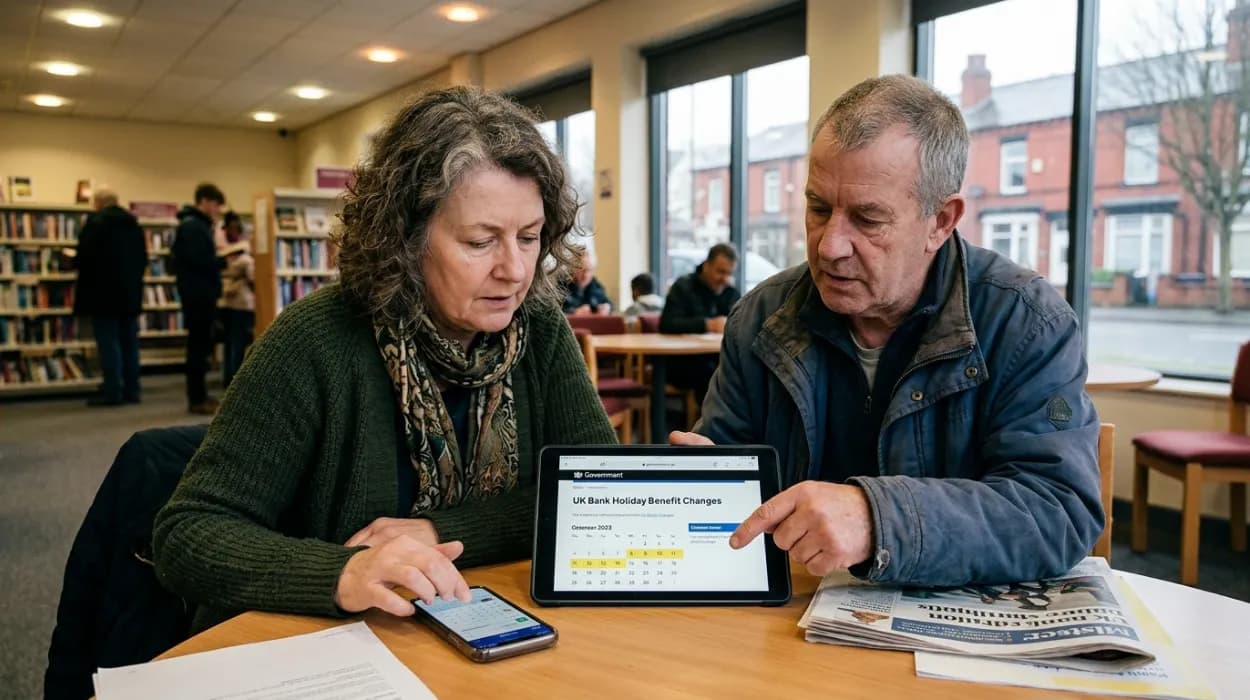
UK bank holiday benefit changes shift state payment dates to the preceding working day when scheduled disbursements coincide with official public holidays. The Department for Work and Pensions and HM Revenue and Customs execute these schedule adjustments automatically across England, Wales, Scotland, and Northern Ireland. Bolton Today outlines the framework governing bank holiday payment adjustments for all UK benefit claimants.
How do UK bank holiday benefit changes affect payment schedules?
UK bank holiday benefit changes force scheduled payments landing on official public holidays to arrive on the final working day prior to the closure. The Department for Work and Pensions and HM Revenue and Customs issue funds early to prevent delays caused by closed banking clearance systems.
The Social Security Administration Act 1992 and the Banking and Financial Dealings Act 1971 set the legal architecture for state financial disbursements and public bank holidays in the United Kingdom. When the Department for Work and Pensions (DWP) or HM Revenue and Customs (HMRC) processes social security disbursements, the transaction requires processing through the Bankers' Automated Clearing Services (BACS) network. The BACS clearing system operates strictly on standard business days and pauses operations on recognized public holidays and weekends.
When a scheduled benefit payment date falls on a bank holiday, the clearing system cannot execute the settlement on that day. The state administrative framework resolves this operational restriction by shifting the payment date forward to the nearest active banking day immediately preceding the holiday. For example, if a payment schedule indicates a payment due on Monday, 31 August, the DWP or HMRC system moves the disbursement to Friday, 28 August. This automated process ensures that claimants retain uninterrupted access to designated state financial funds.
The administrative shift applies across the full spectrum of social security programs administered by central and devolved governments. The specific benefits subject to payment date alterations include Universal Credit, Personal Independence Payment, State Pension, Pension Credit, Attendance Allowance, Carer's Allowance, Disability Living Allowance, Employment and Support Allowance, Jobseeker's Allowance, Child Benefit, and Scottish devolved payments like the Scottish Child Payment and Adult Disability Payment.
Why are UK benefit payment dates moved for bank holidays?
Benefit payment dates shift because the UK's automated banking settlement infrastructure halts transaction clearance operations during national public holidays. The Department for Work and Pensions relies on standard operational clearing days to guarantee that electronic fund transfers land directly into recipient bank accounts.
The United Kingdom relies on BACS Payment Schemes Limited to execute bulk direct credit transactions between government accounts and commercial financial institutions. BACS processing runs on a rigid three-day operational cycle: submission on day one, processing on day two, and entry into the recipient's bank account at midnight on day three. BACS does not process transactions on Saturdays, Sundays, or statutory bank holidays established under the Banking and Financial Dealings Act 1971.
If the DWP or HMRC attempted to disburse payments on a bank holiday, commercial clearing banks would reject the transaction settlement until the following open working day. A scheduled Monday payment would consequently remain uncredited until Tuesday morning. Delaying payment settlements would violate statutory welfare support mandates and place vulnerable low-income households in financial distress due to overdue essential payments.
To mitigate operational delays, the DWP, HMRC, and Social Security Scotland mandate automatic early payment clearing. By initiating the BACS cycle earlier in the week, the government ensures funds clear into high-street banks, building societies, and credit unions on the final working day before bank branches and clearing systems close.
Which government departments manage bank holiday benefit adjustments?
The Department for Work and Pensions, HM Revenue and Customs, and Social Security Scotland independently manage bank holiday benefit payment schedule adjustments. Each authority oversees distinct social security programs and maintains tailored administrative workflows for bank holiday processing.
The Department for Work and Pensions (DWP) represents the largest state department managing social security across England, Wales, and Scotland. The DWP calculates, schedules, and issues Universal Credit, Personal Independence Payment, State Pension, Pension Credit, Disability Living Allowance, Employment and Support Allowance, Jobseeker's Allowance, Attendance Allowance, and Carer's Allowance. The DWP coordinates directly with the Bank of England and commercial financial firms to re-route millions of individual automated payments ahead of statutory holidays.
HM Revenue and Customs (HMRC) operates as a non-ministerial department responsible for tax collection and targeted state payments. HMRC administers Child Benefit and Guardian's Allowance. While HMRC aligns its public bank holiday payment rules with the DWP's working-day-before policy, its processing schedules run on separate administrative protocols that generate unique payment calendar variances for Child Benefit recipients in specific regional jurisdictions like Scotland and Northern Ireland.
Social Security Scotland manages devolved benefits established under the Social Security (Scotland) Act 2018. Social Security Scotland operates independently from the DWP to disburse the Scottish Child Payment, Adult Disability Payment, Child Disability Payment, and Carer Support Payment. Social Security Scotland synchronizes its early disbursement calendar with Scottish public bank holidays, which frequently diverge from the official bank holiday calendar observed in England and Wales.
In Northern Ireland, the Department for Social Development oversees welfare delivery through the Northern Ireland Executive. The Department aligns its bank holiday payment schedules with the DWP while accounting for regional public holidays such as St Patrick's Day on 17 March and Battle of the Boyne observances in July.
What are the official bank holiday benefit payment dates across the UK?
Official bank holiday benefit payment dates move to the immediately preceding working day prior to any public holiday shutdown across England, Wales, Scotland, and Northern Ireland. Payment date changes depend directly on regional public holiday calendars.
National statutory holiday schedules dictate precise payment dates throughout the calendar year. When a bank holiday falls on a Monday, the payment date shifts back to the preceding Friday. When holidays occur over extended festive periods—such as Christmas Day, Boxing Day, and New Year's Day—payments move back to the last standard working day before the holiday cluster begins.
In England, Wales, and Northern Ireland, standard bank holiday shifts follow these precise operational rules:
- New Year's Day (1 January): Payments due on 1 January move to 31 December.
- Good Friday: Payments due on Good Friday move to the preceding Thursday.
- Easter Monday: Payments due on Easter Monday move to the preceding Thursday (prior to Good Friday).
- Early May Bank Holiday (First Monday in May): Payments due on the holiday move to the preceding Friday.
- Spring Bank Holiday (Last Monday in May): Payments due on the holiday move to the preceding Friday.
- Summer Bank Holiday (Last Monday in August): Payments due on 31 August move to Friday, 28 August.
- Christmas Day and Boxing Day (25–26 December): Payments due on 25, 26, 27, or 28 December move to 24 December or the nearest preceding working day.
Regional deviations alter these standard rules in Scotland and Northern Ireland. Scotland observes 2 January as a bank holiday, pushing early January payments back to 31 December. Scotland also marks its Summer Bank Holiday on the first Monday in August rather than the last Monday, shifting August payment dates for Scottish DWP and devolved social security recipients to late July. Northern Ireland observes St Patrick's Day on 17 March and Battle of the Boyne holidays in mid-July, causing localized early payment shifts for NI claimants.
How does Universal Credit manage payment changes during bank holidays?
Universal Credit manages bank holiday changes by adjusting the fixed monthly payment date to the nearest open banking day whenever that date falls on a weekend or public holiday. Assessment period dates and underlying entitlement calculations remain unchanged during these calendar adjustments.
Universal Credit operates under a unique assessment structure established by the Universal Credit Regulations 2013. Unlike legacy benefits disbursed weekly, bi-weekly, or four-weekly, Universal Credit is calculated over a precise one-calendar-month assessment period. A claimant's payment date remains fixed on the same numerical day of each month throughout the duration of the claim.
When a claimant's fixed Universal Credit payment date lands on a bank holiday or weekend, the DWP automated system moves the deposit date to the working day directly preceding the holiday. For example, if a claimant's fixed payment day is the 31st of the month, and 31 August is a statutory bank holiday, the DWP issues the payment on 28 August.
Working out an individual Universal Credit bank holiday payment date requires three administrative steps:
- Review the Universal Credit online statement to locate the end date of the current monthly assessment period.
- Add exactly seven calendar days to the assessment period end date to identify the standard scheduled payment date.
- Check if that calculated payment date falls on a weekend or official bank holiday; if it does, count back to the nearest active working day to find the revised deposit date.
The monthly assessment period does not shift when an early payment occurs. The subsequent assessment period continues on its standard monthly schedule, meaning the following month's payment reverts to its normal date without administrative disruption.
What financial impacts do early bank holiday benefit payments create for claimants?
Early bank holiday benefit payments create extended budget gaps by widening the time window between the early payment and the subsequent scheduled disbursement. Claimants must stretch identical entitlement funds across a longer period before receiving their next regular benefit payment.
An early benefit payment provides funds sooner than expected, but it does not represent additional financial assistance. The total monetary sum credited to the claimant's account remains identical to their standard statutory entitlement. Because the state issues the money early, the time interval between the early payment and the following month's regular payment expands.
For example, a Universal Credit recipient normally paid on the 31st of each month who receives their August payment early on 28 August will not receive another payment until 30 September. This shift expands the normal 31-day budgeting cycle to a 33-day cycle. Claimants who spend early disbursements immediately upon receipt face acute cash-flow deficits in the final days preceding their next scheduled payment date.
Financial advisers at MoneyHelper and Citizens Advice stress that managing an early bank holiday payment requires proactive household budgeting:
- Calculate cycle extension: Determine the exact number of additional days between the early payment date and the next regular payment date.
- Ring-fence core liabilities: Immediately allocate funds toward fixed household expenses, such as rent, council tax, energy bills, and food costs, before spending disposable income.
- Adjust daily allowance: Divide remaining disposable income by the total number of days in the extended cycle rather than a standard 28- or 30-day period.
Do claimants need to take action to receive early bank holiday payments?
Claimants do not need to take any administrative action to receive early bank holiday benefit payments. The Department for Work and Pensions and HM Revenue and Customs automatically recalculate and process revised payment dates through their central IT platforms.
The DWP's Payment Service Platform and HMRC's automated payment frameworks run continuous calendar checks against national public holiday databases. The software automatically identifies all payment files scheduled to settle on a bank holiday and adjusts the transmission date to the preceding working day. Claimants do not need to submit applications, contact helpline call centers, or submit online requests through their digital accounts to trigger the early payment.
Attempts to contact benefit helplines to request manual early payments create unnecessary call volume and processing delays. Telephone call centers and online journal messaging systems cannot manually alter established bank holiday automation rules.
Claimants should verify their payment arrival by logging into their online banking applications or checking bank statements on the morning of the revised payment date. Payment deposits typically clear into commercial bank accounts shortly after midnight on the revised processing date.
What steps should claimants take if a bank holiday benefit payment is missing?
Claimants should first check their online account statement and contact their commercial bank before reporting a missing payment to government benefit helplines. Official offices close on bank holidays, requiring urgent resolution actions prior to holiday weekends.
If funds do not appear in a recipient's account on the revised early payment date, claimants should perform a structured review:
- Check online benefit journal or statement: Log into the Universal Credit account, Child Benefit account, or personal tax account to confirm that the payment date was officially listed for that specific day.
- Verify bank account details: Ensure that bank account sort codes and account numbers registered with the DWP or HMRC are correct and up to date.
- Contact bank customer support: Verify whether incoming BACS transactions are pending clearance or subject to internal fraud security holds.
- Check bank transaction references: Look for official DWP or HMRC payment reference codes on bank statements to verify whether an expected deposit cleared under a different reference description.
If the bank confirms that no incoming transfer was attempted, the claimant must contact the relevant government department immediately. DWP and HMRC phone lines operate strictly during standard working hours and close entirely on bank holidays and weekends. Claimants must call the appropriate helpline before 5:00 PM on the working day preceding the bank holiday to secure manual emergency payment tracing.
How will future welfare reforms impact bank holiday benefit payment policies?
Future welfare reforms will maintain early payment schedules while digitizing real-time payment tracking to reduce processing errors during public holidays. Government modernization initiatives prioritize real-time banking transfers over legacy batch processing systems.
The DWP and HMRC continue to upgrade digital infrastructure through the Payment System Modernisation Programme. Historical payment frameworks relied exclusively on overnight BACS batch processing, which mandated rigid three-day clearing lead times around bank holidays. Modernized infrastructure integrates Faster Payments Service protocols, enabling near-instantaneous bank transfers between state accounts and claimants.
While the adoption of Faster Payments provides greater flexibility, government policy maintains the standard mandate: payments due on a public holiday will continue to be paid early on the preceding working day. This rule remains a core statutory protection preventing low-income households from experiencing payment delays during national shutdowns.
Devolution of welfare powers introduces additional administrative variance across the UK. Social Security Scotland continues to expand its independent benefit programs, aligning disbursement schedules with Scottish local and national holidays. Claimants across Bolton and the broader UK should consult official government portals and Bolton Today guides to maintain precise awareness of scheduled payment changes throughout the year.
FAQS
What happens to benefit payments on a UK bank holiday?
If a benefit payment is due on a bank holiday, it is generally paid on the preceding working day so claimants do not have to wait until banks and payment systems reopen.