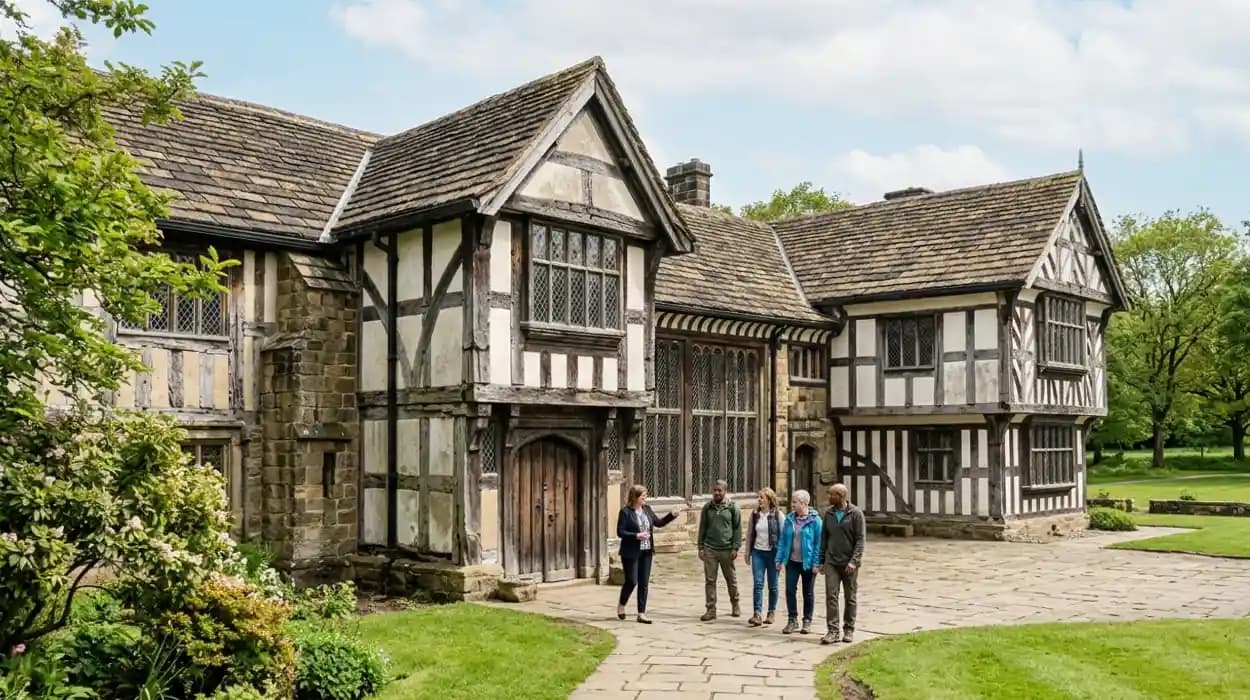
Smithills Hall stands as a Grade I listed manor house and scheduled monument in Smithills, Bolton, Greater Manchester, England. Owned by Bolton Metropolitan Borough Council, this historic site attracts visitors seeking insight into medieval architecture and local heritage.
Bolton Today covers Smithills Hall as one of Bolton's premier historical landmarks. The hall preserves over 800 years of history through its structure and records.
What Is Smithills Hall?
Smithills Hall is a Grade I listed manor house and scheduled monument in Smithills, Bolton, Greater Manchester, England, built from the 14th to 19th centuries on the slopes of the West Pennine Moors at 500 feet elevation, owned by Bolton Metropolitan Borough Council and open to the public.
The hall occupies a defensive site near the Astley and Raveden Brooks, 3 miles northwest of Bolton town center. Its construction spans multiple eras, starting with 14th-century half-timbered elements extended through the 19th century. Authorities designated it Grade I on 23 April 1952 (reference 1388279) and a scheduled monument on 12 November 1991 (reference 43437).
Location Details
Smithills Hall sits at coordinates 53°36′09″N 2°27′20″W on a terrace surrounded by parkland south of a steep valley formed by a Raveden Brook tributary. This positioning provided natural defense and overlooks the landscape.
Ownership and Access
Bolton Metropolitan Borough Council owns the property and maintains public access. Visitors explore the site year-round, with guided tours highlighting its features.
Where Is Smithills Hall Located?
Smithills Hall locates in Smithills, Bolton, Greater Manchester, England, on the West Pennine Moors' slopes at 500 feet (150 meters) elevation, 3 miles (4.8 kilometers) northwest of Bolton town center near Astley and Raveden Brooks.
The site enhances regional heritage tourism in Greater Manchester. Its elevated position integrates with the moorland environment, drawing over 20,000 annual visitors based on local council reports.
Proximity to Bolton
From Bolton town center, Smithills Hall lies 3 miles northwest, accessible via roads through Smithills Dean. Public transport links include buses from Bolton Interchange.
Surrounding Landscape
The hall borders West Pennine Moors, an Area of Outstanding Natural Beauty covering 36 square miles. Streams like Raveden Brook define the valley below.
When Was Smithills Hall Built?
Smithills Hall's oldest parts, including the Great Hall, date to the early 14th century, around 1322, with construction spanning the 14th to 19th centuries through multiple extensions, particularly the west wing.
Records trace habitation in the Smithills estate area to thousands of years before written history. The first documented manor transfer occurred in 1335 when William Radcliffe acquired it from the Hulton family.
Construction Phases
The north range's Great Hall forms the core, built as a half-timbered hall house. Later owners added ranges around an open court and moated sections.
Key Extensions
The west wing saw significant 19th-century alterations. These preserved medieval features while adapting to Victorian needs.
Who Owned Smithills Hall Historically?
The Radcliffe family owned Smithills Hall from 1335, acquired by William Radcliffe from the Hultons, with ownership passing through descendants until the 19th century, when it transferred to Bolton Council predecessors.
The Radcliffe lineage dominated ownership for over 500 years, shaping the hall's development. Their tenure reflects medieval manorial systems where lords controlled estates for agriculture and defense.
Radcliffe Family Role
William Radcliffe obtained the manor in 1335. Successive Radcliffes expanded the structure, adding wings and moats for security.
Modern Ownership Transfer
By the 20th century, Bolton Corporation assumed control, evolving into today's Metropolitan Borough Council ownership in 1974.
What Is the Architecture of Smithills Hall?
Smithills Hall features a 14th-century half-timbered Great Hall as its oldest element, with three ranges around an open court, stone and timber construction, medieval open hearth, and later extensions including a west wing, all Grade I listed.
The design follows a hall house plan, typical of Northwest England manors. It retains original medieval features despite alterations.
Great Hall Features
The Great Hall, built circa 1322, includes an open hearth and high roof timbers. Stone and timber framing defines its walls.
Wing Extensions
Three ranges enclose a courtyard: north (Great Hall), east, and west. The west wing underwent major 19th-century rebuilding.
Why Is Smithills Hall Historically Significant?
Smithills Hall holds significance as one of Northwest England's oldest manor houses, a Grade I listed building and scheduled monument preserving 800 years of architecture, ownership records, and regional history from 1335 onward.
Its survival illustrates medieval to Victorian transitions in domestic architecture. The site contributes to Greater Manchester's over 200 listed buildings.
Listing Status
Grade I status, the highest tier, recognizes exceptional interest. Only 2.5% of England's listed buildings achieve this.
Scheduled Monument
Designation protects archaeological remains, including potential moat evidence.
What Events Occurred at Smithills Hall?
Smithills Hall hosted manorial courts, family events, and dramatic incidents like the 1554 George Marsh martyrdom trial, with its 800-year story encompassing Radcliffe family life, Civil War activity, and preservation efforts.
The hall served as a administrative center for the estate. Historical drama includes religious persecutions during Mary I's reign.
George Marsh Incident
In 1554, Protestant George Marsh faced examination at the hall before execution. A bloodstain legend persists on the stairs.
Civil War Context
During the English Civil War (1642-1651), Royalist Radcliffes used the hall, reflecting local divisions.
How Has Smithills Hall Been Preserved?
Bolton Metropolitan Borough Council preserves Smithills Hall through ownership, maintenance, public access, and conservation projects funded by grants, ensuring its Grade I status and annual visitor operations since the 20th century.
Preservation involves structural repairs and historical interpretation. Friends of Smithills Hall groups support fundraising.
Conservation Efforts
Recent projects restored timber framing and roofs, using traditional materials. Heritage Lottery Fund grants aided work in the 2010s.
Public Engagement
Guided tours and events educate 20,000+ yearly visitors on its history.
What Can Visitors See at Smithills Hall?
Visitors see the 14th-century Great Hall with open hearth, extended wings, courtyard ranges, period furnishings, gardens, and moorland views, accessible via Bolton Council management with guided tours and exhibits.
The interior displays Radcliffe-era artifacts. Exteriors reveal moat traces and defensive positioning.
Interior Highlights
The Great Hall features medieval roof timbers and screens. Upper floors house Victorian kitchens and bedrooms.
Exterior and Grounds
Parkland surrounds the hall, with trails to the West Pennine Moors. Moated remnants outline the original footprint.
How Does Smithills Hall Compare to Other Bolton Manor Houses?
Smithills Hall surpasses Hall i' th' Wood as Northwest England's oldest manor with 14th-century origins versus 16th-century build, both Grade I listed but Smithills larger at three ranges versus Hall's single structure, owned similarly by Bolton Council.
Bolton hosts multiple historic houses, but Smithills leads in age and scale. Comparisons highlight architectural evolution.
Other Local Sites
Queenywood Hall and Crompton Hall exist nearby, but lack Smithills' preservation and visitor facilities.
What Is the Future of Smithills Hall?
Bolton Council ensures Smithills Hall's future through ongoing maintenance, grant-funded restorations, and public programming, sustaining its role in heritage tourism amid Greater Manchester's 36-square-mile moors conservation.
Climate challenges prompt roof and drainage upgrades. Digital exhibits expand access.
Restoration Plans
Upcoming works target west wing stabilization by 2027, backed by £500,000 Heritage Fund support.
Tourism Role
The hall boosts Bolton's economy, contributing to 1.2 million annual regional heritage visits.
Smithills Hall embodies Bolton's deep historical roots, as covered by Bolton Today. Its preserved state offers enduring educational value.
FAQS
What is Smithills Hall?
Smithills Hall is a Grade I listed manor house and scheduled monument in Bolton, preserving over 800 years of history from the 14th to 19th centuries.