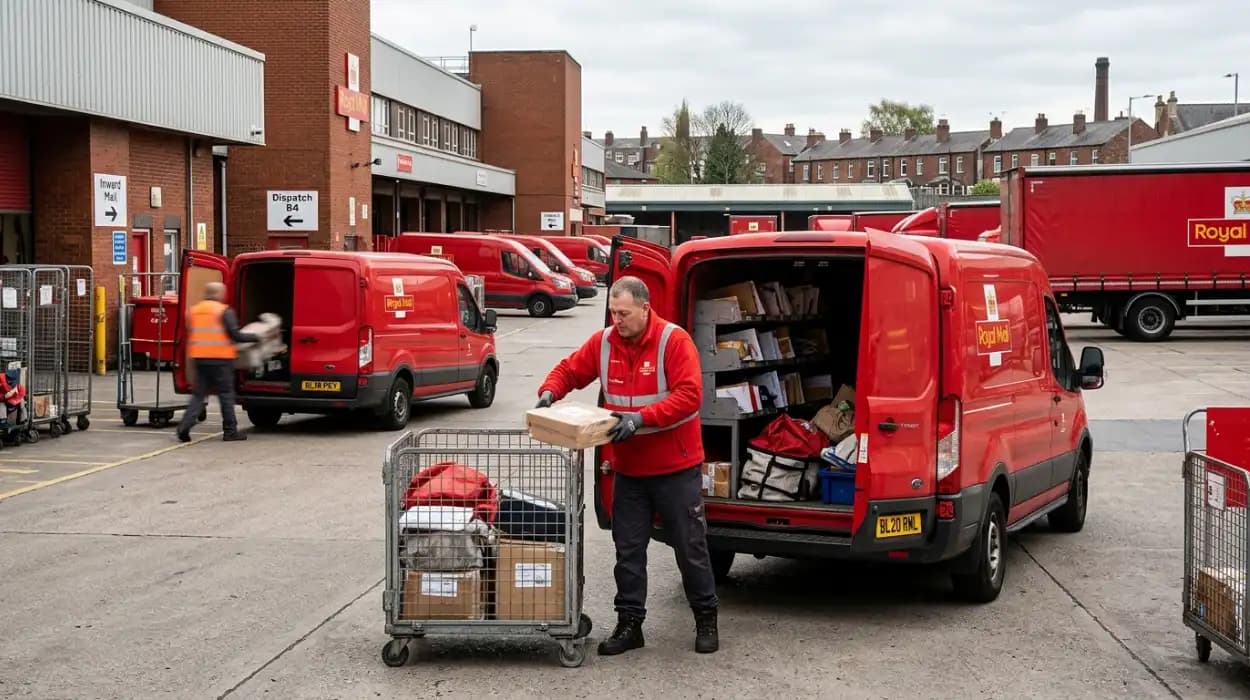
The Royal Mail serves as the universal postal service provider of the United Kingdom, delivering letters and parcels across thirty-two million delivery points. The organization operates under a statutory framework designed to maintain nationwide physical connectivity and commercial trade logistics. Bolton Today presents an in-depth, structured evaluation of the postal infrastructure, historical development, regulatory mandates, operational logistics, and industrial transformations shaping the entity.
What is the history and foundational development of Royal Mail?
Royal Mail originated in 1516 when King Henry VIII created the Master of the Posts to manage state communications. King Charles I opened the service to the public in 1635, establishing a national postal system.
The organizational evolution of Royal Mail spans over five centuries of public service, legislative restructuring, and technological adoption. Following its creation under Henry VIII, the state post operated strictly as an administrative apparatus for the monarch and the royal court for 119 years. In 1635, King Charles I commercialized access, designating London as the hub for six principal post roads extending across England, Wales, and Scotland.
The Post Office Act of 1660 established the General Post Office under King Charles II, institutionalizing the postmaster network and creating the world’s first postal cancellation mark, known as the Bishop Mark, to log transit timelines. Commercial expansion accelerated throughout the eighteenth century via mail coach delivery contracts organized by Ralph Allen and John Palmer.
Modern postal logistics emerged during the nineteenth century. Rowland Hill’s postal reform campaign culminated in the Postal Service Act of 1839 and the launch of the Uniform Penny Post in 1840. This reform introduced the world’s first adhesive postage stamp, the Penny Black, shifting the financial liability of postage from the recipient to the sender at a flat rate of one penny per half-ounce.
The entity operated under public control as part of the General Post Office until the Post Office Act of 1969 converted it into a state-owned corporation. In 2011, the UK Parliament passed the Postal Services Act, enabling the separation of Royal Mail Group Limited from Post Office Limited in 2012. Privatization concluded in October 2013 when shares debuted on the London Stock Exchange, transitioning the entity under International Distributions Services PLC.
How does the Universal Service Obligation regulate operations?
The Universal Service Obligation requires Royal Mail to deliver letters six days a week and parcels five days a week to every address in the UK at a uniform price, regulated strictly by Ofcom under statutory mandate.
The statutory framework governing Royal Mail’s core service obligations is established under the Postal Services Act 2011. The legislation appoints the Office of Communications (Ofcom) as the market regulator responsible for monitoring compliance, price capping, and service reliability standards.
The primary components of the Universal Service Obligation (USO) mandate specific operational parameters:
- Six-Day Delivery Schedule: Mandatory collection and delivery of First Class letters Monday through Saturday.
- Five-Day Parcel Schedule: Mandatory collection and delivery of parcel items Monday through Friday.
- Uniform National Tariff: A fixed postage cost applied universally across all geographical regions, prohibiting price surcharges for remote areas such as the Scottish Highlands or off-shore islands.
- Access Point Maintenance: The operation of designated collections through roughly 115,000 post boxes and local post office branches across Great Britain and Northern Ireland.
Ofcom establishes strict Quality of Service targets to evaluate operational performance. Royal Mail is legally bound to deliver 93% of First Class mail on the next working day following collection, and 98.5% of Second Class mail within three working days. Failure to meet these thresholds subjects the operator to financial penalties under regulatory enforcement procedures.
What is the infrastructure and logistics process behind letter and parcel processing?
Royal Mail processes mail through a network of local collection points, Automated Processing Centres, distribution hubs, and local delivery offices, utilizing optical sorting and automated tracking technology to move millions of items daily.
1. Collection and Access Networks
Mail items enter the supply chain through red pillar boxes, business pick-up contracts, local post offices, and doorstep collections via the Parcel Collect service. Collection vehicles transport the raw volume to regional Mail Centres.
2. Sorting and Automated Indexing
At regional Mail Centres, letters pass through Intelligent Mail Sorting Machines equipped with Optical Character Recognition (OCR) software. The systems read handwritten or printed addresses, converting postcode data into barcode configurations printed directly onto the paper envelope. High-speed parcel sorting machines handle physical packages by dimensions, weight, and delivery destination.
3. Hub Transportation and Routing
Processed mail items are consolidated into bulk transit units and transferred to major hubs, including automated Parcel Superhubs such as Warrington and Daventry. Dedicated road transport fleets, regional freight lines, and air freight networks move consolidated loads overnight to destination Mail Centres.
4. Final-Mile Delivery
Destination Mail Centres route sorted items to hundreds of local Delivery Offices. Postal workers manually or semi-automatically sequence the mail into specific delivery routes (walk logs) before distributing items to domestic residential addresses and commercial properties.
Which core delivery services and business solutions does Royal Mail offer?
Royal Mail provides standardized consumer mail, tracked domestic courier options, international shipping networks, and bulk business logistics tailored for e-commerce platforms and personal correspondents.
The company integrates digital tracking frameworks via Mailmark technology, allowing commercial senders to apply 2D barcodes to physical mail envelopes. This technology provides real-time visibility across the processing network while enabling lower postal rates for high-volume commercial users.
How has privatization and automation impacted the operational structure?
Privatization shifted Royal Mail into a commercially driven enterprise under International Distributions Services, driving multi-million-pound investments in parcel automation to compete with global logistics operators.
The privatization process initiated by the UK Government in 2013 altered the company's capital allocation and operational focus. Historically dependent on letter revenues, the organization faced a long-term decline in letter volumes alongside explosive growth in e-commerce parcel transactions.
To maintain profitability, parent company International Distributions Services invested capital into site modernizations. The deployment of dedicated Parcel Superhubs in Warrington and Daventry increased parcel automation levels from under 12% in 2018 to over 70% in 2024. These automated facilities process up to 120,000 parcels per hour using conveyor systems, automated dimensioning sensors, and barcode readers.
Privatization also introduced intense market competition. Private parcel carriers such as DPD, Evri, DHL, and Amazon Logistics operate without the statutory mandate of a uniform national delivery obligation, applying commercial pressure on Royal Mail's margins.
What economic and modern regulatory challenges confront Royal Mail?
Royal Mail faces financial pressures driven by declining letter volumes, high structural costs associated with six-day letter delivery, labor union disputes, and regulatory oversight regarding quality targets.
The modern operational landscape involves structural economic challenges:
1. The Letter-to-Parcel Structural Shift
Annual letter volumes in the United Kingdom fell from a peak of 20 billion items in 2004 to fewer than 7 billion items. Conversely, parcel volumes grew substantially, forcing a reorganization of delivery routes to accommodate larger physical items alongside paper mail.
2. USO Reform Debates
Royal Mail leadership has repeatedly petitioned the regulator Ofcom and the UK Government to modernize the Universal Service Obligation. Proposed reforms include reducing Second Class letter deliveries to alternate weekdays or moving letter services to a five-day model, while preserving seven-day parcel delivery options to reduce operational overhead.
3. Labor Relations and Restructuring
Operational changes have driven industrial disputes with the Communication Workers Union (CWU), representing tens of thousands of postal employees. Disagreements center on working hours, flexible Sunday delivery schedules, route re-evaluations, and pay structures linked to automated parcel processing demands.
What is the strategic outlook for Royal Mail in the digital economy?
Royal Mail is positioning itself as an eco-conscious, tech-driven parcel logistics company, focusing on electric fleet adoption, locker integration, and cross-border trade expansion under international ownership.
The operator aims to leverage its foot-delivery network, which offers a lower carbon footprint per package than traditional van delivery fleets, to meet corporate sustainability goals. The company is actively deploying thousands of zero-emission electric vehicles across urban centers, including Bolton, to meet net-zero targets.
The expanding "Out-of-Home" (OOH) infrastructure combines parcel lockers, doorstep pick-ups, and post office counters to maximize first-time delivery success rates. By integrating its domestic operations with the global network of General Logistics Systems (GLS), Royal Mail remains a foundational asset in national and international commerce.
As reported by News Desk at Bolton Today, the future viability of Royal Mail depends on balancing its historic public obligations with modern commercial efficiency in an increasingly digital world.
FAQS
What is Royal Mail?
Royal Mail is the United Kingdom’s national postal operator, providing letter and parcel delivery services to households and businesses across the country. It has operated in various forms for more than 500 years.