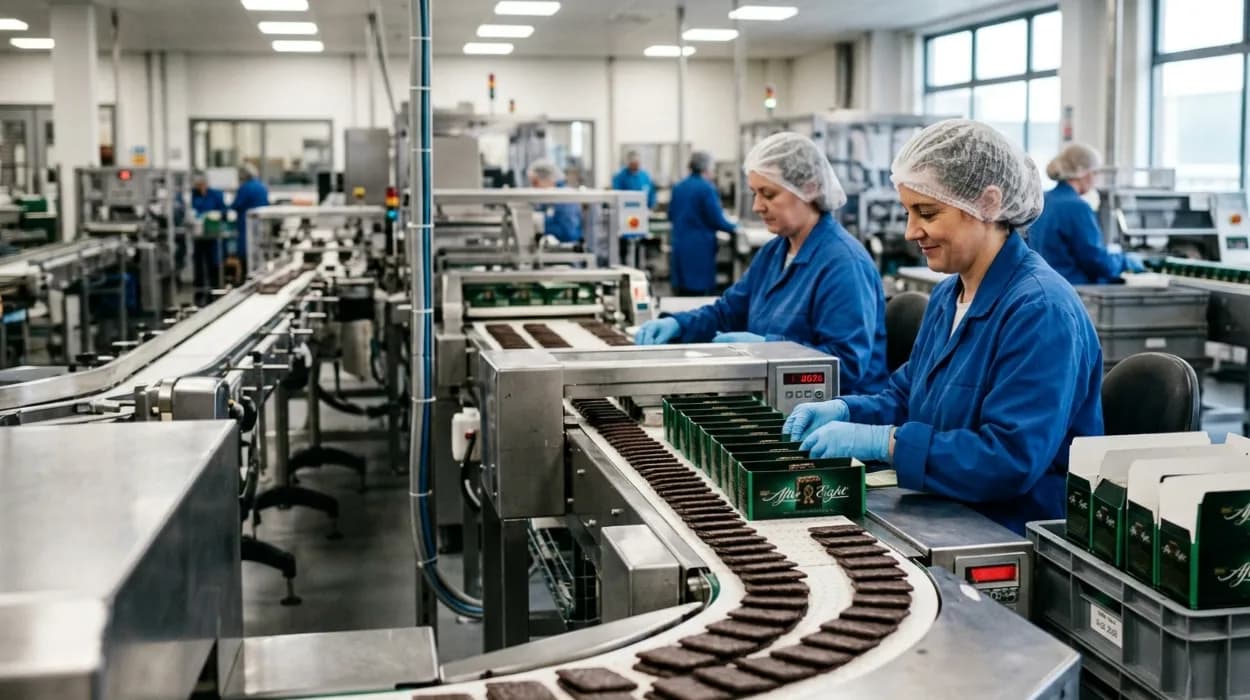
After Eight Mint Chocolate Thins are a UK confectionery brand consisting of thin peppermint fondant enrobed in dark chocolate. Created by Rowntree in 1962 and owned by Nestlé since 1988, over one billion units are manufactured annually for global distribution.
Categorization and Technical Definition
After Eight Mint Chocolate Thins represent a specialized category of sugar confectionery known as enrobed peppermint fondants. Manufactured as thin square wafers, each piece consists of a semi-liquid mint core enclosed within a shell of dark chocolate. The product operates as an after-dinner sweet designed to serve as a digestive aid and palate cleanser following evening dining.
The structural design of After Eight relies on precision geometry. Each wafer measures approximately 4 centimeters by 4 centimeters with a thickness under 5 millimeters. The dark chocolate outer layer provides mechanical rigidity while preserving a soft interior through specific enzymatic activity during storage.
Brand Identity and Architectural Elements
The visual branding of After Eight uses 4 distinctive design elements, including dark green packaging, an analog clock face motif set to 8:01 PM, individual black glassine paper sleeves, and gold foil embellishments. These visual components establish high consumer recognition across retail environments globally.
The brand operates under Nestlé’s global confectionery division. Nestlé distributes After Eight in 5 major regions, including Europe, North America, the Middle East, Asia-Pacific, and Latin America. The product remains a primary driver within the holiday and post-prandial retail sectors.
Who invented After Eight and what is its original historical background?
Confectioner Brian Sollitt invented After Eight at Rowntree Company Limited in York, England, in 1962. Sollitt formulated the mint to capture the expanding post-war British middle-class market seeking affordable luxury after-dinner confectionery for formal home entertainment hostings.
The Role of Brian Sollitt and Rowntree Company Limited
Brian Sollitt joined Rowntree Company Limited in York, North Yorkshire, at age 15 in 1950 as a confectionery worker hand-piping chocolates. Promoted to the product development laboratory in the late 1950s, Sollitt received a corporate directive to engineer a novel peppermint thin that maintained structural stability during transport while delivering a liquid interior upon consumption.
Rowntree Company Limited possessed a history in industrial cocoa processing in York. The company operated facilities capable of large-scale starch molding and chocolate enrobing. Sollitt utilized invertase enzymes to solve the technical hurdle of mass-producing liquid-filled thin chocolates without manual piping or hollow-shell injection.
Post-War Socioeconomic Drivers in 1960s Britain
The launch of After Eight in 1962 coincided with demographic shifts in post-war United Kingdom society. Rising disposable income across 3 socioeconomic groups, including urban white-collar professionals, suburban families, and expanding middle-class households, generated demand for accessible luxury products.
Prior to 1962, post-prandial mints belonged to 2 distinct retail tiers, including expensive handmade chocolates from specialized chocolatiers and basic hard-boiled mint sweets sold loose in paper bags. After Eight bridged this market gap. Rowntree positioned After Eight as an affordable luxury item priced for mainstream retail purchasing while using upscale visual cues like gold foil, dark green boxes, and clock imagery denoting late-night luxury.
How is the liquid mint fondant center inside After Eight manufactured?
The liquid center begins as a firm fondant paste made of sucrose, water, peppermint oil, and the enzyme invertase. After chocolate coating, invertase splits sucrose into soluble glucose and fructose over three days, transforming solid paste into smooth liquid.
Enzymatic Hydrolysis of Sucrose
The physical transformation of After Eight from a firm wafer into a liquid-centered confection depends on the enzymatic hydrolysis of sucrose. Sucrose ($C_{12}H_{22}O_{11}$) is a disaccharide composed of glucose and fructose monomers bound by an alpha-1,2-glycosidic bond. The enzyme invertase ($\beta$-fructofuranosidase) acts as a biological catalyst that breaks this glycosidic bond through a cleavage reaction:
$$C_{12}H_{22}O_{11} + H_2O \xrightarrow{\text{Invertase}} C_6H_{12}O_6 \text{ (Glucose)} + C_6H_{12}O_6 \text{ (Fructose)}$$
$$\text{Sucrose (Low Solubility: 200g/100mL)} \longrightarrow \text{Invert Sugar (High Solubility: 300g/100mL)}$$
During initial batch mixing, workers blend sucrose, water, glucose syrup, natural peppermint oil, and liquid invertase at controlled temperatures below 60 degrees Celsius. High temperatures denature the invertase enzyme, deactivating its catalytic capacity. The mixture forms a firm paste that mechanical extruders deposit onto starch molds or cooling belts to form thin, solid fondant squares.
Mechanical Processing and Maturation Sequence
Industrial enrobers submerge the solid fondant squares in tempered dark chocolate held at 31 degrees Celsius. The dark chocolate shell solidifies rapidly inside cooling tunnels maintained at 10 to 12 degrees Celsius, creating a moisture-proof container around the fondant core.
Once sealed within dark chocolate, the invertase enzyme breaks down the internal sucrose crystals into glucose and fructose. Because the resulting mixture of glucose and fructose (invert sugar) exhibits higher solubility in water than pure sucrose, the solid crystals dissolve into the remaining water phase. This enzymatic breakdown requires 3 days inside climate-controlled warehouses held at 18 to 20 degrees Celsius and 60 percent relative humidity, converting the solid paste into a smooth liquid fondant.
Where are After Eight mints manufactured and how has production evolved?
Production originated at the Rowntree factory in York in 1962 before relocating to Castleford, West Yorkshire, in 1970. Following Nestlé's acquisition of Rowntree in 1988 and Castleford’s 2012 closure, main production for the British market consolidated in Halifax, West Yorkshire.
Historical Production Sites
Manufacturing of After Eight began at the Rowntree industrial complex in York, England, in 1962. Rapid growth in consumer demand led Rowntree management to build a dedicated facility in Castleford, West Yorkshire, in 1970. The Castleford facility operated high-speed continuous extruders and specialized enrobing lines for 42 years.
1962 - 1970: Rowntree Industrial Complex (York, England)
1970 - 2012: Castleford Manufacturing Facility (West Yorkshire, England)
2012 - Present: Nestlé Factory Complex (Halifax, West Yorkshire, England)
In 1988, Swiss multinational corporation Nestlé acquired Rowntree Company Limited in a hostile takeover valued at £2.55 billion. Nestlé integrated After Eight into its international confectionery supply chain, introducing automated quality control imaging and high-density warehouse storage systems.
Modern Manufacturing Facilities and Consolidation
In December 2010, Nestlé announced the closure of the Castleford facility to consolidate UK confectionery operations. In 2012, Nestlé transferred all British After Eight manufacturing lines to its facility in Halifax, West Yorkshire. The Halifax plant manufactures over 1 billion individual After Eight mints each year to support UK domestic supply and export channels across 50 countries.
Nestlé also operates a production facility under Nestlé Deutschland AG in Germany. The German site manufactures regional product variations, including marzipan-filled mints and specific continental holiday assortments tailored to mainland European consumer preferences.
What are the ingredient specifications and dietary certifications of After Eight?
After Eight consists of dark chocolate, sugar, glucose syrup, natural peppermint oil, and invertase enzyme. Originally dairy-free, Nestlé introduced butterfat in 2002 to reduce chocolate bloom, rendering the product non-vegan, though it maintains Orthodox Union Kosher Dairy certification.
Chemical and Formulation Specifications
The standard recipe for After Eight Mint Chocolate Thins uses 6 core ingredients, including sugar, cocoa mass, cocoa butter, butterfat, natural peppermint flavoring, and invertase enzyme. The dark chocolate enrobing layer contains a minimum cocoa solids content of 50 percent, providing bitter contrast to the sweet fondant center. The peppermint flavor derives from 100 percent natural steam-distilled Mentha x piperita peppermint oil.
The addition of butterfat represents a significant change in the formulation history. Between 1962 and 2002, After Eight dark chocolate thins contained no dairy ingredients. In 2002, Nestlé added butterfat to recipes at select European factories to prevent chocolate bloom—a structural defect where fat or sugar crystals migrate to the surface, creating a dull white film. By 2009, Nestlé added butterfat across all production lines globally.
Dietary Certifications and Allergen Profile
The incorporation of butterfat altered the allergen profile and suitability of After Eight across 3 distinct consumer dietary categories:
- Vegan Diets: The product is not vegan due to milk-derived butterfat.
- Vegetarian Diets: The product remains suitable for lacto-vegetarians as it contains no animal-derived rennet or gelatin.
- Kosher Standards: The product holds Kosher Dairy certification from the Orthodox Union.
What product variations, flavors, and seasonal editions does After Eight produce?
The core product line includes Thin Mints in dark and milk chocolate, alongside brand extensions like Bitesize, Straws, Delights, and Bar formats. Limited flavor editions include Orange and Mint, Strawberry and Mint, Gin and Tonic, and seasonal festive holiday items.
Core Line Extensions and Formats
Nestlé expanded the After Eight brand beyond original thin squares into multiple formats designed for distinct retail consumption occasions. The core portfolio includes 5 permanent format types, such as Thin Mints, Bitesize, Straws, Delights, and Multipack Bars.
The Bitesize product line underwent multiple corporate rebrandings. Originally introduced by Rowntree as Mintola, Nestlé renamed the item Mint Munchies in 1995 before incorporating the product into the After Eight brand umbrella in 2006. Bitesize consists of thick, square dark chocolate shells filled with mint fondant, eliminating the individual paper sleeve requirement.
Limited Flavor Variants and Seasonal Items
Nestlé develops seasonal flavor variants to capture retail sales during spring and autumn promotional windows. The company uses 5 limited-edition flavor infusions, including Orange and Mint, Strawberry and Mint, Mint and Blood Orange, Lemon Sorbet, and Gin and Tonic. These variations blend fruit or botanical essences into the standard peppermint fondant core.
For holiday retail periods, Nestlé produces novelty shapes, including 125g hollow mint-flavored dark chocolate Santa Claus figures for Christmas and peppermint-infused dark chocolate Easter Bunnies. In Germany, Nestlé Deutschland AG manufactures After Eight Marzipan, combining almond paste with mint fondant enrobed in dark chocolate. Retail gift assortments, including the 199g Selection Box, the 300g Classic Box, the 550g Variety Sharing Bag, and the 81g Mini Eggs, serve distinct consumer gift-giving markets.
How does After Eight impact the global confectionery market and evening dining culture?
After Eight established the modern after-dinner mint sector by bridging premium positioning with accessible grocery pricing. Producing over one billion mints annually across international markets, the brand influences retail packaging design, enzyme-based manufacturing techniques, and formal post-prandial British hospitality traditions.
Establishing the Post-Prandial Confectionery Sector
The commercial introduction of After Eight created the modern post-prandial (after-dinner) category within mass-market retail channels. Prior to 1962, dark chocolate mints were predominantly high-cost items sold in specialized confectionery shops. Rowntree introduced high-speed enrobing and enzyme maturation, making upscale dark chocolate mints available across general grocery retail networks.
The commercial success of After Eight prompted competing confectionery manufacturers to launch equivalent products. Notable private-label and brand competitors include 3 major market equivalents, such as Royal Mints produced by Halloren, Mint Nights distributed by Poundland, and historic lines like Red Tulip After Dinner Mints in Australia.
Influence on British Hospitality and Culinary Applications
After Eight became integrated into late 20th-century British dining traditions. The product featured in television marketing campaigns reinforcing formal dinner party etiquette, establishing the standard practice of serving dark chocolate peppermint thins alongside coffee at the conclusion of a meal.
Beyond direct consumption, After Eight influences cocktail mixology and dessert preparation. In beverage operations, the "After Eight Shooter" is a layered cocktail combining equal parts Crème de Cacao, Crème de Menthe, and Baileys Irish Cream to emulate the flavor profile of the chocolate thin. Commercial food processors also incorporate After Eight into chilled desserts, including mint chocolate mousses, ice cream tortes, and chocolate biscuits.
Through its combination of enzymatic processing, distinct structural packaging, and targeted socio-cultural positioning, After Eight remains an essential benchmark within global sugar and chocolate confectionery manufacturing.
FAQS
Who invented After Eight mints?
After Eight was created by confectioner Brian Sollitt at Rowntree in York, England, and launched commercially in 1962.