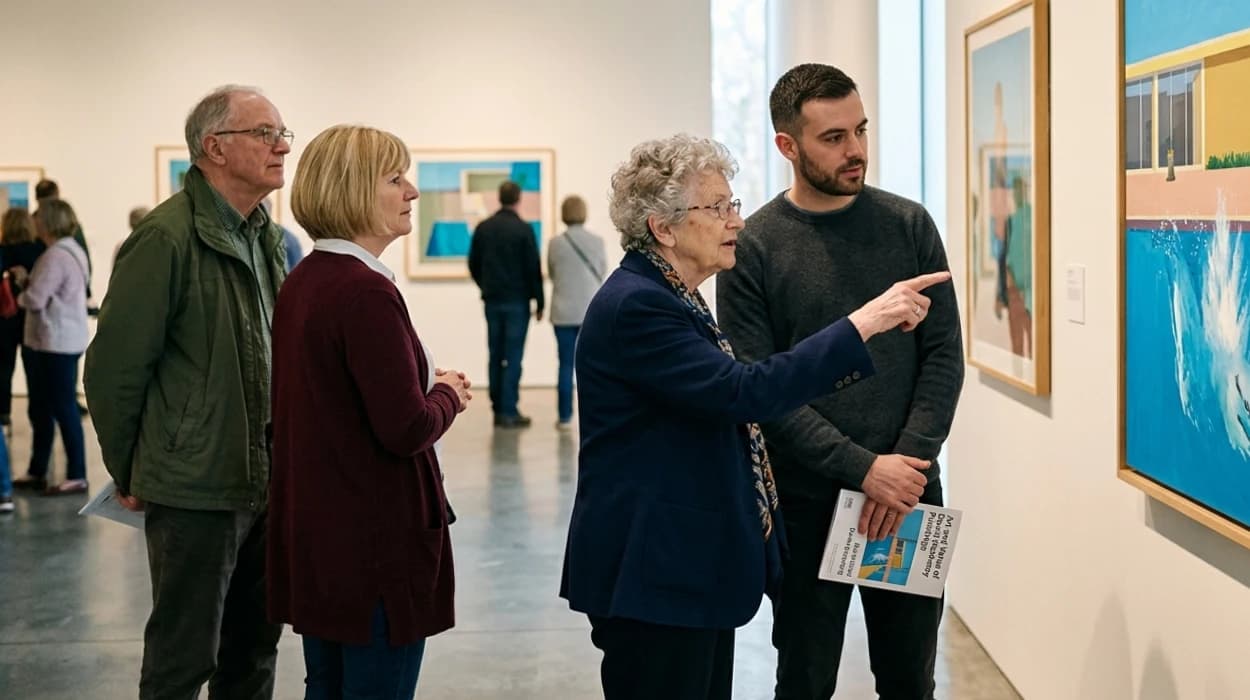
David Hockney is a central figure of the 20th-century Pop Art movement and a pioneer in contemporary figurative painting. Over a career spanning more than six decades, his paintings documented modern life, landscapes, and human relationships with an evolving array of materials, from oils and acrylics to digital software. This comprehensive guide by Bolton Today examines the stylistic evolution, technical mechanisms, and global commercial impact of David Hockney paintings, serving as a definitive resource for collectors, historians, and art enthusiasts across Greater Manchester, Bolton, and the wider international community.
What Is the Art Historical Significance of David Hockney Paintings?
David Hockney paintings represent a critical evolution in contemporary art by bridging British Pop Art with American West Coast modernism. His work rejected mid-century abstraction in favor of figuration, introducing vibrant color theories and pioneering technical experiments with industrial mediums and digital screens.
Definition and Origins
David Hockney paintings refer to the complete body of two-dimensional visual works produced by the British artist from his student days at the Royal College of Art in 1959 until his death in June 2026. Born in Bradford, West Riding of Yorkshire, in 1937, his early work emerged during the rise of British Pop Art. His paintings quickly spread through northern regional collections, reaching institutions like the Bolton Museum and Art Gallery, which actively collects mid-century British works on paper and prints. Unlike contemporaries who focused purely on commercial consumer imagery, his works integrated deeply personal themes, including homoeroticism, domestic intimacy, and autobiographical narratives.
Historical Context and Evolution
The trajectory of his paintings follows his geographical and technical movements across three distinct regions. His early career in London during the early 1960s was characterized by expressive, structural canvases like A Grand Procession of Dignitaries in the Semi-Egyptian Style (1961). His relocation to Los Angeles, California, in 1964 initiated his most famous stylistic phase, capturing the light, geometry, and consumer abundance of Southern California. In the 2000s, his return to East Yorkshire shifted his focus toward massive, multi-canvas monumental landscapes painted en plein air (outdoors), capturing seasonal changes with high-keyed colors that resonated strongly with northern British landscape traditions celebrated by art communities in Yorkshire and Lancashire towns like Bolton.
Which Are the Most Influential David Hockney Paintings and Where Are They Located?
The most influential David Hockney paintings include his mid-century California swimming pool series, his monumental double portraits of the 1970s, and his late-career multi-canvas Yorkshire landscapes. These works are permanently housed across major public institutions in the United Kingdom and the United States.
The California Swimming Pool Series
His swimming pool paintings are celebrated for their formal investigation of depicting moving water, glass, and artificial light. A Bigger Splash (1967), an acrylic painting on canvas measuring 95 by 96 inches, represents the peak of this exploration. The composition uses flat planes of color, a strong graphic border, and sharp geometric diagonals to frame a dynamic explosion of water. While local northern industrial municipal galleries—including those in Bolton, Manchester, and Salford—primarily feature his early graphic prints, the major canvas paintings remain anchored in global metropolises. Examples of other works in this thematic category include:
- California Art Collector (1964)
- Peter Getting Out of Nick's Pool (1966), located at the Walker Art Gallery in Liverpool
- The Splash (1966), which sold privately to a corporate collector
The Large-Scale Double Portraits
Between 1968 and 1977, he painted a series of near-life-sized double portraits of his close friends, lovers, and creative peers. These compositions explore human psychology, domestic spaces, and the visual tension between couples. Mr. and Mrs. Clark and Percy (1970–1971), an acrylic on canvas measuring 84 by 120 inches and held by the Tate Gallery in London, depicts fashion designer Ossie Clark and textile designer Celia Birtwell in their Notting Hill apartment. The painting reverses traditional portrait conventions by bathing the background in natural window light while leaving the figures in soft shadow. Examples of other double portraits include:
- American Collectors (Fred and Marcia Weisman) (1968), held by the Art Institute of Chicago
- Christopher Isherwood and Don Bachardy (1968), held in a private foundation
- Henry Geldzahler and Christopher Scott (1969), held by the Metropolitan Museum of Art in New York
The Yorkshire Landscapes
In the late 1990s and 2000s, he returned to the landscapes of his youth, producing large-scale representations of the Yorkshire Wolds. Bigger Trees Near Warter (2007) is his largest single work, measuring 180 by 480 inches. Composed of 50 individual canvases painted outdoors over a period of six weeks, the painting depicts a copse of trees before the arrival of spring. He donated the entire work to the Tate Gallery in 2008, where it frequently tours regional UK partners to inspire art students from industrial towns like Bolton. Examples of other landscape works include:
- Garrowby Hill (1998), held by the Museum of Fine Arts, Boston
- The Road to York through Sledmere (1997), held in a private collection
- Woldgate Woods, 24, 25, and 26 October 2006 (2006), held in a private collection
What Technical Materials and Processes Did David Hockney Utilize?
David Hockney paintings utilized an evolving sequence of technical materials, progressing from traditional oil paints to fast-drying industrial acrylics in the 1960s, before adapting optical devices, multi-camera photographic joins, and multi-touch digital tablet screens for landscape painting.
The Transition to Acrylic Paint
In 1964, he abandoned traditional oils in favor of newly developed liquid acrylic paints, specifically selecting brands like Liquitex. Acrylics offered a rapid drying time, which allowed him to apply precise, flat layers of color without bleeding or blending. This chemical property was essential for capturing the hard-edged geometric architecture of Los Angeles homes and the sharp contrasts of bright sunlight. He applied the paint using rollers, masking tape, and fine camel-hair brushes to achieve smooth, untextured surfaces that matched the slick, manufactured aesthetic of mid-century suburban life.
The Integration of Photography and Optical Devices
Photography served as both a preparatory tool and a direct medium throughout his painting career. For complex works like Portrait of an Artist (Pool with Two Figures) (1972), he staged hundreds of photographs using a Pentax camera at a villa near Saint-Tropez to gather visual data on light refractions and human forms. In the late 1990s, he conducted exhaustive historical research into the use of optical aids by Old Masters, concluding that artists since the Renaissance relied on mirrors and lenses. He subsequently integrated the camera lucida (an optical instrument that projects an image of an object onto paper) into his own portrait practice, executing over 200 highly precise drawings between 1999 and 2001, a technique analyzed widely in northern art academies from Leeds to the University of Bolton.
Digital Screen Painting Mechanisms
In 2008, he adopted digital screens as a primary canvas, starting with the iPhone before upgrading to the iPad in 2010. Using applications such as Brushes and later custom-built software, he painted directly on LED screens using his fingers and stylus pens. The digital process eliminated drying times entirely, allowed for instant color switching, and let him record the chronological layers of his brushstrokes as animations. These digital drawings were subsequently printed as large-scale, limited-edition ink-jet prints on archival paper. Examples of his major digital cycles include:
- The Arrival of Spring in Woldgate, East Yorkshire in 2011 (2011), a series of 49 iPad drawings
- A Year in Normandie (2020–2021), a continuous 295-foot panoramic digital frieze
How Have David Hockney Paintings Performed at Global Art Auctions?
David Hockney paintings command some of the highest financial values in the global art market, driven by limited supply, institutional validation, and historical rarity. His primary market benchmark occurred in 2018 when a signature canvas set a historic record at public auction.
The Historic 2018 Record Sale
On November 15, 2018, at Christie's auction house in New York City, his 1972 masterwork Portrait of an Artist (Pool with Two Figures) sold for $90.3 million. The transaction established a world record at that time for the most expensive artwork by a living artist sold at public auction. The painting, an acrylic on canvas measuring 84 by 120 inches, surpassed its un-guaranteed estimate of $80 million following a bidding war, highlighting the intense commercial demand for his definitive 1970s output.
Secondary Market Performance Data
The market value of his paintings has risen consistently since his first major gallery representation by John Kasmin in London in 1962. While regional UK collectors in locations like Bolton generally trade in his multi-edition lithographs and etchings, his original canvases remain centralized in high-value international auction house sessions. Financial records demonstrate that works from his mid-career California and landscape periods achieve premium prices at international auction houses, including Christie's, Sotheby's, and Phillips. Examples of notable public auction sales include:
- Pacific Coast Highway and Santa Monica (1990), an oil on canvas that sold for $28.45 million at Sotheby's New York on May 16, 2018
- The Splash (1966), an acrylic on canvas that sold for £23.1 million ($29.8 million) at Sotheby's London on February 11, 2020
- Woldgate Woods, 24, 25, and 26 October 2006 (2006), which realized $11.71 million at Sotheby's New York on November 17, 2016
- Beverly Hills Housewife (1966), an acrylic on canvas that sold for $7.92 million at Christie's New York on May 13, 2009
What Is the Cultural Legacy and Future Relevance of His Artwork?
The cultural legacy of David Hockney paintings rests on their democratization of queer themes, their structural reinvention of human perspective, and their early embrace of digital technology. His paintings continue to shape contemporary figurative art education and museum curation globally.
Legal and Social Impact
His early 1960s paintings were pioneering acts of cultural visibility. Produced at a time when homosexuality remained criminalized in England and Wales under the Offences Against the Person Act 1861, works like We Two Boys Together Clinging (1961) and Cleaning Teeth, Early Evening (1962) openly explored same-sex desire. By using code, quotes from poet Walt Whitman, and domestic tableaus, his paintings brought queer identity into mainstream British galleries years before the partial decriminalization brought by the Sexual Offences Act 1967, sparking vital cultural shifts across northern industrial communities from Bradford to Bolton.
Influence on Contemporary Figurative Art
His rejection of pure abstraction during the height of Minimalism preserved and updated the traditions of figurative painting for subsequent generations. His emphasis on line, vibrant palettes, and alternate perspective systems directly informed the methodologies of 21st-century figurative painters. Examples of contemporary artists whose work reflects his compositional strategies include:
- African-American portraitist Kehinde Wiley
- British painter Peter Doig
- American figurative artist Jonas Wood
Posthumous Institutional Status
Following his death on June 11, 2026, the historical positioning of his paintings has shifted into a definitive legacy phase. Global institutions, along with domestic British venues like the Bolton Museum and regional galleries across the North West, continue to stage retrospective exhibitions and educational workshops dedicated to analyzing his formal contributions to modern art history. His works are permanently preserved in the foundational collections of the world's leading museums, ensuring their ongoing accessibility for academic research, digital archiving, and public exhibition. Examples of world-class institutions holding large quantities of his paintings include:
- The Tate Modern and Tate Britain in London
- The Museum of Modern Art (MoMA) in New York City
- The Los Angeles County Museum of Art (LACMA)
- The Centre Pompidou in Paris
FAQS
Who was David Hockney?
David Hockney was a British painter, printmaker, photographer, and digital artist widely regarded as one of the most influential figures in contemporary art. He became associated with the Pop Art movement during the 1960s and later gained international recognition for his portraits, landscapes, and innovative use of digital technology.