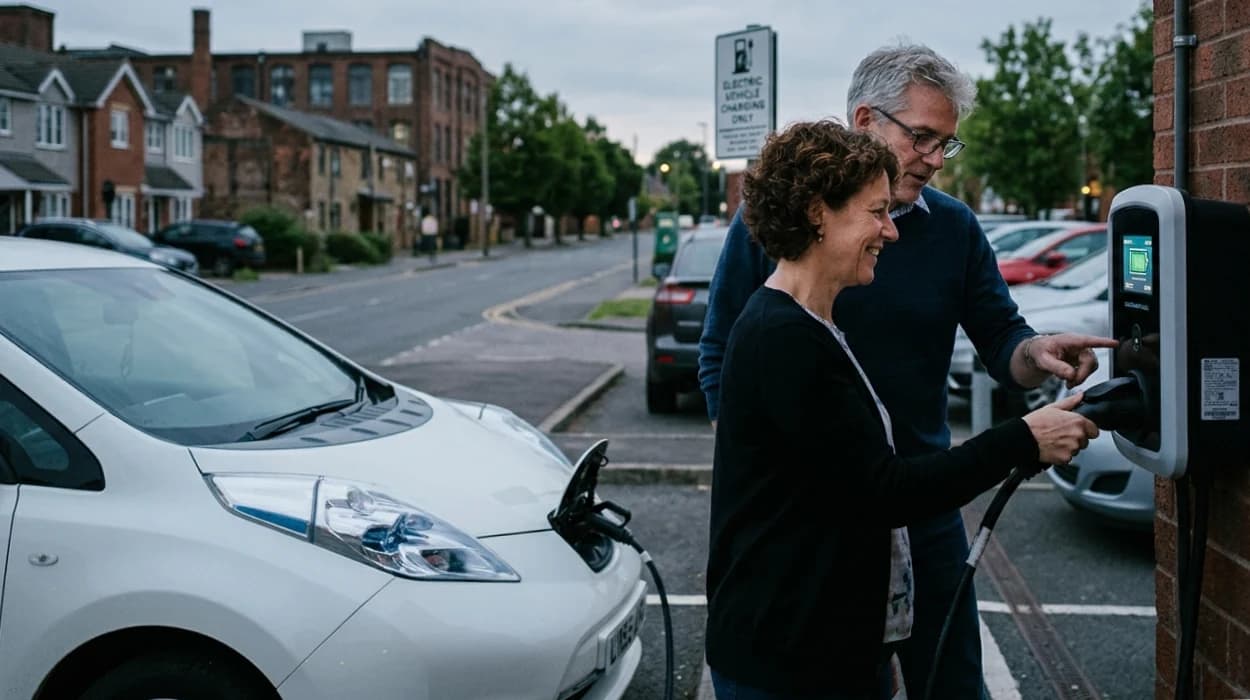
An electric vehicle (EV) is an automobile powered partially or entirely by electricity stored in rechargeable batteries. Electric motors replace internal combustion engines, drawing electrical energy from high-voltage battery packs to generate instant torque and propulsive motion without tailpipe emissions.
An electric vehicle is an advanced transportation system designed to convert chemical energy into kinetic propulsion. The core automotive system relies on a lithium-ion battery array, an electronic inverter, and an alternating current (AC) or direct current (DC) electric motor. Internal combustion engines generate mechanical power through controlled fossil fuel explosions. Electric vehicles eliminate thermodynamic combustion cycles entirely, using electromagnetic induction to turn drive axles.
The automotive industry categorizes electric transport into three distinct structural classifications: battery electric vehicles (BEVs, such as the Tesla Model Y and Nissan Leaf), plug-in hybrid electric vehicles (PHEVs, such as the Mitsubishi Outlander PHEV and BMW 330e), and fuel cell electric vehicles (FCEVs, such as the Toyota Mirai and Hyundai Nexo). Battery electric vehicles operate exclusively on stored grid electricity. Plug-in hybrid electric vehicles combine a smaller battery pack with a secondary internal combustion engine. Fuel cell electric vehicles utilize compressed hydrogen gas passed through an onboard fuel cell stack to generate electricity.
When a driver depresses the accelerator pedal, the central vehicle control unit sends a signal to the power electronics inverter. The inverter converts direct current electricity from the high-voltage traction battery into three-phase alternating current electricity. This alternating current enters the electric motor stator, creating a rotating magnetic field that forces the internal rotor to turn. The motor rotor turns the reduction transmission, which transfers rotational force directly to the wheels.
Energy management systems optimize vehicle efficiency during motion. Regenerative braking systems reverse motor polarity during deceleration, transforming the electric motor into a generator. The kinetic energy generated by stopping converts back into electrical current, which flows back into the traction battery array. This process reduces mechanical brake wear and recovers up to 70% of kinetic deceleration energy.
The mechanical simplicity of electric powertrains alters manufacturing and operating parameters. Electric motors feature single moving drive assemblies compared to over 2,000 moving components in internal combustion engines. Electric powertrains deliver maximum rotational torque at zero revolutions per minute, eliminating multi-gear transmissions. This mechanical configuration eliminates direct emissions of greenhouse gases, nitrogen oxides, and fine particulate matter during vehicle operation.
How Did Electric Vehicle Technology Evolve Historically?
Electric vehicle development began in the 1830s when Scottish inventor Robert Anderson created the first crude electric carriage. Late nineteenth-century advancements led to commercial fleets, but cheaper petroleum reserves and mass assembly of gasoline vehicles temporarily halted market expansion.
Early electrification experimenters built non-rechargeable battery systems during the initial phase of industrial electric design. In 1832, Scottish inventor Robert Anderson constructed an early motor carriage powered by primary galvanic cells. In 1859, French physicist Gaston Planté invented the lead-acid battery, enabling secondary rechargeable electrical storage for mobile applications. In 1881, French engineer Gustave Trouvé demonstrated an electric tricycle at the International Exhibition of Electricity in Paris, marking the first human-carrying electric road transport test.
Commercial production established electric vehicles as dominant urban transport vehicles during the late nineteenth century. In 1890, American chemist William Morrison built a six-passenger electric wagon capable of 14 miles per hour in Des Moines, Iowa. In 1897, the Pope Manufacturing Company established the Samuel’s Electric Vehicle Company fleet in New York City, deploying 12 commercial hansom cabs. Electric taxicabs offered quiet operation, absence of exhaust fumes, and instant starting mechanisms compared to hand-cranked gasoline engines or horse-drawn carriages.
The market share of electric cars peaked in 1900, accounting for 38% of total automobiles registered in the United States, compared to 22% for gasoline cars and 40% for steam cars. Automobile manufacturers produced four prominent early luxury electric models: the Detroit Electric, the Baker Electric, the Columbia Victoria, and the Studebaker Electric. However, three key industrial developments disrupted electric car dominance between 1908 and 1920:
- Henry Ford implemented mass assembly production line techniques for the Model T gasoline car in 1908, reducing vehicle purchasing costs by 60%.
- Charles Kettering invented the electric self-starter motor in 1911, removing dangerous manual hand cranks from internal combustion engines.
- Discovery of extensive petroleum fields in Texas reduced gasoline fuel costs across global supply chains.
By 1935, commercial electric passenger car manufacturing ceased entirely across North America and Europe. Internal combustion vehicles dominated global road infrastructure for six decades. Environmental regulatory mandates restarted electric drivetrain engineering in the late twentieth century. In 1990, the California Air Resources Board (CARB) enacted the Zero-Emission Vehicle (ZEV) mandate, requiring major automobile manufacturers to produce zero-emission cars to maintain California market access.
General Motors developed the EV1 in 1996 as a response to California regulatory requirements. The EV1 introduced lead-acid and nickel-metal hydride battery packs paired with aerodynamic body construction. In 1997, Toyota released the Prius in Japan, establishing mass-market hybrid powertrain commercialization. In 2008, Tesla Motors released the Roadster, proving that high-density lithium-ion battery cells could power high-performance long-range production passenger cars. Major global car manufacturers subsequently transitioned capital expenditure toward dedicated electric vehicle production platforms.
What Are the Key Components of an Electric Vehicle?
An electric vehicle consists of four core engineering systems: a high-voltage lithium-ion traction battery, an electric traction motor, an electronic power inverter, and an onboard charger. These integrated components convert chemical energy into kinetic energy to drive the wheels.
The traction battery pack forms the heaviest, most expensive component within an electric vehicle platform. The pack contains individual lithium-ion battery cells grouped into modules, connected in series and parallel configurations to supply operating voltages ranging from 400 volts to 800 volts. Automotive manufacturers utilize three main battery cell format architectures: cylindrical cells (such as the 2170 and 4680 formats used by Tesla), prismatic cells (such as those manufactured by CATL and BYD), and pouch cells (such as those produced by LG Energy Solution and SK On).
Chemical compositions inside cell cathodes dictate energy density, lifespan, and safety parameters. Manufacturers deploy three primary cathode battery chemistry types:
- Lithium Nickel Manganese Cobalt Oxide (NMC): Provides high energy density for long-range vehicles, exemplified by the Hyundai Ioniq 5 and Volkswagen ID.4.
- Lithium Iron Phosphate (LFP): Provides high thermal stability, longer cycle life, and lower manufacturing costs without cobalt requirements, exemplified by standard range Tesla Model 3 and BYD Atto 3 units.
- Lithium Nickel Cobalt Aluminum Oxide (NCA): Delivers high specific energy outputs for performance vehicles, exemplified by premium Mercedes-Benz EQ series variants.
The Battery Management System (BMS) acts as the primary computational controller for the battery pack. The BMS continuously monitors individual cell voltages, state of charge (SoC), thermal parameters, and state of health (SoH). If temperatures exceed pre-set safety thresholds, the BMS activates active liquid cooling loops containing a mixture of water and ethylene glycol to prevent thermal runaway reactions.
The electric traction motor converts supplied electrical power into mechanical torque. Automotive manufacturers deploy two primary motor architecture designs: permanent magnet synchronous motors (PMSM) and AC induction motors. Permanent magnet synchronous motors deliver high energy efficiency and high power density by placing neodymium magnets inside the rotor assembly. AC induction motors utilize electromagnetic induction without permanent magnets, reducing raw material dependence on rare earth elements.
The power electronics module contains the inverter, direct current to direct current (DC-DC) converter, and vehicle control unit. The inverter uses silicon carbide (SiC) or insulated-gate bipolar transistor (IGBT) semiconductors to switch high-voltage current thousands of times per second. The DC-DC converter steps down 400-volt or 800-volt power from the traction battery to 12 volts or 48 volts to supply auxiliary systems, including steering actuators, infotainment screens, LED lighting, and safety sensors.
The onboard charger handles incoming alternating current during Level 1 and Level 2 charging sessions. The onboard charger converts AC electricity from local electrical grids into direct current to charge internal battery cells. Thermal management systems route liquid coolant through the onboard charger, inverter, electric motor, and battery pack to maintain operating temperatures between 15°C and 35°C.
How Does the Electric Vehicle Charging Process Function?
Electric vehicle charging supplies electrical current from external grid infrastructure to the vehicle’s internal battery storage. The system operates across three standardized power levels using standardized physical connectors to control current flow, temperature thresholds, and charging speeds safely.
Charging infrastructure transfers electrical energy through standardized power delivery levels established by international engineering organizations such as the International Electrotechnical Commission (IEC) and Society of Automotive Engineers (SAE). Grid operator policies and equipment capabilities define four standardized charging bands:
- Standard Charging (Level 1 / Slow): Supplies power output between 3kW and 7.9kW AC. This level utilizes standard domestic single-phase electrical circuits, adding 10 to 25 miles of range per hour. Full charging requires 8 to 16 hours.
- Standard Plus Charging (Level 2 / Fast): Supplies power output between 8kW and 49kW AC. This level uses dedicated home wallbox units or three-phase commercial chargers operating at 32 amps, adding 25 to 60 miles of range per hour. Full charging requires 3 to 6 hours.
- Rapid Charging (Level 3 DC): Supplies direct current power output between 50kW and 149kW DC. Rapid chargers bypass onboard vehicle chargers to supply direct current straight to traction battery terminals, charging batteries to 80% capacity in 30 to 45 minutes.
- Ultra-Rapid Charging (Level 3 High-Power DC): Supplies direct current power output from 150kW up to 400kW DC. Ultra-rapid chargers add up to 200 miles of range in 10 to 15 minutes, utilizing liquid-cooled charging cables to prevent cable overheating.
Physical charging connectors vary by geographical market and power output levels. Charging networks rely on four primary physical connector standards:
- Type 2 (Mennekes): The mandated single-phase and three-phase AC connector standard across the United Kingdom and European Union.
- Combined Charging System 2 (CCS Combo 2): The standard European DC fast-charging plug, incorporating two additional direct-current pins below a standard Type 2 socket.
- CHAdeMO: A Japanese direct-current fast-charging standard utilized by first-generation Nissan Leaf and Mitsubishi Outlander vehicles.
- North American Charging Standard (NACS / SAE J3400): A unified AC/DC connector developed by Tesla, adopted as the North American industry standard.
Digital handshakes control energy flow when a user inserts a charging connector into an electric vehicle inlet socket. The vehicle control unit and charging station communicate via power line communication (PLC) protocols defined by the ISO 15118 international standard. The station verifies electrical ground connection integrity, assesses battery temperature, and establishes maximum allowable current parameters.
Once safety checks pass, high-voltage contactors close inside the vehicle junction box, permitting electrical current flow. Charging speeds follow a non-linear charging curve managed by the vehicle BMS. Current flows at maximum allowable speeds between 10% and 80% state of charge. Above 80% capacity, the BMS automatically throttles electrical current to prevent lithium plating, cell degradation, and excess internal heat generation.
What Real-World Examples Demonstrate Electric Vehicle Capabilities?
Commercial electric vehicles demonstrate high range capabilities, rapid acceleration, and zero direct tailpipe emissions across multiple transport sectors. Leading production models prove that battery electric architectures match or exceed internal combustion vehicle performance metrics across passenger and freight applications.
Automotive manufacturers produce battery electric vehicles across all commercial transportation market segments. Passenger cars, light commercial vans, heavy freight trucks, and municipal transit buses demonstrate the operational capabilities of electric mobility platforms.
In the passenger vehicle segment, the Tesla Model Y serves as an example of mass-market battery electric vehicle engineering. The Model Y Long Range variant features a dual-motor all-wheel-drive system powered by a 75 kWh battery pack, achieving an official WLTP driving range of 331 miles per charge. In 2025, British motorists registered 24,298 Tesla Model Y vehicles, making it the highest-selling electric vehicle model in the United Kingdom.
The Audi Q4 e-tron represents the mid-size premium crossover segment. Built on the Volkswagen Group MEB modular electric drive matrix, the Q4 e-tron incorporates a 77 kWh net battery capacity supplying a rear-mounted or dual-motor setup. The vehicle delivers 320 miles of range per charge and recorded 14,433 UK registrations in 2025.
In the commercial light goods sector, the Ford E-Transit provides zero-emission logistics capability for commercial fleet operators. The E-Transit features a 68 kWh usable battery pack driving a 198 kW rear electric motor, delivering a maximum payload capacity of 1,758 kilograms and an operational range of 196 miles. Commercial operators deploy the E-Transit for middle-mile and last-mile urban delivery routes, reducing fleet fuel costs and avoiding clean air zone entry charges.
Heavy freight transport demonstrates high-power battery technology capabilities through models like the Volvo FH Electric. Designed for regional heavy transport, the Volvo FH Electric utilizes three electric motors generating 490 kW of continuous power paired with a 540 kWh battery pack array. The 44-tonne gross combination weight truck achieves a driving range of up to 186 miles on a single charge and accepts 250 kW fast DC charging, enabling drivers to recharge battery capacity during mandatory driver rest breaks.
Municipal public transit networks deploy battery electric buses to reduce urban air pollution. The Wrightbus Electroliner double-deck bus, manufactured in Ballymena, Northern Ireland, operates across UK public transit fleets. Powered by a 454 kWh battery pack, the Electroliner delivers an operational range of 200 miles on a single charge while carrying up to 95 passengers without generating tailpipe nitrogen oxide emissions.
What Do Key Statistics Reveal About Electric Vehicle Adoption in the UK and Bolton?
Electric vehicle market share in the United Kingdom reached 23.4% of total new car registrations in 2025, with over 2,000,000 fully electric cars operating nationwide. Local infrastructure projects in Bolton support this expansion through £2.3 million in targeted public charging investment.
Data published by the Society of Motor Manufacturers and Traders (SMMT) and the Department for Transport (DfT) tracks national electric vehicle adoption trends across the United Kingdom:
- UK motorists purchased 473,348 new fully electric battery vehicles (BEVs) during 2025, representing a 23.9% year-on-year increase compared to 2024 sales volume.
- Fully electric cars accounted for 23.4% of all new car registrations nationwide in 2025, up from 18.7% market share in 2024.
- Over 2,000,000 fully electric cars operate on UK roads, representing approximately 5.9% of the total 34 million UK passenger car fleet.
- The second-hand electric vehicle market expanded, recording nearly 275,000 used battery electric car transactions in 2025, representing a 45.7% annual growth rate.
- Public charging infrastructure across the United Kingdom reached 121,171 public EV chargers operating across 46,731 locations by June 2026.
- Ultra-rapid charging connectors rated at 150kW or higher expanded by 40% year-on-year, reaching 13,996 active chargers across the national transport grid.
Regional charging distribution maps highlight infrastructure deployment metrics across local administrative areas. The North West of England contains 8,677 public EV chargers. Within Greater Manchester, local council authorities coordinate targeted infrastructure funding to expand charging access for residents without dedicated off-street driveways.
Bolton Council launched its official Electric Vehicle Infrastructure Strategy to address historical charging deficits across the borough. Bolton had fewer than 80 public charge points, mostly situated in central town parking structures. To support the Greater Manchester target of achieving net-zero carbon status by 2038, Bolton Council secured £2.3 million in capital funding through the Local Electric Vehicle Infrastructure (LEVI) scheme and the City Region Sustainable Transport Settlement.
Bolton Council manages its infrastructure deployment across three defined strategic implementation phases:
- Foundation Phase (2025–2026): Installs 150 new public charging points across priority areas and conducts resident pilots for home-connected cable channels. Bolton Council partnered with Kerbo Charge to pilot recessed pavement cable channels, allowing terraced house residents to run home-metered charging cables safely beneath public footpaths.
- Expansion Phase (2026–2027): Expands charging installation to deliver at least 400 public charging points distributed across all 20 Bolton electoral wards, prioritizing high-density residential neighborhoods.
- Optimisation Phase (2027–2028): Integrates local renewable power generation, smart energy monitoring, and rapid charging hubs near key commercial transport corridors, including the A666 St Peters Way and Bolton Interchange transport hubs.
What Are the Future Environmental and Economic Implications of Electric Vehicles?
Electric vehicles eliminate local air pollutants, lower lifecycle greenhouse gas emissions, and reduce total cost of ownership for vehicle operators. Accelerating global adoption drives grid modernization, battery recycling industries, and government policies targeting carbon neutrality by mid-century.
The transition from fossil-fuel mobility to electrified transport alters urban environmental parameters and macroeconomic energy systems. Internal combustion transport emits three primary toxic exhaust compounds: tailpipe nitrogen oxides ($NO_x$), fine particulate matter ($PM_{2.5}$ and $PM_{10}$), and volatile organic compounds (VOCs). Replacing internal combustion engines with electric vehicles removes direct tailpipe emissions, improving urban air quality metrics in population centers.
Lifecycle greenhouse gas emissions analysis evaluates environmental impacts across raw material extraction, manufacturing, vehicle usage, and end-of-life processing. Manufacturing a battery electric vehicle generates higher initial carbon emissions than producing a conventional car due to energy-intensive battery cell production. However, superior electric motor efficiency compensates for manufacturing carbon debts within 12,000 to 20,000 miles of operation under average electrical grid generation mixes.
As national electrical grids shift from fossil fuel generation to renewable sources, the operational emissions of electric vehicles decline automatically. Electricity generation in the United Kingdom relies on zero-carbon sources for over 50% of total grid output, including offshore wind, solar, and nuclear power stations. Under current UK grid energy mixes, a battery electric car produces 70% fewer lifetime carbon dioxide ($CO_2$) emissions than an equivalent petrol vehicle.
Economic implications center on total cost of ownership (TCO) advantages for consumers and fleet operators. Electric vehicles feature lower energy and maintenance expenditure profiles:
- Energy costs: Charging an electric vehicle on off-peak domestic overnight electricity tariffs costs approximately 2p to 4p per mile, compared to 13p to 17p per mile for petrol passenger cars.
- Servicing costs: Electric vehicles require fewer brake pad replacements due to regenerative braking, no oil changes, and no exhaust spark plug replacements, cutting routine servicing costs by 40%.
National energy grids adapt infrastructure to manage increased electrical demand driven by vehicle fleet electrification. Smart charging algorithms schedule vehicle charging sessions during overnight off-peak hours when grid demand drops. Vehicle-to-Grid (V2G) technology enables bidirectional power transfer, converting parked electric vehicle fleets into distributed battery storage networks. During peak demand periods, V2G systems feed electrical current back into local electricity distribution grids, stabilizing voltage frequencies and storing excess renewable energy generation.
Industrial recycling ecosystems scale up processing plants to harvest critical raw materials from end-of-life traction batteries. Closed-loop hydrometallurgical recycling facilities extract up to 95% of nickel, cobalt, lithium, and copper from degraded battery packs. Recycled minerals re-enter battery cathode manufacturing plants, reducing primary mining reliance and lowering production costs for future electric vehicle models.
Regulatory policies accelerate global transition timelines. The UK government's Zero Emission Vehicle (ZEV) mandate enforces increasing annual zero-emission sales percentages for vehicle manufacturers through 2035. Municipal councils, including Bolton, align local transport strategies with these national mandates to ensure infrastructure availability keeps pace with private and commercial vehicle adoption.
FAQS
What is an electric vehicle (EV)?
An electric vehicle is a car or other road vehicle powered partly or entirely by electricity. Battery electric vehicles use rechargeable batteries and electric motors instead of petrol or diesel engines.