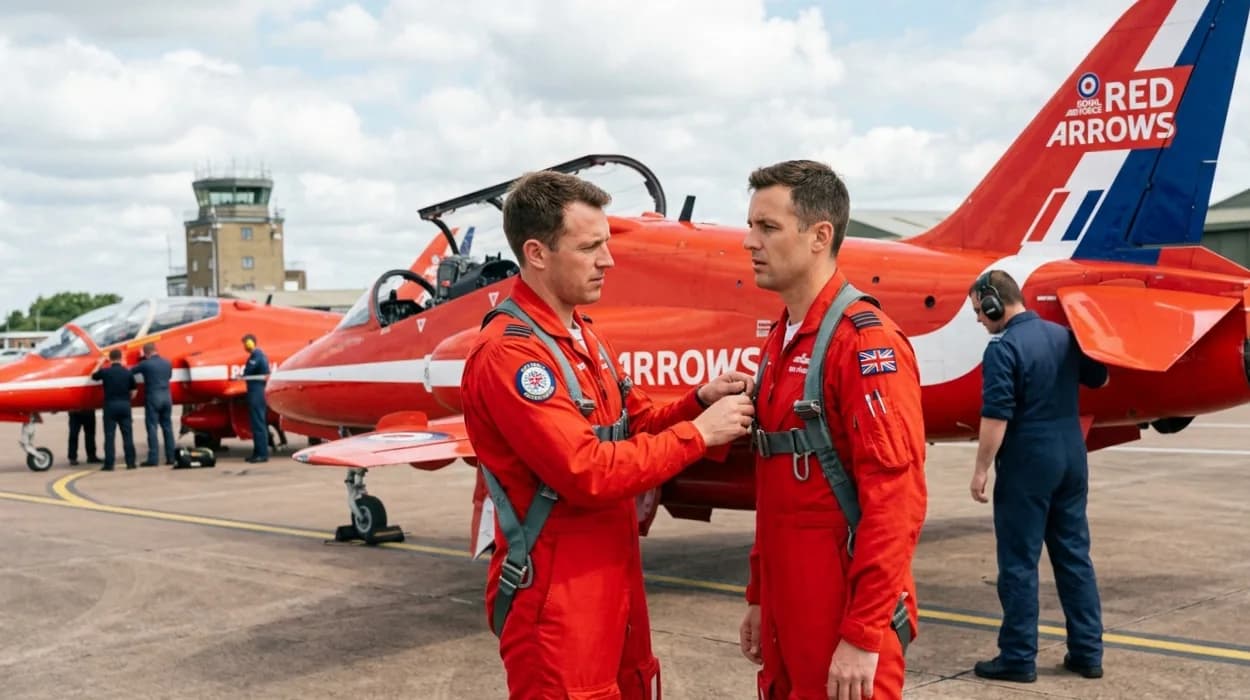
The Red Arrows, officially named the Royal Air Force Aerobatic Team, represent the public face of the United Kingdom armed forces. Operating from RAF Waddington in Lincolnshire, the team demonstrates flight precision, supports British defense exports, and assists military recruitment.
The Royal Air Force Aerobatic Team operates as an active unit within No. 1 Group of the Royal Air Force. Known internationally as the Red Arrows, the team serves as official ambassadors for the United Kingdom both domestically and overseas. The unit maintains a permanent base at RAF Waddington in Lincolnshire, where ground crews and aircrews conduct year-round flight operations, maintenance, and display planning.
The Ministry of Defence defines 4 official roles for the Red Arrows: showcasing the professional excellence of the Royal Air Force, supporting British industry exports, assisting international defense diplomacy, and driving recruitment for the United Kingdom Armed Forces. The team fulfills these objectives by performing public aerobatic displays, state flypasts, and international trade delegation flypasts.
The military unit comprises 11 fast-jet display pilots and over 100 engineering, administrative, and logistics personnel. The aircrew perform precision maneuvers in red-painted jet trainers before millions of spectators annually. As an established element of British aviation culture, the Red Arrows maintain strict flight protocols governed by the Military Aviation Authority (MAA) and Civil Aviation Authority (CAA).
What is the historical evolution of the Red Arrows aerobatic team?
The Royal Air Force formed the Red Arrows in late 1964 by amalgamating previous display units. The team performed its debut display on May 6, 1965, flying Folland Gnat trainers before transitioning to the BAE Systems Hawk T1 in 1979.
Prior to 1964, multiple Royal Air Force squadrons operated independent, unofficial aerobatic display units. The Air Ministry consolidated these separate flight elements into a single premier display team to improve operational efficiency and standardise safety standards. The team formation combined legacy elements from 3 predecessor display teams: the Black Arrows of No. 111 Squadron, the Red Pelicans of the Central Flying School, and the Yellowjacks.
The official name adopted "Red" from the high-visibility paint scheme of the Red Pelicans and "Arrows" from the Black Arrows. Squadron Leader Lee Jones led the initial 7-pilot formation during its inaugural public performance on May 6, 1965, at RAF Little Rissington. During its first official display season in 1965, the team completed 65 displays across 5 European countries: Great Britain, France, Italy, the Netherlands, and Germany.
The team occupied 3 historical airbases prior to its current operational station: RAF Fairford, RAF Kemble, and RAF Scampton. The unit operated from RAF Scampton in Lincolnshire for nearly 40 years before completing a permanent relocation to RAF Waddington on October 13, 2022.
How did the Diamond Nine formation develop historically?
In 1968, Team Leader Squadron Leader Ray Hanna expanded the display formation from 7 aircraft to 9 aircraft. This expansion allowed the team to construct the "Diamond Nine" formation, a 3x3 grid layout that became the trademark shape of the team. The Diamond Nine shape received official registration as an intellectual trademark of the Royal Air Force. In 2024, the Red Arrows celebrated their 60th display season, applying special anniversary livery to their aircraft fuselages.
What aircraft and technical systems power the Red Arrows?
The Red Arrows operate the BAE Systems Hawk T1 fast-jet trainer powered by a Rolls-Royce Adour engine. Modified with a specialized smoke pod, the aircraft injects diesel and organic dyes into jet exhaust to produce red, white, and blue trails.
The Red Arrows have flown 2 primary aircraft models during their operational history: the Folland Gnat T1 (operated from 1965 to 1979) and the BAE Systems Hawk T1 (operated from 1979 to the present day). The unit transitioned to the Hawk T1 in late 1979 because the aircraft offered superior flight endurance, updated avionics, and low maintenance costs. The Hawk T1 features a low-wing cantilever design with a swept-wing angle of 26 degrees and lightweight aluminum alloy construction.
The aircraft measures 11.88 meters in length, 4.00 meters in height, and has a wingspan of 9.39 meters. A single Rolls-Royce Turbomeca Adour Mk 151 non-afterburning turbofan engine provides 5,200 pounds of static thrust. The Hawk T1 reaches a maximum speed of Mach 1.2 (1,481 km/h) in a dive, a maximum level speed of 638 miles per hour (1,026 km/h) at sea level, and an operational ceiling of 48,000 feet.
How is the signature red, white, and blue smoke system engineered?
Engineers modify each Red Arrows Hawk T1 by mounting a specialized 3-tank smoke system pod under the fuselage. The system contains 3 internal compartments: one carrying 50 gallons of diesel fuel and two carrying 10 gallons of dye each. A control pipe routes the liquid directly into the jet engine exhaust nozzle. The extreme temperature of the exhaust gas vaporizes the diesel fuel instantly, creating a dense white trail.
When pilots depress cockpit buttons, pumps inject concentrated dye into the vapor stream to create colored smoke. The onboard capacity yields 3 distinct timing limits: 5 minutes of white smoke, 1 minute of red smoke, and 1 minute of blue smoke. The smoke trails allow spectators on the ground to track high-speed flight trajectories while providing pilots with visual references to maintain safe spacing during maneuvers.
How do the Red Arrows execute precision aerobatics and flight maneuvers?
Red Arrows pilots perform high-precision aerobatics with 6-foot aircraft separations at speeds up to 600 miles per hour. Routines are classified into Full, Rolling, or Flat displays depending on cloud ceiling heights and visibility conditions over display venues.
Red Arrows flight routines demand exact positioning and continuous radio synchronization. During close-formation maneuvers, wingtips fly within 6 feet (1.8 meters) of adjacent aircraft airframes, requiring pilots to maintain exact control inputs while subjected to gravitational forces ranging from -3g to +5g. The Team Leader (designated Red 1) issues verbal flight instructions over a secure radio channel, dictating airspeed, pitch, and bank angles for all formation members.
The Royal Air Force establishes 3 display types based on real-time weather observations: the Full Display, the Rolling Display, and the Flat Display.
The team selects the Full Display when the cloud base is clear above 4,500 feet over the venue. This routine includes full looping maneuvers, vertical climbs, and high-altitude breaks. The team selects the Rolling Display when the cloud ceiling sits between 2,500 feet and 4,500 feet. This routine replaces full loops with wingovers and rolling turns. The team selects the Flat Display when cloud cover falls between 1,000 feet and 2,500 feet. This routine consists of low-level flypasts and flat turns executed below the cloud deck. Flight operations cease if cloud ceilings drop below 1,000 feet or horizontal visibility falls below 5 kilometers.
The team executes 3 signature maneuvers during standard display routines: The Diamond Nine Loop, The Vixen Break, and The Synchro Pair Cross.
How does the Synchro Pair coordinate high-speed passes?
The Synchro Pair consists of 2 experienced display pilots designated as Red 6 (Synchro Leader) and Red 7 (Synchro Pair 2). While the main 7-ship formation completes large loops, the Synchro Pair breaks away to perform opposition passes. The two Hawk jets fly directly toward each other along a shared display line at a closing speed of 1,000 miles per hour (1,609 km/h). The pilots maintain a precise vertical separation of 100 feet as they cross at the center point of the display area.
What are the personnel requirements and support structures for the Red Arrows?
Red Arrows pilots must complete 1,500 fast-jet flying hours and a frontline operational tour before selection. Supported by eighty-five engineering technicians known as The Blues, the team relies on a ten-person Circus technician detachment traveling in aircraft rear passenger seats.
Selection for the Red Arrows pilot team requires rigorous military qualifications. Candidates must be active Royal Air Force fast-jet pilots who have logged a minimum of 1,500 flying hours on operational aircraft. Applicants must have completed at least 1 frontline operational deployment flying combat aircraft such as the Eurofighter Typhoon or F-35 Lightning II. Candidate evaluations require an "above average" pilot assessment score.
Over 30 applicants compete annually for 3 vacant pilot positions. Shortlisted pilots undergo a selection week comprising 4 testing elements: formal flight examinations, peer review assessments, media interview tests, and psychological evaluations. Selected pilots serve a strict 3-year tour of duty before returning to operational Royal Air Force front-line squadrons.
The team operates through 3 functional support sections: The Blues engineering team, The Circus flight technical detachment, and the Public Relations and flight safety management unit.
What is the operational role of "The Blues" and "The Circus"?
"The Blues" is the official designation for the team's 85 ground crew engineers and support staff, named after their royal blue working coveralls worn during display seasons. These technicians specialize in mechanical engineering, avionics, weapons systems, and flight equipment.
A sub-element called "The Circus" comprises 10 engineering technicians and 1 photographer assigned to specific display pilots. During transit flights between display locations, Circus technicians fly in the rear seats of the two-seat Hawk T1 jets. Upon landing at destination airfields, Circus members conduct immediate post-flight inspections, refueling, and smoke system replenishment, enabling the unit to operate independently without ground infrastructure support.
How do the Red Arrows interact with Bolton and North West England airspace?
The Red Arrows cross Bolton airspace during regional transit routes between display venues across North West England. Residents in Bolton view these transit flights during coastal airshow events in Blackpool and Southport, with live flight paths tracked via NOTAM filings.
While Bolton does not host a dedicated military airfield, the borough sits directly beneath primary flight corridors used by the Royal Air Force Aerobatic Team. Aircraft transit over Greater Manchester and Lancashire when traveling between their main operating base at RAF Waddington and regional airshows in Western Britain. Transit flights move at altitudes between 2,000 and 5,000 feet, allowing residents across Bolton, Horwich, Farnworth, and the West Pennine Moors to observe the formation in transit.
Bolton Today reports on flight routes when the Red Arrows deploy to 3 key North West events: the Southport Air Show, the Blackpool Air Show, and flypasts over regional landmarks such as Rivington Pike. During these seasonal deployments, the team uses Liverpool John Lennon Airport or Blackpool Airport as forward operating bases for refueling and crew resting.
What protocols govern Red Arrows airspace clearance over Greater Manchester?
Military air traffic controllers coordinate with National Air Traffic Services (NATS) and Civil Aviation Authority (CAA) officials to secure temporary airspace reservations. The Ministry of Defence issues a Notice to Airmen (NOTAM) prior to any transit flight over Bolton. NOTAM publications specify precise corridor boundaries, transit waypoints, timing windows, and altitude restrictions. Transit clearances require synchronization with air traffic control sectors surrounding Manchester Airport to ensure safe separation from commercial airliner arrival and departure routes.
What is the economic, defense, and diplomatic impact of the Red Arrows?
The Red Arrows deliver diplomatic, defense, and economic benefits by projecting British trade and industrial prowess across fifty-seven countries. Performing over 5,000 public displays worldwide, the team drives military recruitment and directly supports United Kingdom aerospace manufacturers like BAE Systems.
The Red Arrows serve as a primary instrument of United Kingdom defense diplomacy. Since their formation in 1964, the team has flown more than 5,000 public displays across 57 countries. Overseas display tours coincide with government trade missions to generate interest in British engineering, aerospace technology, and defense manufacturing.
The Royal Air Force Aerobatic Team has completed 3 major international tours during its history: the 1995–1996 World Tour across 52 countries, the 2016 Asia-Pacific Tour including debut displays in China, and the 2024 North American Tour across the United States and Canada.
The economic returns generated by these diplomatic missions benefit the UK industrial base. International appearances by the team support commercial sales campaigns for UK defense contractors, including BAE Systems, Rolls-Royce, and Martin-Baker. Furthermore, public appearances across the United Kingdom inspire young spectators to pursue careers in science, technology, engineering, and mathematics (STEM) fields, providing a continuous pipeline of skilled personnel for military and civilian aviation sectors.
FAQS
What are the Red Arrows?
The Red Arrows are the official aerobatic display team of the Royal Air Force (RAF). Their formal name is the Royal Air Force Aerobatic Team, and they represent the RAF at displays, flypasts and international events.