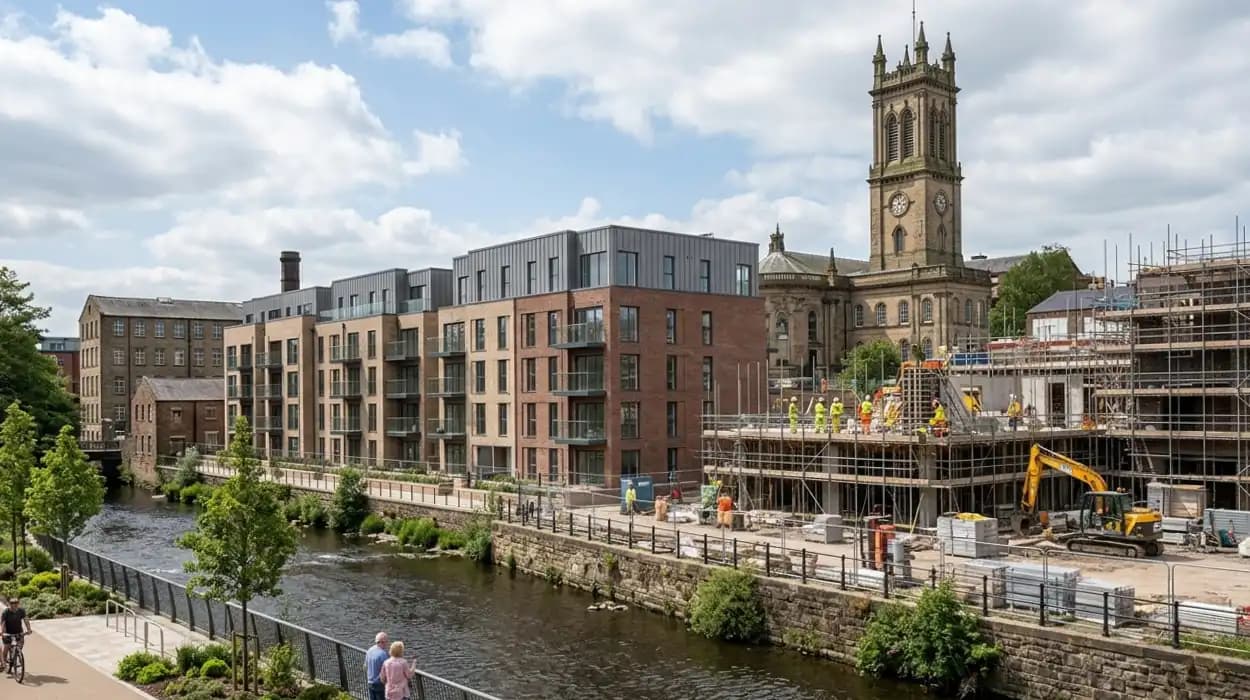
Church Wharf and Deansgate Gardens represent Bolton's newest neighborhoods in the town center regeneration. Church Wharf covers a 7.5-acre riverside site near Bolton Parish Church, delivering 415 homes, a hotel, and commercial spaces. Deansgate Gardens provides 167 build-to-rent homes on a three-acre site, completed in 2025.
What are Church Wharf and Deansgate Gardens?
Church Wharf and Deansgate Gardens are two key regeneration projects in Bolton town center. Church Wharf transforms a 7.5-acre dormant brownfield site into 415 mixed-tenure homes, a 130-bedroom hotel, restaurants, shops, and public spaces along the River Croal. Deansgate Gardens delivers 167 sustainable rental homes, including apartments and townhouses, with communal areas, forming part of Bolton Council's £1 billion masterplan for urban renewal.
Bolton town center masterplan identifies Church Wharf as a priority gateway site vacant for decades. Developer Watson secured planning approval in October 2025 from Bolton Council for the £100 million three-phase scheme. The project receives £5 million from the Greater Manchester Combined Authority’s Brownfield Housing Fund.
Deansgate Gardens, developed by Placefirst, sits opposite the former Beales store near Bolton Town Hall. Caddick Construction completed the £35 million project in 2025, using steel, timber framing, and riverbed enhancements for biodiversity. Both neighborhoods promote town-center living with pedestrian links and public realms.
These developments house over 1,000 residents combined, supporting local businesses through daily spending.
Where are Church Wharf and Deansgate Gardens located in Bolton?
Church Wharf occupies a 7.5-acre riverside plot bounded by the River Croal, Churchgate, and near Bolton Parish Church in Bolton town center. Deansgate Gardens spans three acres on Deansgate, opposite the former Beales department store, close to Bolton Town Hall, train station, and Queen's Park.
Church Wharf's strategic position serves as the town center gateway. It connects to Church Bank and existing retail areas like Bradshawgate. The site integrates the River Croal into public spaces, enhancing accessibility.
Deansgate Gardens benefits from proximity to Bolton train station, with 22-minute links to Manchester. Shops, cafes, and the Bee Network hub lie within walking distance. Green spaces like Queen's Park provide nearby recreation.
Both locations align with Bolton Council's vision to consolidate retail, add residential density, and improve infrastructure. Pedestrian-friendly streets link them to Moor Lane and other projects.
What is the history behind Church Wharf and Deansgate Gardens?
Church Wharf remained a dormant brownfield site for decades, prioritized in Bolton’s town center masterplan. Land transfer to Watson occurred in 2024, with planning approval in October 2025. Deansgate Gardens advanced from 2024 visuals by Placefirst, reaching completion in summer 2025 as part of the £1 billion regeneration.
Bolton Council identified Church Wharf for high-density housing under Policy JP-H4, targeting 120 dwellings per hectare. The council sold the land for £4 symbolically in 2025 to unlock development. Economic studies by Deloitte projected 5,000 new town center residents from such projects.
Placefirst unveiled Deansgate Gardens name and images in January 2024. Construction addressed brownfield remediation, river extensions with Environment Agency collaboration, and substation relocation. Completion in September 2025 marked a milestone in town center vibrancy.
Historical dormancy at Church Wharf stemmed from post-industrial decline. Current efforts shift focus to mixed-use neighborhoods.
What homes and features define these neighborhoods?
Church Wharf offers 415 homes in one-, two-, and three-bedroom apartments and houses, including affordable units; a 130-bedroom hotel; restaurants, shops, leisure spaces; and a public plaza with riverside walks. Deansgate Gardens includes 111 apartments in two blocks, 56 townhouses for long-term rent, rooftop terraces, communal courtyards, a public square, and pet-friendly amenities.
Church Wharf's three phases deliver sustainable homes certified for energy efficiency. Public realm improvements include upgraded infrastructure and heritage nods near Bolton Parish Church. Commercial spaces target bars, cafes, and operators for 24/7 activity.
Deansgate Gardens emphasizes build-to-rent with institutional landlord security. Features incorporate light-gauge steel and timber for rapid build, plus resident parking and improved roads. Levitt Bernstein Architects designed for community interaction.
Examples include Church Wharf's plaza opening to Churchgate and Deansgate Gardens' gabion walls for ecology.
What is the development timeline for Church Wharf and Deansgate Gardens?
Deansgate Gardens completed construction in summer 2025, with residents moving in by September 2025 under Placefirst management. Church Wharf starts construction in 2026, progressing in three phases to full completion by 2029.
Placefirst oversaw Deansgate Gardens from site prep through 2025 handover. Remediation and piling preceded framing, achieving Consider Constructors Scheme's perfect 45/45 score for community engagement.
Watson plans Church Wharf's first phase post-2025 approval, funded partly by council land sales. Phased delivery ensures steady infrastructure upgrades. Delays from planning were resolved in October 2025.
Timelines support Bolton's masterplan pace, complementing Moor Lane's near-completion.
How do these neighborhoods benefit Bolton’s economy?
Church Wharf generates £7 million annual local spending from 1,000+ residents, creates 1,500 jobs, and injects £64 million gross value added. Deansgate Gardens adds 167 homes to attract 5,000 town center residents per Deloitte research, boosting retail and transport use.
Independent assessments quantify Church Wharf's impact through resident expenditure on nearby businesses. Construction phases employ locals and supply chains.
Deansgate Gardens sustains vibrancy near stations and shops, increasing footfall. Placefirst's on-site teams maintain long-term occupancy, stabilizing rental income for investors.
Combined, projects shift population to town center, supporting £1 billion regeneration by drawing investment.
What amenities and accessibility features exist?
Church Wharf provides riverside paths, a public plaza, restaurants, shops, leisure venues, and links to Bolton Parish Church. Deansgate Gardens offers public square, rooftop terraces, courtyards, parking, pet-friendly homes, and walks to the train station, shops, and Queen's Park.
Church Wharf enhances pedestrian routes from Church Bank to the retail core. River Croal integration creates leisure walks.
Deansgate Gardens prioritizes walkability with streets designed for community. Proximity to Bee Network and Manchester trains aids commuters.
Both include biodiversity via plantings and walls, plus sustainable materials.
Who develops Church Wharf and Deansgate Gardens?
Watson develops Church Wharf, designing the £100 million mixed-use scheme with jmarchitects. Placefirst develops Deansgate Gardens as build-to-rent, constructed by Caddick Construction with Levitt Bernstein Architects.
Watson specializes in regeneration, securing council partnerships. Jmarchitects handles the landscape with the River Croal focus.
Placefirst manages long-term rentals, using in-house teams. Caddick implemented value engineering for efficiency.
Bolton Council facilitates via land transfers and funding.
How do they fit into Bolton’s town center masterplan?
Church Wharf and Deansgate Gardens execute Bolton Council’s £1 billion masterplan by densifying housing to 120+ per hectare, mixing uses, and enhancing public spaces alongside Moor Lane and Crompton Place demolition.
Masterplan targets retail consolidation, residential growth, and hospitality. Deloitte forecasts 5,000 residents revitalizing core.
Projects create live-work-play hubs, boosting confidence in Bradshawgate.
Future phases include Primark relocation synergies.
What future impact do they have on living in Bolton?
Church Wharf houses 1,000 residents by 2029, driving £64 million economic value and town center shift. Deansgate Gardens sets rental benchmarks with sustainable, community-focused living, influencing further North West investments by Placefirst.
Increased density supports amenities expansion. Job creation totals thousands across phases.
Sustainability features like timber framing reduce emissions. Placemaking elevates Bolton's appeal for young professionals.
Regeneration sustains long-term growth, per council leader Nick Peel.
FAQS
What are Church Wharf and Deansgate Gardens in Bolton?
Church Wharf and Deansgate Gardens are major town centre regeneration projects bringing new homes, public spaces, and commercial areas to Bolton.