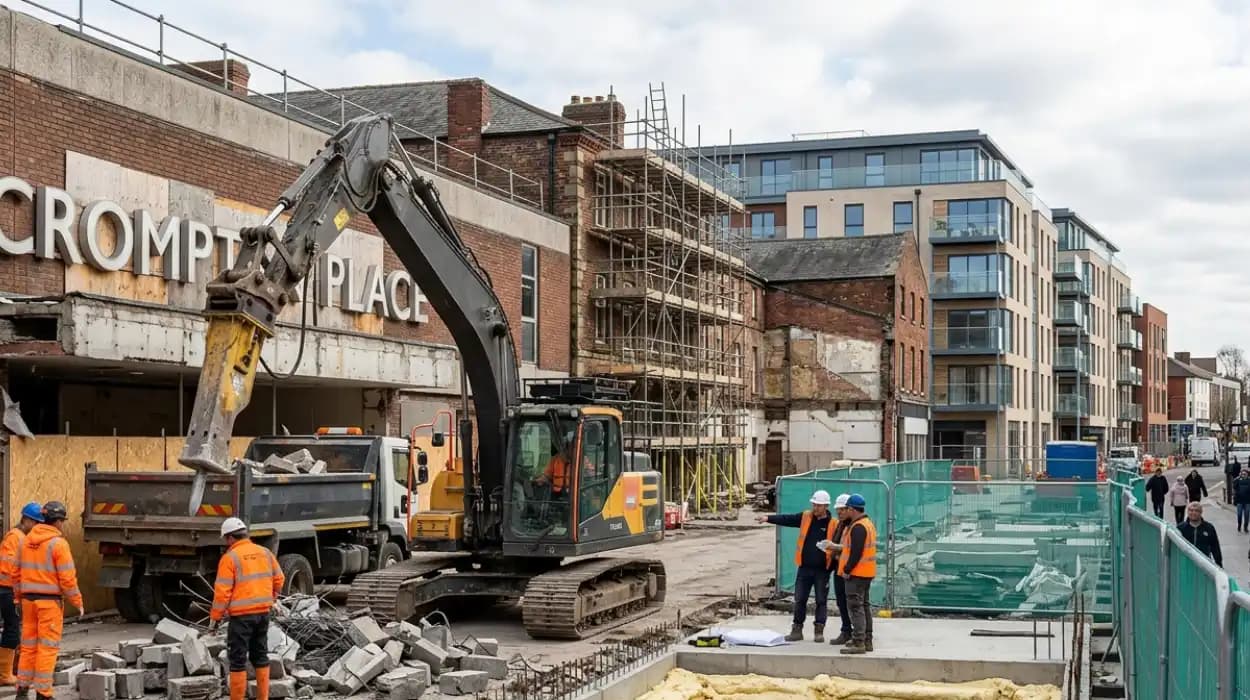
The Bolton Blueprint outlines Bolton Council's £1 billion masterplan for town centre regeneration, approved in 2017 and advancing in 2026 with key demolitions and new developments. This plan targets five strategic sites to deliver 1,800 new homes, 7,400 jobs, and £412 million in economic activity by 2030 and beyond. In 2026, flagship projects like Crompton Place drive the transformation toward residential-led mixed-use spaces.
What is the Bolton Blueprint?
The Bolton Blueprint is Bolton Council's £1 billion masterplan, published in 2017, to regenerate Bolton town centre through 2030 by redeveloping five sites: Trinity Quarter, Cheadle Square, Crompton Place, Church Wharf, and Croal Valley, creating 1,800 homes, 7,400 jobs, and £412 million economic impact.
Bolton town centre, located in Greater Manchester, UK, faced decline from retail shifts post-2010s, with empty shops and reduced footfall. The Blueprint provides a structured framework defining regeneration goals, including housing, employment, and public realm improvements.
Key components include residential developments, office spaces, leisure venues, and enhanced pedestrian links. Processes involve council-led land acquisition, such as purchasing Crompton Place in 2018 for £14.8 million, followed by leaseholder relocations. In 2026, MEPC, owned by Federated Hermes, leads Crompton Place after a competitive selection based on financial strength and design quality.
Implications extend to economic growth, with £100 million council commitment in February 2026 for infrastructure and jobs. This positions Bolton for sustained vitality amid UK high street challenges.
What are the main projects in the Bolton Blueprint?
Main projects encompass five sites: Crompton Place for residential-led mixed-use; Church Wharf for housing and waterfront; Trinity Quarter, Cheadle Square, and Croal Valley for jobs and leisure, with 2026 focus on Crompton demolition and Mayoral Development Corporation proposal.
Macro context traces to 2017 approval, borrowing £100 million to initiate works. Crompton Place, a 1971 shopping centre opposite the Grade II listed town hall, closes in 2025, with demolition starting early 2026 by Rhodar, lasting through 2026.
Church Wharf progresses with housing along the River Croal. Other sites like Moor Lane, Deansgate Gardens, and Wellsprings already deliver homes and public spaces. The proposed Bolton Town Centre Mayoral Development Corporation (MDC) covers 13 sites, enabling land acquisition and infrastructure via statutory powers, modeled on Stockport's success.
Real-world examples include Market Food Hall and Elizabeth Park, boosting footfall. Data shows potential for 2,000 homes, 31,000 sqm employment space, 300 hotel beds, 14,000 sqm food/drink, and 5,000 sqm leisure across MDC sites. Future relevance lies in Vision 2040 alignment, accelerating delivery.
What changes occurred in Bolton town centre historically?
Bolton town centre evolved from industrial hub in the 19th century, with Crompton Place opening in 1971 as a retail anchor, declining post-2010s due to online shopping, leading to council purchase in 2018 and Blueprint launch in 2017.
Historical context roots in Samuel Crompton's spinning mule invention in 1779, spurring textile growth. 20th-century retail boomed with Crompton Place's 280,000 sq ft space.
Decline accelerated after 2020 COVID impacts, rendering a £250 million retail plan unviable. Council interventions from 2018 included buying underused sites, relocating businesses, and completing Moor Lane apartments.
By 2025, the centre closed permanently. Statistics indicate delays, like £20 million Levelling Up funds approved 2023 but contracted at £15 million in 2026. Implications include shift from retail dominance to mixed-use, mirroring UK trends.
What is happening with Crompton Place in 2026?
Crompton Place demolition starts early 2026, completes by spring/summer 2027, clearing 280,000 sq ft for residential-led development by MEPC, restoring pedestrian route from Victoria Square to Bradshawgate, with £1 million local spend and apprenticeships.
The site, heart of town centre, gains "meanwhile uses" post-demolition like events and markets. Processes involve planning permission from August 2025, Rhodar execution, and GMCA Good Growth funding pursuit.
MEPC's selection followed evaluation on deliverability and social value, drawing from NOMA Manchester experience. Examples of prior successes: Deansgate Gardens and Wellsprings transformations.
Data projects new homes, workspace, leisure; demolition opens key walkway. Impacts include immediate economic boost via £1 million local procurement and apprenticeships, signaling market confidence.
How does the Mayoral Development Corporation fit in?
The proposed Bolton Town Centre MDC, consulted March 2026, covers 13 sites for 2,000 homes, 31,000 sqm jobs space, using powers to acquire land and build infrastructure, run by councillors and experts, approved by Parliament.
MDC definition: A statutory body under UK law granting development powers beyond standard planning. It builds on Blueprint momentum, like Church Wharf progress.
Mechanisms include transport improvements and compulsory purchase if needed. Stockport MDC example delivered top UK living rankings via phased regenerations.
Consultation from March 2-30, 2026, at gmconsult.org shapes scope. Research from Greater Manchester Combined Authority supports growth. Implications: Faster delivery for Vision 2040, enhancing jobs and quality of life.
What economic impacts result from these changes?
Regeneration generates 7,400 jobs, £412 million activity from Blueprint; 2026 adds £100 million council investment, £1 million demolition spend, targeting 2,000 homes and 31,000 sqm employment via MDC.
Macro context addresses post-industrial decline, with town centre vacancy rates high pre-2026. Subtopics cover direct job creation in construction, like Rhodar apprenticeships.
Statistics: MDC enables 300 hotel beds, 14,000 sqm food/drink boosting footfall. £200 million MEPC scheme at Crompton Place.
Examples: Market Place £15 million overhaul draws visitors. Future relevance: £1 billion total investment by 2030 sustains growth amid UK levelling up.
How does this benefit local residents and businesses?
Residents gain 2,000 homes, improved public spaces like Bradshawgate link, leisure areas; businesses benefit from higher footfall, new office/hotel spaces, £1 million local procurement, supporting relocations from Crompton.
Benefits stem from residential influx increasing dwell time. Processes ensure community input via consultations and events.
Real-world: Wellsprings and Deansgate Gardens added vibrant spaces. Data: 5,000 sqm community/leisure use.
Implications include better connectivity, quality of life, per Council Leader Nick Peel. Businesses access pop-up markets during transitions.
What is the timeline for Bolton town centre changes in 2026?
2026 timeline: Demolition starts early at Crompton Place, runs through year; MDC consultation March; £100 million budget February 10; partner announcements spring; meanwhile uses post-demolition; full site ready 2027.
Sequence begins with February budget commitment. Demolition: January start, one-year duration.
March MDC consultation ends March 30. Summer: Pedestrian route reopens. GMCA funding secured mid-year.
Parliament approval follows consultation for MDC. Long-term: Development starts post-2027.
What future developments follow the 2026 changes?
Post-2026: Crompton Place builds residential-led scheme with homes, offices, leisure, hotel; MDC delivers across 13 sites toward Vision 2040; expanded homes/jobs beyond 2,000/31,000 sqm, with GMCA support.
Vision 2040 defines borough-wide goals, using MDC as vehicle. Components: Multi-phase by MEPC, community collaboration.
Mechanisms: Normal planning applies to buildings. Examples: Trinity Quarter offices, Croal Valley leisure.
Stats project significant scale-up. Relevance: Positions Bolton as investment hub, like Stockport.