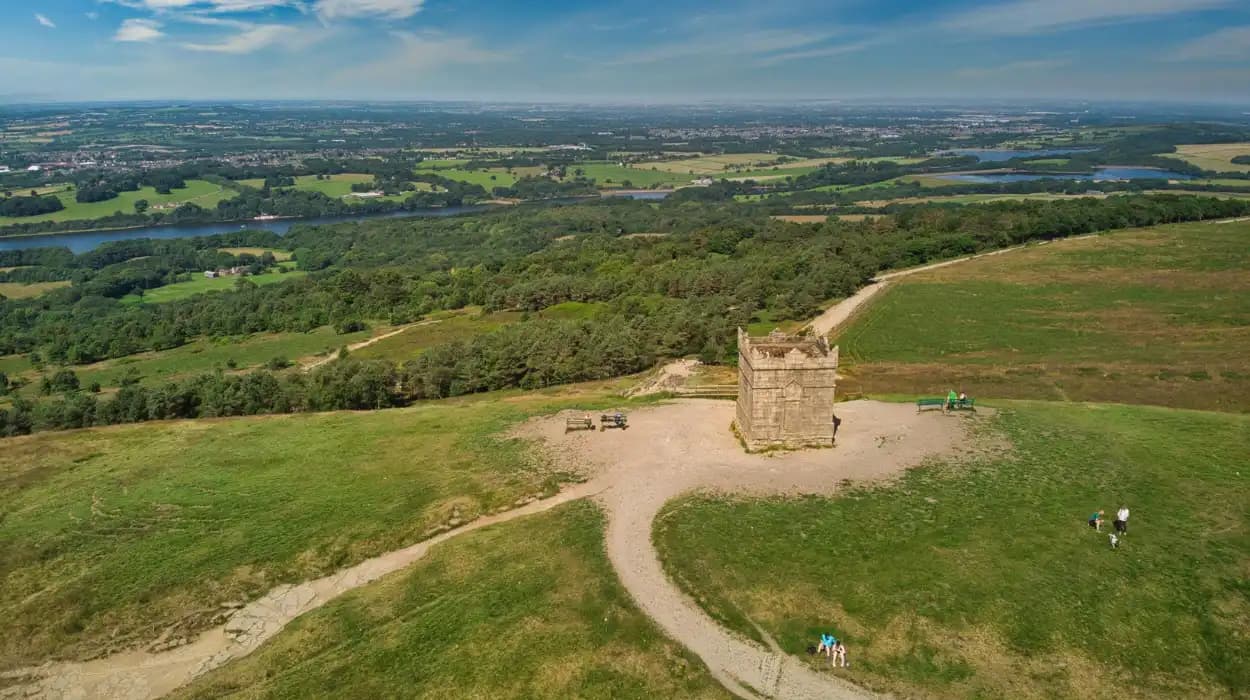
Rivington is one of Lancashire’s most significant historic landscapes for combining outdoor recreation with industrial, architectural, and landscape history. Located on the western edge of the West Pennine Moors, the area contains reservoirs, parkland, historic farms, designed gardens, woodland, open grassland, and Rivington Pike. Its picnic landscape developed from a much longer history of agriculture, water management, estate ownership, public recreation, and early twentieth-century landscape design.
For families, Rivington provides several distinct settings for an outdoor meal. Lever Park offers open parkland and tree-lined spaces. The Lower Rivington Reservoir area provides waterside views. Rivington Village provides access to historic buildings and traditional village scenery. The Terraced Gardens contain lawns, terraces, summerhouses, lakes, and stone structures created under William Hesketh Lever, later Lord Leverhulme. Higher ground around Rivington Pike provides panoramic views but requires more demanding walking.
Rivington is also a heritage landscape rather than simply a recreational destination. Historic England records Lever Park as a Grade II Registered Park and Garden. The landscape was laid out between 1901 and 1911 by landscape designer Thomas Hayton Mawson in collaboration with Lever. The park incorporated earlier estate features, reservoirs, farmland, woodland, and designed viewpoints.
The result is a picnic destination where outdoor recreation takes place within a documented historic landscape. Understanding that history helps visitors select locations according to scenery, walking distance, heritage interest, and family requirements.
What makes Rivington a historic destination for family picnics?
Rivington combines historic parkland, reservoirs, woodland, gardens, moorland, and surviving buildings within one landscape. Its modern picnic appeal reflects centuries of estate history followed by twentieth-century public park development under Lord Leverhulme.
Rivington’s landscape developed from the medieval Manor of Rivington. Historic England records that the manor belonged to the Pilkington family from 1212 until 1605. Ownership subsequently changed before the estate became associated with William Hesketh Lever at the beginning of the twentieth century.
The landscape also contains evidence of agricultural history. Farmhouses, barns, field boundaries, lanes, and village buildings remain alongside the later designed park. These elements distinguish Rivington from a purpose-built modern recreation ground.
The reservoirs introduced another major historical layer. Two reservoirs west of the park were constructed during the 1850s as part of Liverpool’s water supply system. The water infrastructure transformed the valley and became a defining component of the later landscape. Historic England records that the Hall and Manor of Rivington were offered to Liverpool Corporation in 1899 because they formed part of the gathering grounds for the reservoirs.
William Hesketh Lever subsequently purchased the estate. In 1901, he offered approximately 160 hectares of land to Bolton Corporation for a public park while retaining land farther east for his residence and gardens. This public park became Lever Park.
This history explains why picnic locations in Rivington range from formal historic lawns to informal grassland beside water and woodland. The recreational landscape was deliberately planned to provide public access to countryside while preserving important visual and architectural features.
Where is the best family picnic location in Lever Park?
Lever Park is the strongest general family picnic setting because it combines open grassland, mature trees, historic avenues, reservoir views, paths, and nearby heritage attractions within a large public park created for recreation in the early twentieth century.
Lever Park covers more than 400 acres and forms the central recreational landscape around Rivington. The park was designed by Thomas Hayton Mawson in collaboration with Lord Leverhulme between 1901 and 1911. Its historic layout remains substantially identifiable on the 1929 Ordnance Survey map.
For a family picnic, the open parkland around the main avenues provides flexibility. Visitors can choose grass areas away from busy paths while remaining close to walking routes and historic features. Mature trees provide important visual structure and create different settings from open viewpoints to more enclosed areas.
The park was designed as a public amenity rather than a private garden. Lever’s decision to donate approximately 160 hectares to Bolton Corporation established a direct connection between landscape design and public recreation. The historical purpose of the park therefore remains relevant to contemporary outdoor use.
The park also provides access to several heritage landmarks. Rivington Hall, Rivington Hall Barn, Great House Barn, the reservoir, and the replica Liverpool Castle are positioned within or around the historic landscape.
The combination of open space and nearby heritage makes Lever Park particularly suitable for families who want a picnic combined with a short walk. The landscape does not require every visitor to undertake a strenuous hill climb.
Families should select durable ground sheets rather than relying on picnic furniture throughout the park. Outdoor seating availability varies by location. Visitors should also avoid blocking paths, gates, access roads, or entrances to heritage structures.
The park receives substantial visitor numbers. United Utilities stated in 2022 that the wider Rivington area, including Lever Park and Rivington Reservoir, attracted more than one million visitors annually. The company identified parking, visitor facilities, and signage as important issues because visitor pressure affected the area and local residents.
This visitor pressure makes responsible picnic behaviour important. Taking litter home, keeping food waste secure, and avoiding damage to vegetation help protect the historic landscape.
Why is the Lower Rivington Reservoir area suitable for a waterside picnic?
The Lower Rivington Reservoir area provides a waterside setting within the historic Lever Park landscape. Its combination of open views, woodland, paths, and water makes it suitable for relaxed picnics when visitors choose stable ground away from operational infrastructure and busy routes.
The Lower Rivington Reservoir forms a major visual feature of Lever Park. The reservoir landscape was established during the nineteenth century as part of the water-supply infrastructure associated with Liverpool Corporation. The later park deliberately incorporated water, woodland, avenues, and viewpoints into its design.
The reservoir edge is particularly valuable for visitors who want scenery without climbing Rivington Pike. The valley setting provides views toward the surrounding hills while retaining relatively close access to the central park.
A prominent historic feature beside the reservoir is the unfinished replica of Liverpool Castle. Historic England identifies the castle as part of the designed landscape of Lever Park. The replica was begun in 1912 and formed one of the park’s major visual focal points.
The castle setting provides an educational dimension for families. Liverpool Castle was a medieval royal fortress in Liverpool, and the Rivington structure was created as a landscape feature rather than as a functioning defensive building. The distinction illustrates how early twentieth-century estate landscapes used historical references as architectural decoration.
Picnickers should remain aware that a reservoir is part of a managed water infrastructure system. The waterside environment is not equivalent to a swimming or boating beach. Food preparation should remain simple, and visitors should keep children away from steep banks, water edges, and operational areas.
The reservoir also supports wildlife. Historic landscape accounts describe woodland birds and overwintering wildfowl in the wider Lever Park environment. The combination of water and woodland makes the area useful for informal family observation of local wildlife.
The best use of the reservoir area is therefore a quiet picnic followed by a short heritage or nature walk. Families can combine outdoor dining with observation of the reservoir landscape without committing to the longer ascent toward Rivington Pike.
Which Rivington Terraced Gardens areas work best for a historic picnic?
The Great Lawn and Tennis Lawn provide the clearest historic picnic settings within Rivington Terraced Gardens. These lawns were created as entertainment spaces by Lord Leverhulme and retain summerhouses, terraces, stone steps, and designed views that explain their original recreational purpose.
Rivington Terraced Gardens were created between 1905 and 1925 by Lord Leverhulme with landscape designer Thomas Hayton Mawson. The gardens cover approximately 45 acres and contain terraces, paths, lakes, caves, structures, lawns, and ornamental features.
The Great Lawn was designed as an entertainment space where Lever hosted private guests. A summerhouse provided shelter and a place for serving tea. The Tennis Lawn formed another recreational space and was associated with the gardens’ early twentieth-century leisure programme.
These lawns are historically significant because they demonstrate how wealthy industrialists used landscape architecture for recreation and hospitality during the Edwardian period. The gardens were not simply ornamental planting. They incorporated architecture, water, views, terraces, circulation routes, and recreational spaces into one coordinated design.
The scale of the landscape required substantial engineering. The creation of the lawns involved removing large quantities of stone from the hillside. The gardens’ history records that a temporary railway was built to transport the excavated material.
The gardens also have a documented connection with public access. During the summers from 1919 to 1924, Lever held annual open days. Members of the public purchased tickets to enter the gardens, while proceeds went to local charities.
This history gives the lawns particular significance for family visitors. A picnic here takes place within a landscape originally designed for outdoor social activity.
Visitors should respect the conservation character of the gardens. The site contains historic walls, steps, water features, terraces, and fragile landscape elements. Food should remain on stable areas, and children should be supervised around drops, lakes, stonework, and uneven ground.
The Terraced Gardens are currently open to the public free of charge. Rivington Heritage Trust, working with partners and volunteers, continues conservation work to reveal and protect the historic landscape.
To experience this historic landscape in person today, consult our comprehensive [History of Rivington Terraced Gardens and Parkland] for itineraries and visiting parameters.
What picnic opportunities are available around Rivington Village?
Rivington Village provides a heritage-focused picnic environment rather than one defined by formal picnic infrastructure. Historic buildings, village lanes, the green, nearby parkland, and access toward the reservoirs allow families to combine outdoor eating with architectural and local-history exploration.
Rivington Village sits within the wider registered historic landscape. Lancashire’s landscape assessment identifies the village as part of the Grade II Registered Park and Garden associated with Lever Park and records that Rivington is covered by a Conservation Area.
The village provides a useful starting point for understanding Rivington before the later Leverhulme landscape. Historic farms and buildings connect the present settlement with its agricultural past.
Great House Barn is one of the most significant surviving structures. Historic England lists it at Grade II and dates the barn probably to the sixteenth century, although the building carries a 1702 date stone. Its cruck-frame structure survives alongside alterations made around 1905 for Lord Leverhulme.
The barn illustrates how older agricultural buildings were adapted for the emerging visitor economy. Jonathan Simpson altered and enlarged it around 1905 for Leverhulme, creating a building that became associated with visitor use.
Rivington Village is therefore particularly useful for educational family outings. Children and students can compare agricultural architecture, Victorian water infrastructure, Edwardian landscape design, and modern recreation within a relatively compact area.
Visitors seeking a picnic should distinguish between public open land and private or commercially operated premises. A village location does not automatically mean every grassed area is available for informal dining. Families should use clearly accessible public spaces and avoid private gardens, entrances, and working farm areas.
The village also provides food options for visitors who do not want to carry a complete picnic. Current visitor information identifies the Village Green Tea Room and other nearby food outlets around the park.
The most useful approach is to treat the village as a heritage base rather than simply a picnic field. A family can eat in an appropriate public setting and then examine historic buildings, lanes, and nearby landscape features.
Is Rivington Pike suitable for a family picnic?
Rivington Pike is best suited to families seeking a picnic combined with a hill walk and panoramic landscape. Its exposed moorland setting, elevation, historic tower, and uneven paths make it less suitable for very young children than lower parkland locations.
Rivington Pike rises to approximately 1,191 feet and forms the western high point of Winter Hill within the West Pennine Moors. The summit provides extensive views across Lancashire and surrounding uplands.
The Pike has a long defensive history. Historic England records that the tower stands on the site of an earlier beacon and was built in 1733 by John Andrews of Little Lever, then owner of the Manor of Rivington. The building functioned as a hunting lodge.
Rivington Pike Tower is a Grade II listed building. Historic England describes it as approximately 5 metres square and 7 metres high, constructed from gritstone. Its original interior included a fireplace and small cellar.
The earlier beacon system gives the site wider national historical significance. Rivington Pike formed part of a network of elevated warning sites used to communicate threats across northern England. The beacon tradition is particularly associated with the Spanish Armada crisis of 1588.
The tower itself is not the best place to spread a picnic blanket. The surrounding moorland provides open ground, but exposure to wind and changing weather conditions makes preparation important. Families should carry food in secure containers and use suitable clothing.
The Pike is more appropriate for a picnic after a walk than for a short-access family outing. A family with younger children can choose lower areas of Lever Park and treat the tower as a historical destination rather than making the summit the main picnic location.
The contrast between Rivington Pike and Lever Park is educational. The Pike represents upland landscape, beacon history, and eighteenth-century estate architecture. Lever Park represents early twentieth-century public landscape design. The two settings demonstrate how the same geographical area acquired different functions across centuries.
How did Lord Leverhulme transform Rivington into a public recreation landscape?
Lord Leverhulme transformed Rivington through land purchase, public park creation, landscape design, and garden construction. His work connected industrial wealth with public recreation while retaining a private garden landscape and introducing architecture, avenues, lawns, water features, and historic references.
William Hesketh Lever was a Lancashire industrialist and philanthropist who founded Lever Brothers, the soap manufacturer that later became part of Unilever. His connection with Rivington began around 1900, when he acquired the estate.
Lever commissioned Thomas Hayton Mawson, one of Britain’s important landscape designers of the period, to develop the landscape. Mawson’s work at Rivington formed part of a broader Edwardian movement that treated landscape architecture as an integrated discipline involving gardens, buildings, roads, water, planting, views, and public recreation.
Lever Park was developed between 1901 and 1911. Historic England identifies Mawson and Lever as the principal figures responsible for its design. The park was created from land associated with the historic Manor of Rivington and incorporated existing topography and water features.
The public park and private gardens had different functions. Lever retained land on the eastern side for his residence and gardens while offering approximately 160 hectares to Bolton Corporation for public recreation.
The Terraced Gardens represented the private side of the project. Their terraces, lakes, summerhouses, lawns, and ornamental structures created a highly controlled landscape on the hillside. The gardens were developed between 1905 and 1925 and later fell into disrepair after Lever’s death and the sale of the property.
This distinction remains visible today. Lever Park is a public parkland landscape, while the Terraced Gardens preserve the remains of a more formal private estate garden.
The transformation also illustrates the relationship between industrialisation and leisure. Bolton and surrounding Lancashire towns developed rapidly through textile manufacturing, while wealthy industrialists accumulated the resources to create large estates and philanthropic projects. Public parks provided access to green space during a period of intense urban and industrial growth.
Rivington therefore represents more than an attractive picnic destination. Its present recreational character is directly connected to the social, economic, and landscape history of industrial Lancashire.
What historic landmarks can families combine with a Rivington picnic?
Families can combine a Rivington picnic with Rivington Pike Tower, Lever Park, Rivington Terraced Gardens, Great House Barn, Rivington Hall, and the replica Liverpool Castle. Together, these landmarks represent medieval estate history, eighteenth-century architecture, nineteenth-century water infrastructure, and Edwardian landscape design.
Rivington Pike Tower provides the clearest eighteenth-century landmark. Built in 1733, it was commissioned by John Andrews as a hunting lodge on an earlier beacon site. Historic England lists the structure at Grade II.
Great House Barn provides evidence of earlier agricultural architecture. Historic England describes it as probably sixteenth-century in origin, with major alterations around 1905. Its cruck-frame construction demonstrates traditional timber engineering adapted to the local landscape.
Lever Park represents the Edwardian period. Its avenues, parkland, woodland, reservoir views, and designed features were established between 1901 and 1911. The park remains a registered historic landscape.
Rivington Terraced Gardens represent another phase of Edwardian landscape design. Historic England records the gardens as approximately 18 hectares and identifies features including the Italian Garden, Great Lawn, former tennis lawn, Japanese Garden, summerhouses, terraces, and the Long Walk.
The replica Liverpool Castle provides a different historical reference. It was constructed as a landscape folly rather than as a functioning medieval castle. Its position overlooking the reservoir demonstrates how Lever’s landscape used architectural references to create focal points.
These landmarks create a useful educational sequence. Families can begin with the older agricultural landscape, examine the nineteenth-century reservoirs, study the eighteenth-century Pike Tower, and then investigate Leverhulme’s twentieth-century park and gardens.
For students of local history, the area also demonstrates how historical landscapes retain evidence through buildings and spatial arrangements. Roads, field boundaries, avenues, terraces, ponds, reservoirs, and structures all contribute to understanding the past.
How should families choose the best picnic location in Rivington?
Families should choose Rivington picnic locations according to walking ability, weather exposure, heritage interest, access to facilities, and proximity to water. Lower Lever Park suits general family use, while the reservoir, gardens, village, and Pike provide progressively more specialised outdoor experiences.
The best general choice is the open parkland within Lever Park. It offers the broadest combination of grass, trees, paths, heritage features, and relatively easy access.
The best waterside choice is the Lower Rivington Reservoir landscape. It provides a strong connection between picnic recreation and the nineteenth-century water infrastructure that shaped the valley.
The best heritage-focused choice is the Terraced Gardens. The Great Lawn and Tennis Lawn were deliberately designed as outdoor entertainment spaces, making them particularly relevant to visitors interested in landscape history.
The best architectural choice is the area around Rivington Village and Great House Barn. The surviving buildings provide clear evidence of agricultural and estate history.
The best panoramic choice is Rivington Pike. The elevated landscape provides the strongest views but also introduces more demanding walking and greater exposure to weather.
Facilities should also influence planning. Visitor information for Rivington identifies four car parks within Lever Park and additional small lay-bys. It also lists food and refreshment options around Rivington Village and the park.
Parking pressure is an established issue. United Utilities reported that the wider Rivington area attracts more than one million visitors annually and has sought improvements to parking, visitor facilities, and signage.
Families should therefore avoid treating the landscape as an unlimited-access picnic ground. Parking spaces are finite, roads are shared with other users, and some paths pass through sensitive heritage or environmental areas.
Weather also matters. Rivington combines low-lying parkland with exposed moorland. The Pike is more vulnerable to wind and rapid weather changes than sheltered areas near the park.
A practical family picnic should use lightweight equipment, secure food containers, reusable water bottles, and waste bags. Visitors should leave no food packaging behind and should avoid disposable items that can enter waterways or woodland.
Why does responsible picnicking matter for Rivington’s historic landscape?
Responsible picnicking protects Rivington’s historic buildings, designed landscapes, water environment, wildlife habitats, and public access. Low-impact behaviour preserves the physical evidence that makes Lever Park, the reservoirs, the Terraced Gardens, and Rivington’s historic buildings significant.
Rivington is both a recreational landscape and a heritage asset. Historic England’s designation of Lever Park as a Grade II Registered Park and Garden recognises its historic landscape importance.
The Terraced Gardens also require active conservation. Rivington Heritage Trust works with Groundwork CLM and volunteers to maintain and restore the gardens. Conservation work has revealed historic paths, stairways, terraces, and structures that became obscured through vegetation and neglect.
Picnic behaviour affects this conservation environment. Walking repeatedly across planted areas damages vegetation and can expose archaeological or historic surfaces. Climbing historic walls and structures increases physical wear. Leaving food waste attracts wildlife and creates additional maintenance requirements.
Water protection is equally important. The Rivington reservoirs form part of a managed water-supply landscape. Food waste, plastic packaging, and other litter have no place near reservoir margins.
Visitors should also respect livestock and wildlife. Dogs should remain under control where required, and families should avoid disturbing birds, nesting areas, or grazing animals.
The scale of visitor numbers makes individual behaviour significant. With more than one million annual visitors reported for the wider Rivington area, even small levels of litter or erosion become substantial management issues when repeated across thousands of visits.
Responsible recreation also protects historical authenticity. Rivington’s value comes from the survival of relationships between buildings, paths, lawns, water, woodland, fields, and hills. Preserving those relationships ensures that future visitors can understand how the landscape developed.
For educators, this provides an important lesson. Heritage preservation is not limited to restoring buildings. Historic landscapes require protection of vegetation, landform, water features, circulation routes, views, and archaeological evidence.
What is the long-term historical significance of Rivington as a picnic landscape?
Rivington’s long-term significance comes from the survival of a connected historic landscape where agriculture, water supply, public recreation, industrial philanthropy, architecture, and landscape design remain visible together. Its picnic spaces therefore function as accessible points for understanding Lancashire’s changing history.
Rivington demonstrates several major stages of landscape development. The medieval manor established the estate framework. Nineteenth-century reservoirs introduced industrial water infrastructure. The eighteenth-century Pike Tower added an estate hunting structure on an older beacon site. Edwardian development introduced Lever Park and the Terraced Gardens.
The twentieth century also changed the relationship between private estates and public recreation. Lever’s donation of land to Bolton Corporation created a major public park at a time when industrial communities increasingly valued access to countryside and landscaped open space.
The survival of Lever Park is especially important because its historical layout remains legible. Historic England states that the landscape is substantially shown in its 1929 Ordnance Survey form. This provides documentary evidence for comparing historic plans with the surviving landscape.
The Terraced Gardens demonstrate another form of survival. Although the gardens suffered decades of neglect, conservation work has exposed original paths, steps, lawns, water features, and structures. Their restoration provides evidence of how historic landscapes can be recovered through archaeological investigation, archival research, vegetation clearance, and conservation management.
Rivington also has value for genealogical research. Historic buildings and estate records provide clues about families, landowners, agricultural workers, industrialists, and local communities. Researchers can combine census records, electoral registers, maps, deeds, photographs, and heritage records to investigate connections between people and places. Historic England identifies census records, electoral registers, title deeds, maps, plans, and photographs as useful resources for researching historic properties and their occupants.
For educators, Rivington provides a compact field-study environment. Students can examine land use, architecture, industrial infrastructure, landscape design, conservation, public recreation, and environmental management without separating these subjects into unrelated locations.
For cultural tourists, the significance lies in the concentration of heritage features. A single visit can include an eighteenth-century tower, nineteenth-century reservoirs, Edwardian gardens, a designed public park, historic barns, and surviving village structures.
The picnic therefore becomes secondary to the landscape itself. Outdoor dining provides a practical reason to spend time in the environment, while the surrounding historic evidence provides the educational context.
Rivington’s future historical value depends on continued conservation and responsible public use. The area already experiences substantial visitor pressure. Maintaining access while protecting historic fabric, water infrastructure, wildlife, and landscape character will remain central to its long-term management.
Rivington is consequently one of the most historically layered outdoor destinations around Bolton. Its best picnic locations are not defined only by grass, shade, or scenery. They are defined by their relationship with a landscape shaped by centuries of ownership, water management, industrial wealth, public recreation, and conservation.
For families, the most accessible starting point is Lever Park. For waterside scenery, the Lower Rivington Reservoir provides a strong setting. For architectural history, Rivington Village and Great House Barn provide important evidence. For designed landscape history, the Terraced Gardens offer the richest concentration of Edwardian features. For panoramic walking and beacon history, Rivington Pike provides the highest-level experience.
Together, these locations explain why Rivington remains an important destination for outdoor recreation and local heritage. A family picnic can therefore serve as part of a wider historical visit, connecting present-day leisure with the documented evolution of one of Lancashire’s most distinctive landscapes.
FAQS
What is the best picnic spot in Rivington?
Lever Park is one of the best picnic locations in Rivington because it offers open grassland, mature trees, historic scenery, walking paths, and views across the surrounding landscape.