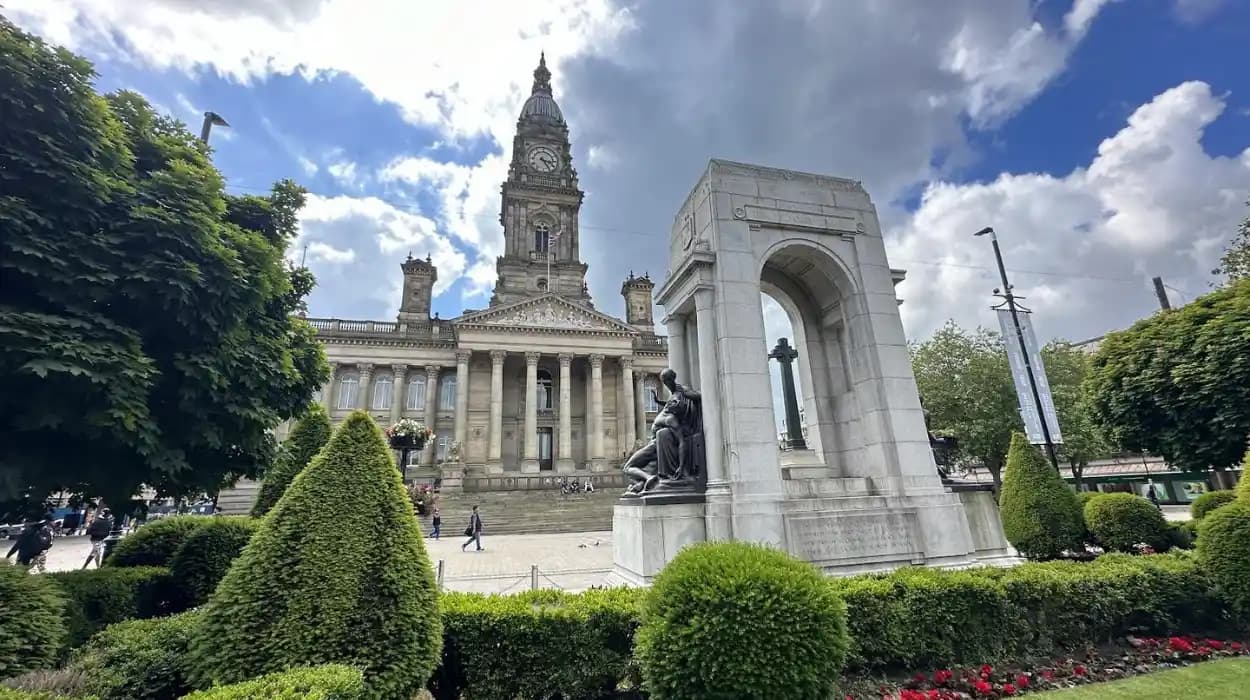
Bolton town centre is widely recognised for its industrial heritage, historic markets, civic architecture, and cultural institutions. Less widely appreciated is its collection of public gardens, landscaped parks, memorial spaces, and restored Victorian green areas that provide peaceful walking opportunities within a short distance of the commercial centre. These gardens reflect more than a century of urban planning, public health reform, philanthropy, and landscape design.
Today, Bolton's gardens serve multiple purposes. They preserve local history, support biodiversity, provide recreational space, and connect visitors with important landmarks including museums, churches, historic halls, and conservation areas. Many originated during the Victorian period, when rapidly expanding industrial towns invested in public parks to improve living conditions for growing populations.
This guide explores the most significant gardens surrounding Bolton town centre, explains their historical development, and examines why they remain valuable landscapes for residents, visitors, educators, and local historians.
Why are gardens around Bolton town centre important for peaceful afternoon walks?
Gardens around Bolton town centre combine Victorian landscape planning, historic monuments, mature woodland, seasonal planting, and accessible pathways within an urban environment. They provide quiet spaces for relaxation while preserving important examples of Bolton's civic development, environmental heritage, and nineteenth-century public health initiatives.
The creation of public gardens in Bolton closely followed Britain's rapid industrial expansion during the nineteenth century. Between 1801 and 1901, Bolton's population increased dramatically as textile manufacturing transformed the town into one of Lancashire's leading industrial centres.
Industrial growth created crowded housing, smoke pollution, and limited access to natural landscapes. Reformers argued that public parks and ornamental gardens improved physical health, mental wellbeing, and civic pride.
Municipal authorities gradually purchased land for public recreation. Wealthy industrial families also donated land and financed improvements that benefited local communities.
Modern visitors walking through Bolton's gardens experience landscapes originally designed to offer respite from mills, factories, and busy commercial streets. Mature trees planted over one hundred years ago continue to define these spaces.
Unlike modern recreational parks, many Victorian gardens intentionally combined ornamental horticulture, memorial architecture, education, and public recreation within carefully planned landscapes.
Which gardens are the most beautiful near Bolton town centre?
Queens Park, Leverhulme Park, the landscaped grounds surrounding Bolton Museum, Moss Bank Park, and several memorial gardens represent Bolton's finest accessible green spaces. Each combines distinctive planting, historical significance, mature trees, and well-maintained walking routes suitable for peaceful afternoon visits.
Although Bolton town centre itself contains civic green spaces, several larger historic gardens lie within walking distance or a short journey.
Queens Park
Opened in 1866, Queens Park became Bolton's first public park.
Its creation reflected Victorian ideals that urban populations required attractive public landscapes. The park includes ornamental lakes, mature avenue trees, flower beds, bridges, and formal lawns.
Many original landscape features survive despite later restoration projects.
Leverhulme Park
Leverhulme Park developed through the philanthropy of William Hesketh Lever, later known as Viscount Leverhulme.
The extensive grounds combine recreational facilities with broad open landscapes, woodland planting, and riverside walks.
Although designed for active recreation, quieter areas remain ideal for peaceful walking.
Moss Bank Park
Originally part of a private estate, Moss Bank Park later became public open space.
The gardens contain mature woodland, seasonal planting, ornamental borders, and wide pathways.
Its elevated position provides attractive views across Bolton.
Civic Memorial Gardens
Around Bolton Town Hall and nearby civic buildings, landscaped gardens commemorate military service, community history, and important civic events.
These formal spaces feature carefully maintained planting alongside memorial structures.
How did Bolton's public gardens develop during the Victorian era?
Victorian Bolton developed public gardens through municipal investment, philanthropy, and public health reform. Industrialisation created overcrowded neighbourhoods, prompting civic leaders to establish landscaped parks that improved sanitation, recreation, education, and environmental quality for rapidly expanding urban populations.
The nineteenth century transformed Bolton from a market town into one of Britain's major cotton manufacturing centres.
Industrial prosperity generated wealth alongside overcrowding.
Factory workers often lived close to mills where housing density remained extremely high.
Urban reformers increasingly recognised the importance of accessible green space.
The Public Health Act of 1848 encouraged local authorities to improve urban environments.
Municipal parks became visible symbols of responsible civic government.
Landscape architects designed gardens that balanced ornamental beauty with practical recreation.
Tree-lined avenues reduced dust.
Lawns created open visual space.
Flower displays demonstrated horticultural achievement.
Lakes improved visual appeal while supporting wildlife.
Many public gardens also included educational planting schemes introducing visitors to native and imported tree species.
Bolton followed national trends established in cities including Liverpool, Manchester, and London while adapting designs to local geography and available land.
What historical features can visitors still see in Bolton's gardens today?
Historic gardens around Bolton retain Victorian pathways, mature specimen trees, ornamental lakes, memorials, historic entrances, stone bridges, heritage railings, and original landscape layouts. These surviving features demonstrate nineteenth-century park design principles and continued municipal conservation across successive generations.
Many original design elements remain remarkably intact.
Victorian park designers carefully arranged circulation routes.
Curved pathways encouraged leisurely walking while revealing changing views.
This approach reflected landscape principles developed during the eighteenth and nineteenth centuries.
Large specimen trees now dominate many gardens.
Cedars, beeches, oaks, horse chestnuts, and lime trees planted during the Victorian period have reached full maturity.
These living historic features often represent the oldest elements within the landscape.
Stone bridges crossing streams or ornamental water features survive in several parks.
Decorative cast-iron railings, historic gates, and original entrance lodges also remain.
War memorials introduced during the twentieth century added further historical significance without fundamentally altering Victorian layouts.
Interpretation boards increasingly explain these features for modern visitors.
How do Bolton's gardens support local wildlife and biodiversity?
Historic gardens support birds, insects, mammals, flowering plants, mature trees, wetlands, and seasonal habitats. Their ecological importance complements historical value by preserving urban biodiversity while demonstrating how nineteenth-century landscape planning continues benefiting modern environmental conservation across Bolton.
Victorian park designers valued visual beauty.
Modern conservation additionally recognises ecological importance.
Large mature trees provide nesting opportunities for numerous bird species.
Examples include robins, great tits, wood pigeons, tawny owls, and nuthatches.
Flower borders support pollinating insects.
Examples include bees, butterflies, hoverflies, and moths.
Ponds and lakes create freshwater habitats.
Examples include ducks, moorhens, dragonflies, damselflies, and amphibians.
Dead wood retained within woodland sections encourages fungi and invertebrates.
Native planting programmes increasingly strengthen ecological resilience while maintaining historical character.
Urban biodiversity contributes to wider environmental networks linking gardens, woodlands, rivers, and agricultural landscapes throughout Greater Manchester.
What role did philanthropy play in creating Bolton's green spaces?
Industrial philanthropists donated land, funded improvements, and promoted public recreation throughout Bolton. Their contributions reflected Victorian beliefs that education, health, recreation, and environmental improvement strengthened communities while supporting social stability during rapid industrial expansion.
Philanthropy significantly influenced Bolton's urban landscape.
Successful industrialists frequently invested in civic improvement.
Among the most influential figures was William Hesketh Lever.
Lever accumulated wealth through soap manufacturing before supporting numerous public initiatives.
His donations extended beyond Bolton and included museums, villages, educational institutions, and public parks.
Other benefactors funded libraries, schools, hospitals, churches, and landscaped recreational areas.
Municipal authorities frequently partnered with private donors to expand public amenities.
This combination of public funding and private philanthropy shaped much of Bolton's surviving historic environment.
Many commemorative plaques within parks continue acknowledging these contributions.
How have Bolton's gardens changed during the twentieth and twenty-first centuries?
Bolton's gardens evolved through restoration projects, conservation programmes, improved accessibility, biodiversity initiatives, community volunteering, and heritage funding. Modern management balances historical preservation with contemporary recreational needs while protecting significant landscape features for future generations.
Public parks experienced changing priorities throughout the twentieth century.
Following both World Wars, memorials became important additions.
Post-war recreational facilities expanded.
Some ornamental planting schemes simplified because of maintenance costs.
From the late twentieth century onwards, heritage conservation gained increasing importance.
Historic landscape restoration programmes repaired original pathways.
Examples include resurfaced Victorian walks, restored ornamental lakes, and reconstructed heritage entrances.
Tree management focused on preserving mature specimens while introducing carefully selected replacements.
Community volunteer groups increasingly assisted with planting projects, habitat improvement, and educational events.
Accessibility improvements enabled wider public use without compromising historic layouts.
Digital interpretation now helps visitors understand historical significance through heritage trails and educational resources.
To experience these historic landscapes in person today, consult our comprehensive [How Public Gardens Became Part of Bolton's Heritage] for itineraries and visiting parameters.
Why do Bolton's historic gardens remain valuable for education and heritage?
Historic gardens provide outdoor classrooms illustrating urban history, landscape architecture, ecology, industrialisation, conservation, and civic planning. Their preserved environments help students, researchers, genealogists, and visitors understand how Bolton developed through successive historical periods.
Educational value extends far beyond horticulture.
Landscape historians examine surviving Victorian layouts.
Architectural researchers study memorials and entrance structures.
Environmental scientists monitor biodiversity.
Genealogists explore commemorative monuments linked to local families.
Schools regularly use parks for outdoor learning.
Examples include history fieldwork, geography surveys, ecological observation, and local heritage projects.
Museums frequently collaborate with park authorities to interpret civic history.
Public gardens also encourage historical literacy.
Visitors gain direct understanding of how industrial towns invested in public welfare through carefully planned green infrastructure.
This combination of historical evidence and living landscape makes Bolton's gardens valuable educational resources.
How can visitors enjoy peaceful afternoon walks while respecting Bolton's historic gardens?
Visitors protect Bolton's historic gardens by following designated paths, respecting heritage features, supporting conservation initiatives, observing wildlife responsibly, and appreciating the historical landscapes without causing damage to protected monuments, planting, or natural habitats.
Responsible access ensures historic gardens remain preserved.
Walking routes minimise soil erosion.
Historic walls and memorials require protection from climbing.
Wildflower areas benefit from reduced disturbance.
Seasonal planting requires ongoing maintenance.
Photography remains one of the best ways to document these landscapes without affecting their condition.
Visitors often discover changing seasonal colours.
Examples include spring bulbs, summer floral displays, autumn foliage, and winter architectural tree forms.
Local heritage organisations regularly organise guided walks explaining historical development, notable landscape features, and restoration projects.
These events strengthen community understanding while encouraging continued conservation.
Historic gardens therefore function simultaneously as recreational landscapes, educational resources, ecological habitats, and enduring symbols of Bolton's civic identity.
Bolton's gardens represent far more than attractive green spaces within an urban setting. They preserve over 150 years of landscape history shaped by industrial growth, Victorian public health reform, philanthropy, municipal planning, and ongoing conservation. Queens Park, Leverhulme Park, Moss Bank Park, civic memorial gardens, and other landscaped areas demonstrate how carefully designed public environments improved quality of life during one of Britain's most significant periods of industrial expansion.
Today, these gardens continue serving residents and visitors through peaceful walking routes, mature woodland, ornamental planting, wildlife habitats, and accessible heritage landscapes. Their surviving pathways, historic trees, memorials, lakes, and architectural features provide tangible connections to Bolton's past while supporting biodiversity and environmental resilience.
For educators, historians, genealogists, conservationists, and cultural tourists, Bolton's historic gardens offer an accessible way to understand the town's evolution beyond its mills and markets. As restoration programmes and community stewardship continue, these landscapes remain essential components of Bolton's cultural heritage and enduring places for peaceful afternoon walks.
FAQS
What are the best gardens around Bolton town centre for peaceful walks?
Queens Park, Leverhulme Park, Moss Bank Park, and the civic gardens around Bolton Town Hall are among the best places for peaceful walks. They offer landscaped paths, mature trees, seasonal flower displays, and historic surroundings.