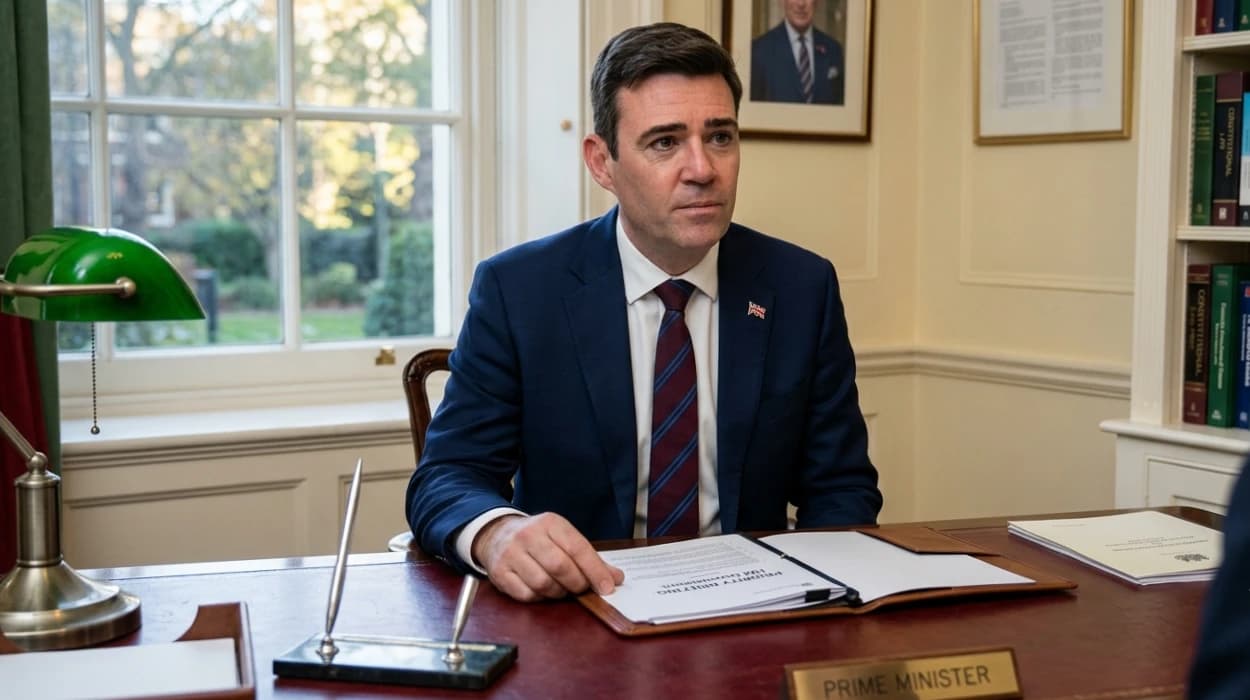
The office of the Prime Minister of the United Kingdom represents the head of His Majesty's Government, holding primary executive authority within the British parliamentary constitutional monarchy. On July 20, 2026, Andy Burnham officially assumed the role of Prime Minister following his formal appointment by King Charles III at Buckingham Palace. He succeeded Keir Starmer, becoming the seventh individual to hold the position of Prime Minister within a ten-year span. This analysis by Bolton Today provides a comprehensive examination of the modern Prime Minister's role, constitutional authority, succession mechanics, cabinet governance structure, and policy impact within the United Kingdom.
Who is the new Prime Minister of the United Kingdom?
The Right Honourable Andy Burnham MP became the Prime Minister of the United Kingdom on July 20, 2026, succeeding Keir Starmer. A former Mayor of Greater Manchester and Cabinet minister, Burnham was elected Leader of the Labour Party prior to taking office.
Background and Early Parliamentary Career
Andy Burnham entered the House of Commons as the Member of Parliament (MP) for Leigh in June 2001. He served continuously in Parliament until May 2017. During the Labour administrations of Prime Ministers Tony Blair and Gordon Brown, Burnham held key executive portfolios.
He served across three Cabinet positions:
- Chief Secretary to the Treasury (2007–2008): Managed public expenditure allocation and departmental budget reviews.
- Secretary of State for Culture, Media and Sport (2008–2009): Oversaw government strategy for the London 2012 Olympic Games.
- Secretary of State for Health (2009–2010): Administered the operational strategy and capital budget of the National Health Service (NHS) in England.
Following the 2010 general election, Burnham held three senior Shadow Cabinet roles:
- Shadow Secretary of State for Health (2010–2011)
- Shadow Secretary of State for Education (2011–2015)
- Shadow Home Secretary (2015–2016)
Devolved Governance as Mayor of Greater Manchester
In May 2017, Burnham transitioned from Westminster to local government upon winning the inaugural election for Mayor of Greater Manchester. He secured re-election for two subsequent terms in May 2021 and May 2024. As metro mayor, Burnham exercised devolved executive powers over 2.8 million residents across 10 metropolitan boroughs, including Bolton, Manchester, Salford, and Wigan.
Burnham implemented structural regional reforms, including 2 major transport and administrative initiatives:
- The Bee Network: Re-regulated the regional bus network under public control via franchising contracts, marking the first local public bus control in England since deregulation in 1986.
- Places for Everyone Plan: Formulated a joint spatial framework to guide housing development, employment zone allocation, and infrastructure funding across 9 Greater Manchester boroughs.
Return to Parliament and Elevation to Prime Minister
Burnham returned to national politics by winning a parliamentary by-election as MP for Makerfield in June 2026. Following the resignation of Keir Starmer on June 22, 2026, the Labour Party initiated a leadership election. Burnham received nominations from 379 out of 401 Labour Members of Parliament, exceeding the required threshold of parliamentary support. The Labour Party formally declared Burnham as party leader on July 16, 2026. On July 20, 2026, King Charles III invited Burnham to form a government, officially establishing him as Prime Minister and First Lord of the Treasury.
How is a new Prime Minister appointed in the United Kingdom constitutional system?
A new Prime Minister is appointed by the Sovereign under Royal Prerogative once an individual demonstrates the ability to command the confidence of the House of Commons. This transition occurs without a general election when the ruling party changes leaders.
The Constitutional Mandate and Royal Prerogative
The United Kingdom does not feature a directly elected executive branch. Instead, executive power flows through the constitutional convention of parliamentary command. Under the constitutional framework, the Sovereign acts on the convention that the leader of the political party with a majority of seats in the House of Commons is invited to form a government.
The legal process follows 3 constitutional steps:
- Formal Resignation: The outgoing Prime Minister meets the Monarch at Buckingham Palace to tender their official resignation.
- Audience with the Monarch: The prospective Prime Minister attends an audience with the Sovereign shortly thereafter.
- Kissing Hands: The Sovereign formally asks the individual to form an administration. Upon acceptance, the individual assumes executive authority as Prime Minister, First Lord of the Treasury, and Minister for the Civil Service.
Parliamentary Confidence Mechanics
The fundamental prerequisite for holding the office of Prime Minister is maintaining the confidence of the House of Commons. This confidence is periodically tested through parliamentary votes.
Confidence is demonstrated through 3 primary parliamentary mechanisms:
- The King's Speech Vote: Approval of the legislative agenda presented during the State Opening of Parliament.
- Supply and Appropriation Bills: Passing annual state budgets and government taxation legislation.
- Explicit Motions of Confidence: Votes specifically tabled under parliamentary rules to test government support.
If a government loses a motion of no confidence by a simple majority vote in the House of Commons, conventions require either the resignation of the Prime Minister or the dissolution of Parliament, triggering a general election.
What are the official constitutional powers and responsibilities of the Prime Minister?
The Prime Minister exercises executive power derived from Royal Prerogative and statutory law. Responsibilities include directing the Civil Service, appointing government ministers, managing Cabinet meetings, commanding national security apparatus, and representing the nation internationally.
Directing the Executive Administration and Civil Service
The Prime Minister serves as the head of His Majesty's Government and Minister for the Civil Service. The Prime Minister sets the internal structure of government departments, allocates portfolio boundaries, and approves senior civil service appointments.
Administrative authority encompasses 3 core structures:
- The Cabinet Office: Provides operational and administrative support to the Prime Minister and coordinate policy across government departments.
- 10 Downing Street Operations: Houses the Prime Minister's Private Office, Policy Unit, Communications team, and specialized task forces.
- No10 North Situation Room: Established in July 2026 as a regional government command center in Greater Manchester to decentralize executive decision-making.
Ministerial Patronage and Cabinet Formation
Under Royal Prerogative delegated powers, the Prime Minister holds absolute discretion over ministerial patronage. The Prime Minister hires, fires, and reshuffles all members of the government.
This authority controls 3 tiers of government appointments:
- Cabinet Ministers: Heads of major state departments, such as the Chancellor of the Exchequer, Foreign Secretary, and Home Secretary.
- Ministers of State: Senior departmental executives responsible for specific policy directorates.
- Parliamentary Under-Secretaries of State: Junior ministers managing specific legislative files.
National Security and War Powers
The Prime Minister exercises ultimate responsibility for national security, intelligence oversight, and defense policy. The Prime Minister chairs the National Security Council (NSC) and maintains sole operational authority over the deployment of the United Kingdom's Trident nuclear deterrent.
Defense responsibilities include 3 specific statutory authorities:
- Letters of Last Resort: Direct written instructions stored aboard Vanguard-class ballistic missile submarines detailing nuclear response protocol in the event of command structure destruction.
- Intelligence Agency Oversight: Direct supervision of MI5 (Security Service), MI6 (Secret Intelligence Service), and GCHQ (Government Communications Headquarters).
- Civil Contingencies Chairmanship: Directing the COBR (Cabinet Office Briefing Room) committee during national security emergencies or natural disasters.
What political mechanism allows a transition of executive leadership without a general election?
British parliamentary rules permit a governing party to select a new leader who automatically becomes Prime Minister if the party holds a House of Commons majority. No general election is constitutionally required until parliamentary terms expire.
Midterm Succession Principles
In the United Kingdom, voters elect local Members of Parliament rather than a president or head of executive government directly. The parliamentary system decouples the mandate of the political party in power from the individual serving as Prime Minister. Consequently, if a Prime Minister resigns mid-term due to illness, political pressure, or loss of party support, the governing party retains its legislative majority.
Historical precedents of mid-term executive replacement include 6 notable modern transitions:
- Winston Churchill to Anthony Eden (1955): Conservative Party leadership transfer.
- Harold Wilson to James Callaghan (1976): Labour Party leadership transfer.
- Margaret Thatcher to John Major (1990): Conservative Party leadership transfer.
- Tony Blair to Gordon Brown (2007): Labour Party leadership transfer.
- David Cameron to Theresa May (2016): Conservative Party leadership transfer.
- Keir Starmer to Andy Burnham (2026): Labour Party leadership transfer.
Governing Leadership Election Frameworks
Each political party maintains internal rules for electing leaders. When the party holds a government majority, these internal rules dictate who becomes Prime Minister.
The Labour Party leadership election framework requires 3 sequential phases:
- Parliamentary Nomination Phase: Candidates must secure formal nominations from a minimum threshold of Parliamentary Labour Party (PLP) members. In July 2026, Burnham secured 379 nominations out of 401 MPs.
- Endorsement Phase: Candidates require backing from affiliate organizations, including trade unions and socialist societies.
- Electoral College Voting: If multiple candidates meet nomination thresholds, a vote occurs among party members and affiliated supporters. In 2026, prospective opponents withdrew, leaving Burnham as the sole candidate.
What is the structure and role of the Prime Minister's Cabinet and executive administration?
The Cabinet is the supreme decision-making body of the executive branch, composed of approximately 20 senior ministers appointed by the Prime Minister. It operates on collective responsibility, coordinating policy, managing budgets, and directing legislative priorities.
Cabinet Collective Responsibility
The Cabinet operates under the doctrine of Cabinet Collective Responsibility. All Cabinet ministers must publicly support all government decisions made in Cabinet, regardless of personal opinion or private debate. If a minister disagrees with a collective Cabinet decision, constitutional tradition dictates that they must resign from office.
The administration relies on 3 principal executive offices:
- 10 Downing Street: The official office and primary official residence of the Prime Minister.
- The Treasury: The ministry responsible for developing and executing public finance policy and national economic planning.
- The Foreign, Commonwealth and Development Office (FCDO): The department directing international diplomacy, foreign intelligence, and overseas development assistance.
Executive Cabinet Committees
To streamline decision-making, the Prime Minister delegates specific policy oversight to Cabinet committees. These committees possess delegated executive authority, and their decisions carry the full weight of a plenary Cabinet agreement.
Structure includes 3 distinct types of executive bodies:
- Cabinet Committees: Permanent bodies dealing with long-term policy priorities such as economic growth, national security, and public service reform.
- Sub-Committees: Specialized groups focusing on technical sub-topics within a broader Cabinet committee's domain.
- Implementation Taskforces: Temporary action-oriented units created by the Prime Minister to monitor progress on urgent government directives.
How does the Prime Minister interact with Parliament and the Crown?
The Prime Minister acts as the chief liaison between the Crown and Parliament. The role involves reporting weekly to the Monarch, leading government business in the House of Commons, and answering parliamentary inquiries.
Executive Relations with the Sovereign
The Prime Minister holds a weekly private audience with the Monarch, continuing a constitutional practice spanning centuries. During these audiences, the Prime Minister briefs the Sovereign on major government decisions, national security developments, and legislative progress. While the Monarch retains the legal right to be consulted, to encourage, and to warn, constitutional monarchical practice dictates that the Sovereign acts strictly on the advice of the Prime Minister and Cabinet.
The relationship involves 3 formal constitutional obligations:
- Weekly Audiences: Private discussions regarding national policy and governance matters.
- Distribution of Cabinet Papers: Transmitting official Cabinet agendas, minutes, and intelligence briefings to the Sovereign daily via red dispatch boxes.
- Prerogative Approvals: Formal advice tendered to the Monarch on royal assent for bills, public honors, and senior diplomatic appointments.
Parliamentary Accountability and Question Time
The Prime Minister remains directly accountable to Parliament and must maintain an active seat in the House of Commons.
Parliamentary scrutiny operates through 3 core mechanisms:
- Prime Minister's Questions (PMQs): A mandatory 30-minute weekly session held every Wednesday in the House of Commons, where the Prime Minister answers questions from the Leader of the Opposition and backbench MPs.
- Statements to the House: Formal oral announcements delivered by the Prime Minister following international summits, national emergencies, or major policy shifts.
- Liaison Committee Appearances: Multi-hour questioning sessions conducted twice yearly by the Liaison Committee, which comprises the chairs of all House of Commons select committees.
What economic and domestic policies define the governance agenda of the new administration?
The administration focuses on regional devolution, public infrastructure re-regulation, economic decentralization, and industrial transition. Policy shifts include establishing No10 North and reforming national growth distribution models.
Regional Devolution and Executive Decentralization
Andy Burnham's administration emphasizes decentralizing governance away from Whitehall. The centerpiece of this strategy is the operationalization of "No10 North," an executive situation room and administrative hub located in Greater Manchester.
Devolution policies target 3 primary sectors:
- Transport Franchising: Expanding the Bee Network model nationally to allow local authorities to regulate bus services, integrate ticketing systems, and set fares.
- Housing and Planning Integration: Granting regional mayors statutory powers over land assembly, spatial planning, and local development zone designation.
- Skills and Workforce Training: Transferring post-16 adult education budgets directly to combined authorities and local council partnerships.
Economic Strategy and Energy Sector Governance
The government seeks to balance structural investments in green energy with immediate energy security measures. The administration maintains existing North Sea oil and gas concessions while halting the issuance of new exploration licenses.
Industrial policies target 3 economic goals:
- Targeted Growth Protocols: Implementing tailored industrial strategies across distinct region-specific hubs.
- Artificial Intelligence Taskforce: Establishing the Prime Minister's AI Taskforce, chaired by Lord Vallance, to integrate technology applications within Civil Service delivery.
- Business Compact Reforms: Delivering negotiated regulatory frameworks directly to industrial groups to drive private sector capital investments.
How does the transition of Prime Ministerial leadership impact foreign policy and international relations?
Foreign policy maintains foundational commitments to NATO, Ukraine defense support, and international trade agreements. The transition alters international engagement strategies by emphasizing domestic economic stabilization alongside diplomatic alliances.
Transatlantic Diplomacy and Global Alliances
The Prime Minister directs foreign policy alongside the Foreign Secretary, maintaining bilateral relations with global superpowers and international organizations. Following his appointment on July 20, 2026, Burnham held initial diplomatic communications with US President Donald Trump, discussing strategic maritime security in the Strait of Hormuz and bilateral trade coordination.
Foreign relations encompass 3 core security frameworks:
- NATO Obligations: Maintaining defense spending above 2% of Gross Domestic Product (GDP) and supporting Joint Expeditionary Force deployments.
- Bilateral European Ties: Strengthening security partnerships and trade coordination with European Union nations, as highlighted by formal discussions with EU Commission President Ursula von der Leyen.
- Commonwealth Coordination: Re-engaging with member nations on economic treaties and shared security frameworks, affirmed during official statements on the Commonwealth Games.
Strategic Overview of Modern UK Prime Ministers
The rapid succession of Prime Ministers since 2016 highlights the dynamic nature of British executive political transitions.
Historical summary of recent UK Prime Ministers:
- David Cameron (2010–2016): Conservative; resigned following the June 2016 European Union referendum vote.
- Theresa May (2016–2019): Conservative; appointed after party leadership contest; resigned over parliamentary Brexit deadlock.
- Boris Johnson (2019–2022): Conservative; won 2019 general election majority; resigned following government ethics controversies.
- Liz Truss (2022): Conservative; served 49 days; resigned following market volatility linked to autumn fiscal plans.
- Rishi Sunak (2022–2024): Conservative; appointed following leadership contest; left office after 2024 general election.
- Keir Starmer (2024–2026): Labour; won July 2024 general election; resigned June 2026 following internal political developments.
- Andy Burnham (2026–Present): Labour; assumed office July 20, 2026, after winning parliamentary leadership vote.
The legal continuity of the United Kingdom executive branch remains grounded in parliamentary conventions. As Prime Minister Andy Burnham assumes executive authority, Bolton Today will continue to deliver accurate reporting on national policy changes, constitutional developments, and regional economic impacts.
FAQS
Who is the current Prime Minister of the United Kingdom?
According to the article provided, Andy Burnham became Prime Minister of the United Kingdom on 20 July 2026, succeeding Keir Starmer.