Key Points
- A six-month trial using a monitoring camera at the junction of Blackburn Road, Moss Bank Way and Crompton Way in Astley Bridge recorded about 700 red-light offences each month.
- Highways officers said 99.5 per cent of motorists passing through the busy junction comply with the traffic signals.
- Most red-light offences were recorded between 5am and 9am, with the highest number at 7am.
- Following the monitoring trial, council authorities are working with Greater Manchester Police (GMP) to penalise offenders and enforce road safety laws.
- Crash records show 35 injury-causing collisions at the junction between 1999 and 2023, including 15 between 2019 and 2023.
- Local ward councillors and residents have criticised previous £1 million junction reconfigurations, pointing to missing right-turn filter arrows and traffic signals that are out of sync.
- The monitoring and planned police enforcement are part of Greater Manchester’s ‘Vision Zero’ strategy, which aims to eliminate traffic fatalities and life-changing injuries by 2040.
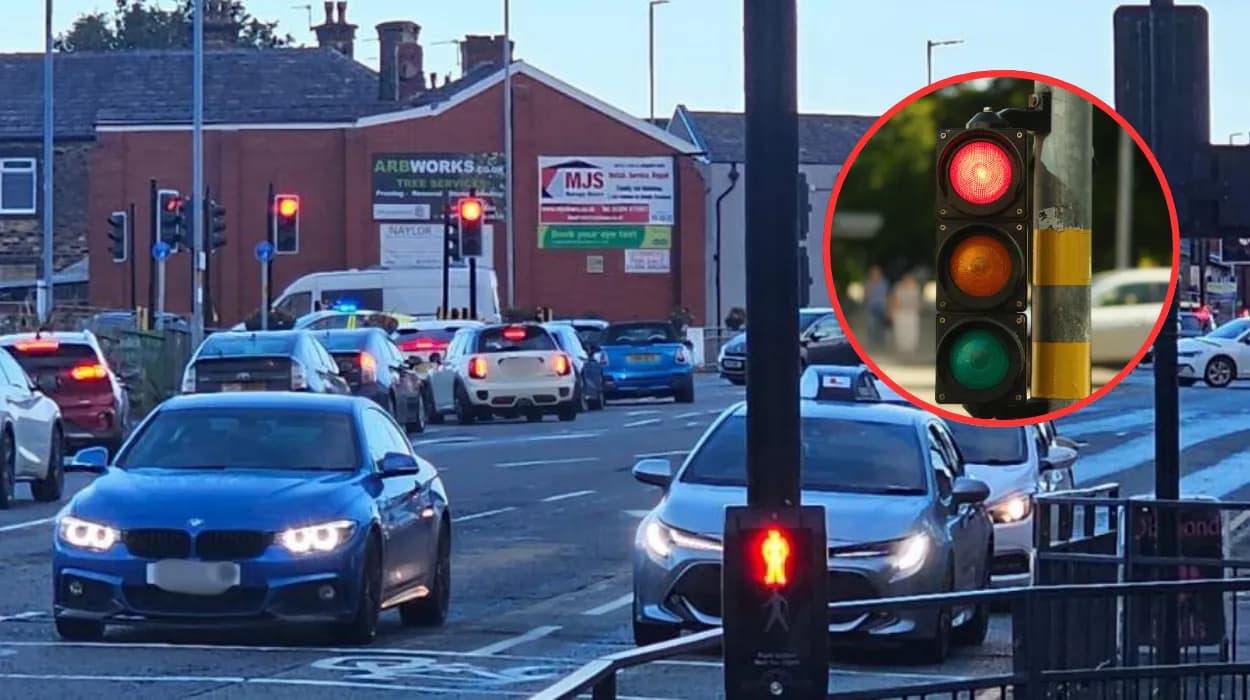
Bolton (Bolton Today) August 27, 2026 — A notorious road intersection in Astley Bridge, widely dubbed by local residents as the "junction of doom", is facing imminent police enforcement after a six-month monitoring trial revealed that around 700 drivers jump red lights at the site every single month.
The stark monitoring data was presented directly to municipal leaders as council highways officers confirmed plans to transition from data collection to active criminal enforcement alongside traffic officers from Greater Manchester Police. Located at the busy crossroads where the A666 Blackburn Road intersects with the A58 Moss Bank Way and Crompton Way, the junction has long been a flashpoint for road traffic collisions, technical signal glitches, and persistent driver frustration.
Despite the high volume of monthly violations recorded by the monitoring apparatus, council officials emphasized that the vast majority of road users act lawfully. Out of the tens of thousands of vehicles traversing the major arterial link daily, 99.5 per cent of motorists obey the signal controls, leaving a small minority responsible for the hundreds of potentially catastrophic traffic offences recorded every four weeks.
What Did the Six-Month Trial Reveal About Driver Behaviour?
The preliminary findings of the council's road safety audit were delivered during a formal meeting of Bolton Council's Place Scrutiny Committee. Highway directors outlined how public outcry and a pattern of vehicular collisions forced municipal authorities to install dedicated monitoring equipment to capture empirical evidence of motorist behaviour.
As reported by journalist Gaynor Clarke of The Bolton News, Dwayne Lowe, deputy director of highways and planning at Bolton Council, stated that
"We have seen an awful lot of incidents at this junction, in particular at the change of the alignment of this junction, which has resulted in several minor incidents and accidents".
Detailing the pressure placed upon the local authority by concerned residents and elected representatives, Lowe explained the scope of the trial and its statistical outcome to the committee members. As documented by Gaynor Clarke of The Bolton News, Dwayne Lowe stated that
"There was a lot of pressure on us to look into it. We've had a red light camera there to get that data for six months. It has shown 700 offences, which sounds a lot. However, it does show 99.5 per cent compliance at that junction".
The monitoring trial revealed specific temporal patterns regarding when drivers are most inclined to break the law. Highways data highlighted that red-light running is overwhelmingly concentrated in the early morning hours before typical peak rush-hour congestion fully materialises.
As reported by Gaynor Clarke of The Bolton News, Dwayne Lowe stated that
"Between 5am and 9am there's an awful lot of cars running through red lights. The peak being at 7am when drivers think the roads are quieter and so it's acceptable to run through red lights".
How Are Authorities Moving from Monitoring to Police Enforcement?
Having gathered six months of continuous traffic data from one approach, council engineers have now physically relocated the trial camera to another arm of the Blackburn Road intersection to compile comparative baseline statistics across all traffic lanes. However, official strategy is rapidly shifting from passive observation to punitive measures designed to deter reckless driving.
Addressing the committee on the immediate next steps for the local authority and law enforcement, highway chiefs confirmed that motorists jumping signals will soon face formal prosecution, penalty points, and fines. As reported by Gaynor Clarke of The Bolton News, Dwayne Lowe stated that
"The next step is to work with GMP to enforce upon some of those drivers, as they are breaking the law".
The junction already falls within the routine operational zone of Greater Manchester Police’s Astley Bridge neighbourhood policing team, who treat Blackburn Road and Moss Bank Way as priority corridors for combatting excess speed and aggressive driving maneuvers. The integration of red-light enforcement cameras into active police databases is expected to streamline the issuance of Notices of Intended Prosecution (NIPs) to offending vehicle owners.
Explore More Astley Bridge News
Moss Lea Allotment Show Celebrates Community Spirit in Astley Bridge 2026
Pineapple Inn Named Pub of the Week in Astley Bridge 2026
Why Is the Intersection Known as the 'Junction of Doom'?
The moniker "junction of doom" was coined by local residents and road users following years of recurring vehicular crashes, near-misses, and severe traffic congestion. Historical crash data maintained by transport authorities underscores the safety risks associated with the site.
Official casualty records show that between 1999 and 2023, a total of 35 injury-causing collisions occurred at the Blackburn Road, Moss Bank Way, and Crompton Way intersection. Notably, nearly half of those casualties occurred in recent years, with 15 injury collisions recorded in the five-year window between 2019 and 2023 alone.
Local ward representatives have consistently highlighted that public anxiety regarding the junction escalated significantly following major civil engineering works aimed at improving traffic throughput.
As reported by Gaynor Clarke of The Bolton News, Cllr Toby Hewitt stated during council proceedings that
"I know one of the trials on red light running is in Astley Bridge, and Cllr Hilary Fairclough has really pushed to get a trial to drill down into what local residents call a dangerous junction since the reconfiguration".
Expressing the deep-seated concern among the local populace regarding collision risks, Hewitt reinforced the necessity of translating camera data into tangible safety improvements. As reported by Gaynor Clarke of The Bolton News, Cllr Toby Hewitt stated that
"There was this groundswell of local opinion that there were always crashes there, so it's really interesting to see the analysis has found those 700 offences. I know it's a low percentage, but it's a really busy junction and, if there are repeated road traffic collisions there, there's that potential for danger".
What Is the Controversy Surrounding the £1 Million Scheme?
The ongoing driver disobedience and collision statistics follow a major £1 million infrastructure overhaul funded via the Greater Manchester Growth Deal Fund. The scheme was specifically designed to reduce severe queue times, create safer pedestrian crossings, and introduce a dedicated left-turn lane from Moss Bank Way onto Blackburn Road.
However, the major works drew fierce criticism from community groups and local politicians who argued that the redesign failed to address the core safety hazards identified by drivers who navigate the intersection daily.
As reported by desk journalists at The Bolton News, Astley Bridge ward councillor Hilary Fairclough stated that the Blackburn Road and Moss Bank Way junction had been a “nightmare” for motorists and residents throughout and after the construction period.
Critiquing the lack of permanent enforcement hardware and missing turn filters during the initial £1 million investment, Fairclough voiced local frustration at public Police and Communities Together (PACT) meetings. As reported by The Bolton News, Cllr Hilary Fairclough stated that
“It's a huge disappointment that the alleged all singing all dancing junction didn't have cameras”.
Detailing the disruption and safety failures experienced by local commuters, Fairclough criticized transport planners for failing to incorporate essential safety features into the original project scope. As reported by The Bolton News, Cllr Hilary Fairclough stated that
“Residents and drivers have endured a horrendous time with tailbacks and travel time increasing massively. Accidents became an everyday occurrence, sadly including one fatality, yet none of the so called improvements were what users were calling for, such as safer travel turning right from Moss Bank Way and cameras to catch red light jumping, lane changing and general poor driving”.
Fairclough also challenged the administrative approach of regional transport bodies regarding community feedback. As reported by The Bolton News, Cllr Hilary Fairclough stated that
“Why are the people who use these things the least consulted and subject to a 'we know best' mentality, £1m to achieve so little?”.
What technical glitches have affected the signals?
Beyond deliberate driver non-compliance, the junction has been plagued by recurring operational faults that have exacerbated local motorists' frustration. Reports logged with municipal highways departments include:
- System Desynchronisation: Traffic lights frequently falling out of synchronization with adjacent signalized junctions along the A666 corridor, creating artificial gridlock.
- Filter Light Failures: Technical glitches causing right-turn filter arrows to become frozen or stuck permanently on red, tempting frustrated drivers to complete illegal turns against the signal.
- Total Signal Outages: Intermittent power and software failures leaving the multi-lane interchange completely unguided during peak travel times.
How Does This Enforcement Fit into Greater Manchester's 'Vision Zero'?
The targeted crackdown at Blackburn Road is not an isolated initiative but a key operational component of Greater Manchester’s region-wide road safety framework, known as 'Vision Zero'.
Adopted by the Greater Manchester Combined Authority (GMCA) and supported by local councils including Bolton, Vision Zero sets a strict target to eliminate all road fatalities and life-altering injuries across the ten boroughs by the year 2040.
Highway managers view high-volume enforcement trials—such as the one currently operating in Astley Bridge—as essential toolkits for identifying high-risk driver behavior before fatal collisions occur. By deploying high-definition red-light cameras alongside automated speed enforcement across priority routes, transport managers aim to alter driver culture across urban centers.
As monitoring turns to active prosecution in Bolton, drivers navigating the Blackburn Road 'junction of doom' during the early morning hours face formal notices, fixed penalty fines, and license points as police seek to bring the remaining 0.5 per cent of non-compliant motorists into line.