Key Points
- Greater Manchester Police (GMP) sent Christmas cards to Bolton’s most wanted suspects as part of a festive campaign.
- The cards included a friendly message and a reminder that officers were still looking for them.
- Seven individuals responded by surrendering at police stations across Bolton in December.
- GMP’s Operation Reconnect aims to encourage voluntary surrenders and reduce manhunts.
- Officers said the campaign was designed with “a dash of festive humour” but had “a serious purpose.”
- Police said the operation helped save resources and avoided unnecessary risk to the public.
- Several suspects now face charges ranging from burglary to assault and drugs offences.
- A senior officer described the public’s response as “incredibly positive.”
- GMP continues to seek others who remain on its “wanted” list.
- Community leaders praised the “innovative and human” approach but urged compassionate handling of cases.
Seven of Bolton’s most wanted suspects turned themselves in
after receiving an unusual Christmas greeting card from Greater Manchester
Police (GMP), which reminded them they were being sought by authorities.
The move, part of a fresh policing initiative during the festive season,
combined holiday humour and community policing to surprising success. GMP
confirmed that all seven individuals who responded are now in custody and co‑operating
with investigations.
Why did police send Christmas cards to wanted individuals?
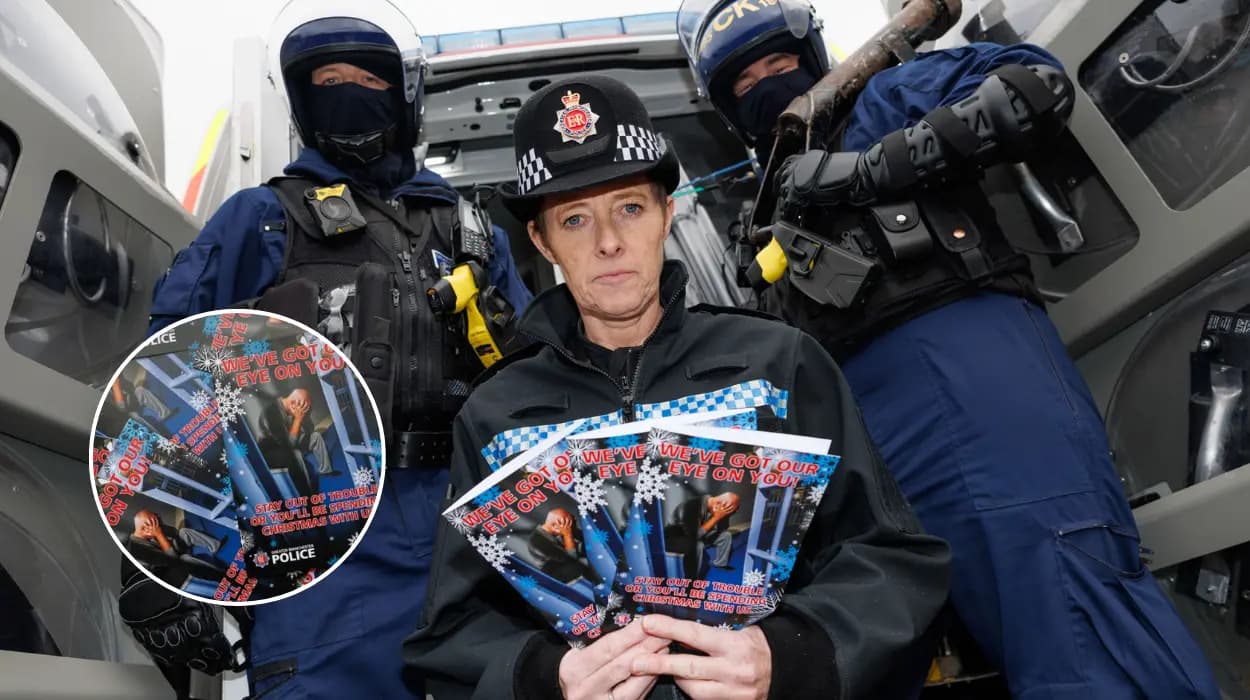
According to The Bolton News reporter Chris Gee, the campaign was coordinated under Operation Reconnect, a GMP initiative originally designed to locate offenders wanted on warrant or recall to prison. Instead of traditional enforcement letters, officers issued Christmas cards to thirteen of Bolton’s most wanted individuals in early December.
The front of the card featured a festive design with a simple message:
“Merry Christmas – we know you’re on our list!”
Inside, officers offered a reminder that the recipients were being sought by police and encouraged them to make contact voluntarily.
Speaking to BBC News Manchester, Detective Inspector Mark Nicholson explained that
“the cards were a light‑hearted way to reach people who’ve been evading us, but with a clear message that we haven’t forgotten them.”
He added,
“No one expected seven people to actually hand themselves in – but we’re glad they have.”
How did the suspects respond to the festive message?
The Manchester Evening News reported that out of the thirteen card recipients, seven visited police stations across Bolton and surrounding areas within two weeks of receiving the letters. Some arrived within days, while others arranged through solicitors to surrender.
One of the first to appear, a 32‑year‑old man wanted in connection with a burglary investigation, turned up at Bolton Police Station “wearing a Christmas jumper,” according to GMP Inspector Helen Fletcher, who spoke to ICTV Granada News.
“He said he thought the card was hilarious but also felt it was time to sort things out,”
she said.
Another recipient reportedly wrote back through his family, saying he “appreciated the humour” but understood that “it was time to face the music.” Officers who later arrested him described him as “co‑operative and aware that the card tipped the balance.”
Which offences were involved?
According to GMP’s official statement, those who came forward were wanted for a range of offences, including theft, burglary, assault, and possession with intent to supply drugs. One individual had been on the run for several months after breaching bail conditions.
As outlined in The Bolton News follow‑up report by Catherine Barton, Inspector Fletcher confirmed that
“we can’t go into operational details of each case, but several have now been charged and are awaiting hearings early in the new year.”
Police also noted that issuing the cards had no impact on ongoing investigations and that all actions were compliant with operational security and privacy standards.
What did officers hope to achieve with this campaign?
The core aim of Operation Reconnect was to reduce time spent tracking fugitives, particularly repeat offenders who had chosen not to appear in court or respond to bail conditions.
Speaking to BBC Radio Manchester, Superintendent Danny O’Neill described the effort as “an example of creative policing that resonates with people.” He continued,
“When individuals see that we can mix humour with responsibility, it changes the tone – it shows we’re still approachable but serious about justice.”
The Guardian’s North of England correspondent Simon Murphy observed that GMP has experimented with community‑driven communications before but called this “the boldest iteration” of the strategy yet, noting that “the power of light‑touch communication” yielded tangible results.
How did the community respond?
Reaction in Bolton was broadly positive. Many residents took to local social media pages to praise the imaginative approach. The Bolton News published community comments showing strong support: one local reader wrote,
“It’s the most Bolton thing ever — humour that actually made the town safer.”
However, some contributors expressed caution. Community advocate Farhan Ali, quoted by Manchester Evening News, said,
“As long as those who came forward are treated fairly and given proper legal support, then this is a positive story, not a publicity stunt.”
Councillor Linda Thomas, the Leader of Bolton Council, also responded on X (formerly Twitter), commending GMP for its “light‑hearted but effective” idea and adding that “getting results through empathy and wit is still good policing.”
Have other forces tried similar tactics?
Festive law enforcement campaigns have become more common across the UK, though few produce such measurable results. In previous years, police forces in Lancashire and Merseyside released Christmas‑themed appeals featuring Santa‑style wanted posters or jingles to attract community tips.
As reported by ITV News, Greater Manchester Police’s latest version stands out because it directly targeted individuals — not the general public — through personalised communication. A policing analyst interviewed by Sky News, Dr Amanda Hesketh of the University of Central Lancashire, remarked that “psychologically, the tactic worked because it reframed the pursuit as a conversation, not a confrontation.”
What are the next steps for those who surrendered?
According to GMP’s official press release (dated 29 December 2025), all seven individuals are now engaged in judicial proceedings. Several are remanded in custody pending court appearances in early January, while others have been granted conditional bail.
Detective Chief Inspector Mark Nicholson reiterated that surrendering voluntarily would be taken into account by the courts, though “it doesn’t absolve anyone from responsibility.” He also reminded those still at large that “it’s never too late to do the right thing.”
A solicitor representing one of the surrendered suspects told The Bolton News that his client “felt genuine relief” after handing himself in.
“Sometimes people live with the stress of warrants and lose perspective,”
he said.
“That card was the final nudge.”
What have experts said about the wider impact?
Policing commentators have highlighted the campaign’s potential to change community perceptions of law enforcement. Criminologist Dr Hesketh told BBC News that acts like this help “soften the image of the police at a time when public trust is under pressure.” She added that voluntary surrender campaigns also “reduce operational strain and demonstrate the constructive use of humour in communication.”
Meanwhile, The Times’ correspondent for northern England, Fiona Hamilton, pointed out that while seven out of thirteen is “a remarkable hit rate,” the approach also underscores “the delicate balance between levity and law enforcement ethics.”
Will GMP repeat the campaign next year?
When asked by ITV Granada, Superintendent O’Neill said there were no firm plans yet but acknowledged the internal discussion.
“We’ll see how this batch of cases unfolds,”
he said.
“If the results remain positive and public feedback supportive, then maybe next Christmas we’ll extend it beyond Bolton.”
Speaking humorously, he concluded,
“Though we may need to think of some fresh puns — we’ve probably used all the festive ones already.”