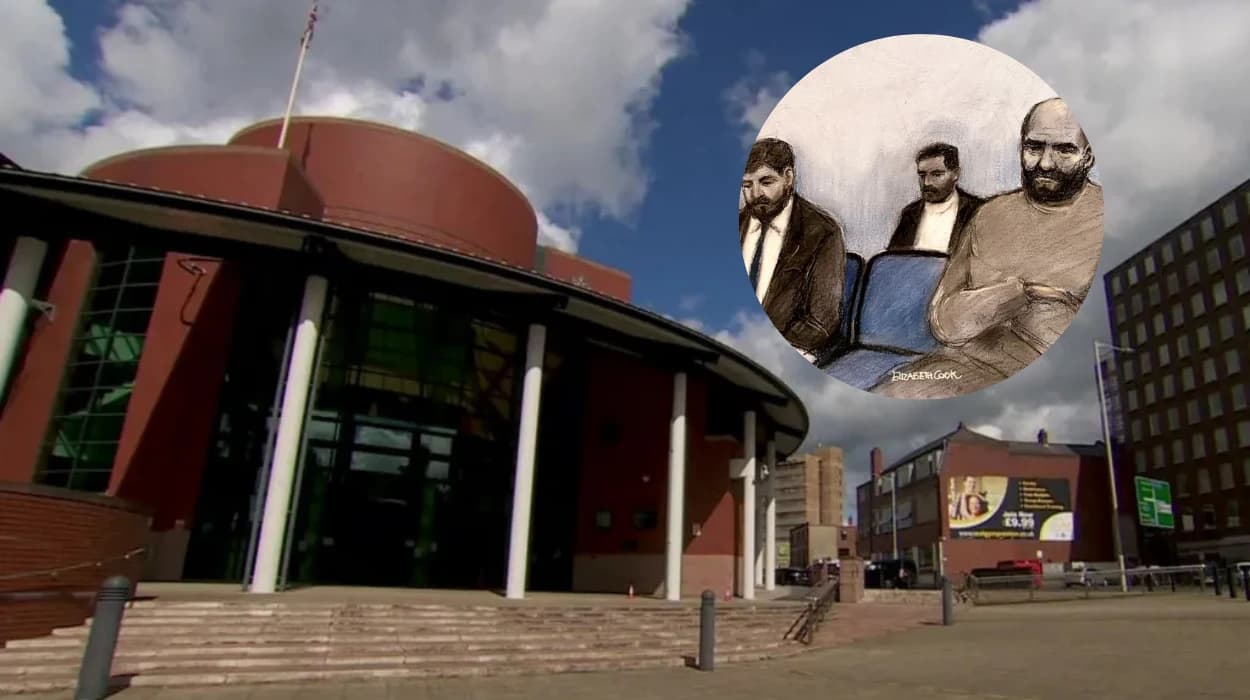
Key Points
- Walid Saadaoui, 38, and Amar Hussein, 52, are on trial at Preston Crown Court, accused of preparing acts of terrorism between 13 December 2023 and 9 May 2024, with plans to cause mass casualties among the Jewish community in north west England.
- The prosecution, led by Harpreet Sandhu KC, alleges the pair planned a suicide attack using assault rifles and handguns, intending to kill as many Jewish people as possible and any police officers who intervened.
- Saadaoui was arrested in a Bolton hotel car park on 8 May 2024 after a video sting operation revealed him near a vehicle containing two assault rifles, a semi-automatic handgun, and nearly 200 rounds of ammunition; he was expecting a further shipment of weapons and 700 rounds.
- The men communicated with an individual they believed was a fellow extremist named Farouk, but who was in fact an undercover police agent, allowing authorities to thwart the plot.
- A third defendant, Bilel Saadaoui, 36, Walid's brother, is charged with failing to disclose information about the terrorist acts, having sympathised with Islamic State ideology and received a will prepared by his brother for a "martyrdom" operation.
- During the trial's opening, Amar Hussein shouted obscenities at the prosecution, denying the allegations and questioning the number of children harmed, leading to his temporary removal from the courtroom by order of Mr Justice Wall.
- The judge explicitly instructed the jury that the case was not connected to a recent attack on the Heaton Park Hebrew Congregation Synagogue in Crumpsall, Manchester, urging them to judge the defendants fairly without external influence.
- Evidence presented includes WhatsApp messages between the defendants celebrating Jewish casualties and images of the Manchester Jewish Museum found on Hussein's phone, which the prosecution argues demonstrate a long-standing, deep-rooted animosity.
- All three defendants deny the charges, and the trial is expected to last for 12 weeks.
Inverted Pyramid of Triangle
Walid Saadaoui and Amar Hussein are standing trial at Preston Crown Court, accused of plotting a terrorist attack designed to inflict "untold harm" and "mass fatalities" on the Jewish community in Manchester, a case that has already seen a dramatic courtroom outburst from one of the defendants. The prosecution has laid out a detailed case alleging that the two men, radicalised Islamic extremists, spent months preparing for a suicide mission involving high-powered firearms, with the intent to kill as many Jewish people as possible in the north west of England. An undercover police operation reportedly foiled the plot, after the pair unknowingly communicated with an officer posing as an extremist accomplice, leading to Saadaoui's arrest in a Bolton car park on 8 May 2024. Alongside them, Bilel Saadaoui, Walid's brother, faces charges for failing to report the planned atrocity, despite being aware of his sibling's intentions and extremist ideology. The trial, which is expected to run for 12 weeks, has been marked by its gravity and sensitivity, with the presiding judge, Mr Justice Wall, having to intervene to maintain order and ensure a fair trial.
Who are the men accused of plotting the terrorist attack?
The two primary defendants are Walid Saadaoui, 38, from Abram, near Wigan, and Amar Hussein, 52, who has no fixed address. As reported by Harpreet Sandhu KC, the prosecutor, Saadaoui was arrested in a hotel car park in Bolton after a video sting operation showed him near the open trunk of a vehicle. Inside the car, counter-terrorism officers discovered two assault rifles, a semi-automatic handgun, and nearly 200 rounds of ammunition. Sandhu told the jury that these weapons were "lethal" and comparable to those used in the 2015 Paris attacks, capable of discharging several hundred rounds per minute. He stated that Saadaoui was on the verge of receiving a further shipment of weapons and ammunition, which would have enabled the pair to carry out their planned attack. Hussein, who was employed at a location on Gian Crescent, Bolton, is alleged to have been a key conspirator, sharing Saadaoui's extremist views and intent to cause mass casualties.
What was the nature of the planned attack?
The prosecution's case, as presented by Sandhu, is that Saadaoui and Hussein were not merely preparing for a random act of violence, but for a coordinated, high-casualty terrorist assault. "Their aim was to kill," Sandhu stated, explaining that the pair sought to
"cause mass casualties, particularly targeting as many members of the Jewish community as possible".
The plan involved acquiring the necessary weapons and identifying large gatherings of Jewish individuals to attack, with the prosecution noting that the defendants had specifically identified areas in Greater Manchester with significant Jewish populations. Furthermore, the prosecution alleges that the men intended to kill any law enforcement officers who attempted to intervene, demonstrating a willingness to die in the process. Sandhu described them as "Islamic extremists willing to risk their own lives" to become "martyrs," a sentiment that was reinforced by evidence that Walid Saadaoui had prepared a will in anticipation of his death.
How was the plot uncovered and thwarted?
The investigation into Saadaoui and Hussein's activities was made possible through a covert operation involving an undercover police agent. As reported by the prosecution, the two men believed they were communicating with a third individual named Farouk, whom they assumed shared their extremist ideology and could assist in their plot. However, the court was informed that Farouk was, in fact, an undercover officer. Their communications with this agent provided the police with the intelligence needed to monitor their activities and ultimately prevent the attack from being carried out. The culmination of this surveillance was Saadaoui's arrest on 8 May 2024, when he was caught on police body-worn cameras fleeing from officers as they approached to arrest him in the Bolton hotel car park. The discovery of the weapons in the vehicle at that time was a critical piece of evidence that confirmed the seriousness of the threat.
What role did Bilel Saadaoui play in the alleged plot?
The third defendant, Bilel Saadaoui, 36, is not accused of direct involvement in the planned attacks but of a serious failure to act. As stated by prosecutor Harpreet Sandhu KC, Bilel was aware of his brother Walid's activities and sympathised with the ideology of the Islamic State. The prosecution presented evidence that Walid had prepared a will in anticipation of "martyring himself," which he left with Bilel along with access to his possessions and a substantial amount of cash to support his family. This act, the prosecution argues, demonstrates that Bilel was complicit in the broader extremist enterprise, even if he did not participate in the operational planning. For this reason, he is charged with failing to report information related to terrorism, a charge that carries significant legal weight under UK counter-terrorism law.
What evidence has been presented to support the prosecution's case?
The prosecution has presented a range of evidence to build its case against the three defendants. This includes the physical evidence of the weapons and ammunition found in the car in Bolton, which Sandhu described as being capable of "inflicting significant harm". The court has also examined digital evidence, such as WhatsApp messages exchanged between Bilel Saadaoui and Amar Hussein. In one instance, Bilel sent Hussein a link to a news article about Jewish casualties from a bridge collapse, accompanied by the hashtag "Beloved Palestine". Hussein responded, "Allah is truly vigilant over them," a message that Sandhu interpreted not as sympathy, but as a celebration of the deaths of Jewish people. The prosecution also highlighted images of the Manchester Jewish Museum found on Hussein's phone, including one taken from inside the building, which they argue shows pre-attack reconnaissance. These pieces of evidence, combined with the testimony about the undercover operation, form the core of the prosecution's argument that the defendants were actively preparing for a terrorist atrocity.
How did the trial begin, and what was the reaction in the courtroom?
The trial began with a dramatic and unsettling moment that underscored the high tensions surrounding the case. As reported by Sky News, when prosecutor Harpreet Sandhu KC mentioned Amar Hussein's name during the opening statement, Hussein shouted across the courtroom,
"Don't talk shit, how many babies, how many children? Don't talk shit, we defend ourselves".
This outburst caused a significant disruption, prompting Mr Justice Wall to order the jury to leave the courtroom. Upon their return, the judge apologised to the jurors for the "disturbance" and informed them that Hussein had chosen not to return for the remainder of the prosecution's opening remarks. This incident highlighted the volatile nature of the proceedings and the deep-seated beliefs held by the defendants. Despite this, the prosecution was able to continue laying out its case, presenting a chilling picture of a planned attack that was only prevented by the intervention of the security services.
Is this case connected to recent events at a Manchester synagogue?
The judge, Mr Justice Wall, took the important step of explicitly addressing a potential source of bias for the jury. As reported by Sky News, he informed the jury that the background of the case was "coincidental" to a recent attack on the Heaton Park Hebrew Congregation Synagogue in Crumpsall, Manchester, which had occurred the previous week. He was clear in his instructions, stating,
"It is no part of the prosecution's case that any of these defendants had anything to do with what happened in the synagogue in Manchester last week".
He urged the jury to
"try them fairly without reference or thought to what happened there,"
ensuring that the trial would be based solely on the evidence presented and not on public sentiment or fear. This careful judicial management is crucial for maintaining the integrity of the legal process in a case of such national and community significance.